Reptile & Amphibian Forums

Welcome to kingsnake.com's message board system. Here you may share and discuss information with others about your favorite reptile and amphibian related topics such as care and feeding, caging requirements, permits and licenses, and more. Launched in 1997, the kingsnake.com message board system is one of the oldest and largest systems on the internet.

Click for 65% off Shipping with Reptiles 2 You
Click here to visit Classifieds

Kenyan vs Egyptian.. same thing?

AaronBayer Aug 02, 2013 02:23 PM

Quick question about kenyan vs egyptian sand boas. Are they the same? I've seen what looks like the same snake advertised as both names, but I've also heard that kenyans are orange/brown and egyptians are yellow/brown.

Also, a few years back I saw a sand boa that was orangeish yellow and grey rather than brown. It was advertised as an egyptian sand boa, but I've never seen another like it. Any idea on what it actually was?
-----
1.1 Argentine Boas
1.1 Dumerils Boas
1.1 Black Milk Snakes
2.3 California King Snakes
1.1 Nelsons Milk Snakes
2.2 Corn Snakes

Replies (13)

chrish Aug 03, 2013 11:01 AM

Kenyan and Egyptian Sandboa are both common names for the same species of snake, Eryx colubrinus. That snake is probably more correctly known as the East African Sandboa since it occurs across a wide area of eastern Africa.

Here's an approximate range map for the species -
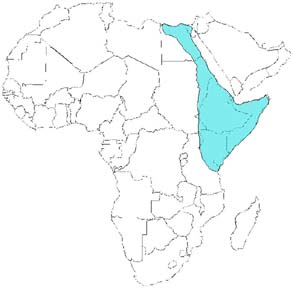
So it effectively ranges from northern Tanzania through Kenya up through the Sudan to Egypt and then over to the horn of Africa in Ethiopia and Somalia.

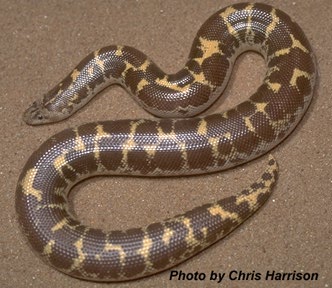
Just like any other wide ranging species of snake, animals from one end of the range look a bit different than others from the other end of the range. In the northern parts of the range (in Egypt) they snakes tend to be pale yellow in the ground color with blotches of chocolate brown.

Here is a specimen that actually came from Egypt. IIRC, it was confiscated by USFWS from an illegally imported shipment out of Egypt -
As you go south in the range, the snakes become darker and the ground color becomes more orange and the blotches become more black. These more orange and black snakes were described as a separate subspecies by Stull and given the name Eryx colubrinus loveridgei. This subspecies was later given the name "Kenyan Sandboa". However, all the authorities that have looked at this species across its whole range have rejected the validity of the two subspecies saying that it is simply one taxon of snake that varies from one end of the range to other.

Actually the most colorful of the "Kenyan" Sandboas and most of the lineages in the US didn't even come from Kenya, they were exported from Tanzania (south of Kenya). People with experience in Kenyan have told me that the snakes in Kenya vary from yellow to orange depending on where you are.

Here is a wild caught Tanzanian specimen of Eryx colubrinus -
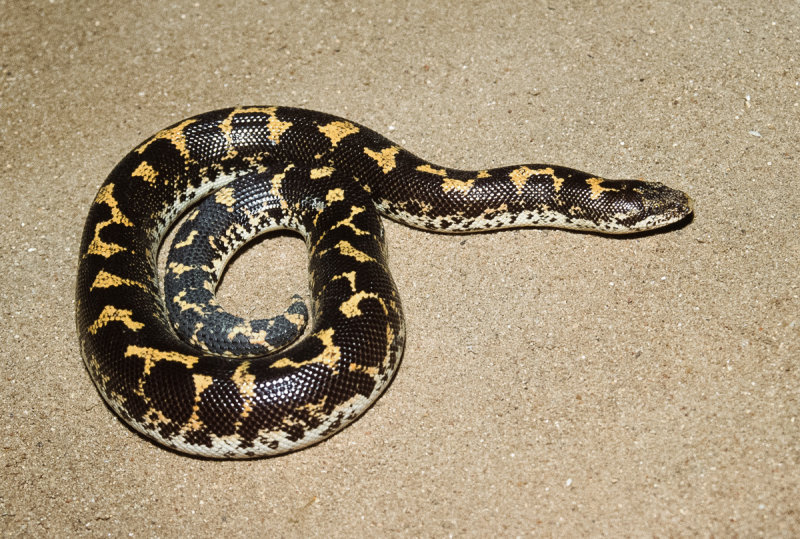
They can be more orange than this specimen. Specimens from the vicinity of Dodoma, Tanzania are generally regarded as the most colorful regional variant and many captive lineages of "Kenyan" Sandboa are now derived from that Tanzanian bloodline.

In the captive population, hobbyists have further screwed up this delineation by selling snakes as Kenyan or Egyptian not based on their country of origin but their color phase. I actually saw a person at an expo many years ago with a big group of captive born baby sandboas and he was selling some as Kenyan for higher prices and some as Egyptian for lower prices. Problem was they were all from the same clutch of snakes!

When I first got interested in this species (~25 years ago?) the only readily snakes in the hobby were wild caught snakes out of "Egypt". They were the standard yellow/brown snakes. They were cheap, but people really wanted the more expensive Kenyans which were still hard to get. Then people started breeding Kenyans a lot and the price dropped way down. When the imports out of the northern parts of the range stopped, suddenly Egyptian Sandboas became more valuable. Some people started selling their paler Kenyans as Egyptians. The result is that very few, if any, of the captive lineages of Eryx colubrinus can be traced to a particular region or origin anymore.

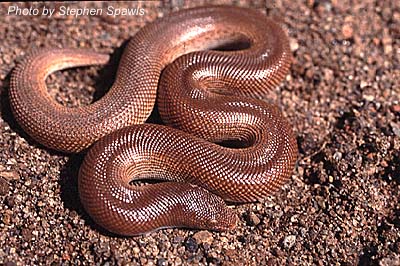
There is another color phase of Eryx colubrinus that occurs in Ethiopia and Somalia that was originally described as Eryx rufescens. This color phase is a solid chocolate brown snake. When bred back to the "normal" color phases, they produce striped snakes with solid brown sides and orange striped backs.

Here is a photo of a wild caught "rufescens" phase Eryx colubrinus from northeastern Ethiopia -
A good analogy for understanding East African Sandboas is to compare them to California Kingsnakes. In some parts of their range (the eastern areas) Cal Kings are banded black and white. As you move west towards the coast, you run into snakes that are banded brown and white or even brown and yellow. Same species of snake and the black/white and brown/yellow snakes don't get subspecies designations because there is a fairly smooth cline from east to west. In one area of their range (San Diego area), there is a gene which produces a striped pattern. In this area, many of the snakes are striped. As you move away from that area you find snakes that are unusual mixes of striped and banded or somewhere in between.

In East African Sandboas, there is the same pattern. At one end of their range they are brown/yellow and as you move to the other end they get progressively more black/orange. In one area there is a genetic mutation which causes the snake to come out solid brown. If solid brown snakes mate with normally patterned snakes they end up with an intermediate striped pattern.

This is why they are generally considered to be variant color patterns of the same taxon of snake and the subspecies E.c.colubrinus, E.c.loveridgei, and E.c.rufescens are all regarded as invalid.

And unfortunately, you can't really evaluate the taxonomic validity of any of these names by looking at captive populations. You have to look at the distribution of the particular color patterns and phases in wild snakes of specific known localities, and you have to see numbers of individuals from those localities. The last person to do that scientifically (Anatoly Tokar) found that the subspecies are not real.

So calling them Kenyan and Egyptian Sandboas is like distinguishing between Florida and South Carolina Cornsnakes. They may look different most of the time, but they are just variations on the same species of snake.
-----
Chris Harrison
San Antonio, Texas


StevePerry Aug 04, 2013 08:43 AM

Great explination Chris.
-----
Steve Perry
facebook.com/StevePerryReptiles

Rick Staub Aug 08, 2013 02:15 AM

Hi Chris,

Do you recall who invalidated the subspecies? Was it Noonan?

Thanks
-----
Rick Staub

vjl4 Aug 22, 2013 08:55 PM

I'd also like to know who officially sunk them all into a single species. I don't think it was Noonan, for that matter I can't think of any genetic studies that included an "Egyptian" and a Ruffie. If anyone has access to vouchered Egyptians and Ruffies I'd do the genetic work in my lab

Vinny
-----
“There is a grandeur in this view of life, with its several powers, having been originally breathed into a few forms or into one; and that whilst this planet has gone on cycling according to the fixed laws of gravity, from so simple a beginning endless forms most beautiful and most wonderful have been, and are being, evolved.” -C. Darwin, 1859

Natural Selection Reptiles

chrish Sep 16, 2013 06:24 AM

Sorry, hadn't checked in here for a while.

It was Anatoly Tokar's revision of colubrinus that officially sunk the subspecies.

Tokar, A.A. 1996. Taxonomic revision of the genus Gongylophis Wagler 1830: G. colubrinus (L. 1758) (Serpentes Boidae). Tropical Zoology 9: 1-17.
-----
Chris Harrison
San Antonio, Texas

vjl4 Sep 16, 2013 12:33 PM

Thanks for the reference. It's interesting because I have an old molecular dataset that suggests Eryx colubrinus colubrinus and Eryx colubrinus loveridgei are paraphyletic, I never could get rufescens DNA though.

Vinny
-----
“There is a grandeur in this view of life, with its several powers, having been originally breathed into a few forms or into one; and that whilst this planet has gone on cycling according to the fixed laws of gravity, from so simple a beginning endless forms most beautiful and most wonderful have been, and are being, evolved.” -C. Darwin, 1859

Natural Selection Reptiles

chrish Sep 19, 2013 10:47 AM

..
-----
Chris Harrison
San Antonio, Texas

chrish Sep 19, 2013 10:49 AM

Sorry, should clarify my question.

You are saying colubrinus and loveridgei are paraphyletic compared to what outgroup/ingroups.

I know that Gongylophis (sensu Tokar) is paraphyletic, but what makes colubrinus and loveridgei paraphyletic?
-----
Chris Harrison
San Antonio, Texas

vjl4 Sep 20, 2013 02:12 PM

With respect to each other. There is a clade of three colubrinus specimens that is sister to a clade of two colubrinus and one loveridgei. The tree looks like ((col,col),col),(col,(col,lov)).

Vinny
-----
“There is a grandeur in this view of life, with its several powers, having been originally breathed into a few forms or into one; and that whilst this planet has gone on cycling according to the fixed laws of gravity, from so simple a beginning endless forms most beautiful and most wonderful have been, and are being, evolved.” -C. Darwin, 1859

Natural Selection Reptiles

chrish Sep 23, 2013 08:36 PM

With respect to each other. There is a clade of three colubrinus specimens that is sister to a clade of two colubrinus and one loveridgei. The tree looks like ((col,col),col),(col,(col,lov)).

Wouldn't that be what you expect from a group of 6 specimens of the same taxon/evolutionary group?
With regard to the specimens of colubrinus that ended up coming out closer to loveridgei, what was the basis for calling those specimens colubrinus, not loveridgei?
-----
Chris Harrison
San Antonio, Texas

vjl4 Sep 26, 2013 11:28 AM

Hey Chris,

"Wouldn't that be what you expect from a group of 6 specimens of the same taxon/evolutionary group? "

Not necessarily, if for example loveridgei and colubrinus were distinct (sub)species then I would expect them to be reciprocally monophyletic with a monophyletic clade of colubrinus and a monophyletic clade of loveridgei. Instead loveridgei nests within colubrinus so at the very least they are not species by the phylogenetic species concept (for whatever worth that may be to you).

"With regard to the specimens of colubrinus that ended up coming out closer to loveridgei, what was the basis for calling those specimens colubrinus, not loveridgei?"

I don't think these molecular data had anything to do with the sinking of loveridgei into colubrinus (they are not published as far as I know). Rather I think it's a matter of priority, if memory serves me right (and it may not), colubrinus was named first so it has priority on the species name.

Actually I would probably not be so ready to sink loveridgei yet, I would prefer many more individuals sampled from throughout the range and to have Ruffies sampled to. Also the current molecular data is a single mitochondrial gene so it would be good have some nuclear markers as well. Lots of things could make a true species of loveridgei nest within a true species of colubrinus (incorrect species IDs, incomplete lineage sorting, a single introgressing female line of loveridgei into colubrinus, poor sampling leading to spurious results, etc..)

Vinny
-----
“There is a grandeur in this view of life, with its several powers, having been originally breathed into a few forms or into one; and that whilst this planet has gone on cycling according to the fixed laws of gravity, from so simple a beginning endless forms most beautiful and most wonderful have been, and are being, evolved.” -C. Darwin, 1859

Natural Selection Reptiles

chrish Sep 27, 2013 11:00 PM

Reading your reply made me wonder exactly what the "current" validity of loveridgei is anyway. Last I knew, Tokar had sunk it and no one had ressurected it.

In doing some quick research, I reread parts of this paper -
http://www.fupress.net/index.php/tropicalzoology/issue/view/16
which is the original description of Eryx borri (bogus, IMHO).

But the authors point out that "rufescens" type snakes were originally described as Eryx jaculus var. sennaariensis which means that the subspecies name sennaariensis has precedence over rufescens if that taxon has any validity at all.
-----
Chris Harrison
San Antonio, Texas

vjl4 Oct 01, 2013 11:32 AM

I think we can all agree that Eryx taxonomy is kind of a mess and in dire need of revision. I know there is some new molecular data in the works that includes "all" described species of Boid, but I'm not sure when it will be published. If I get an undergrad interested in snake phylogenetics I'll be sure to put them to work figuring out what is going on with the Ruffies, finding museum vouchered species may not be easy though!

Vinny
-----
“There is a grandeur in this view of life, with its several powers, having been originally breathed into a few forms or into one; and that whilst this planet has gone on cycling according to the fixed laws of gravity, from so simple a beginning endless forms most beautiful and most wonderful have been, and are being, evolved.” -C. Darwin, 1859

Natural Selection Reptiles

Site Tools