I have been working with hogs for just over a year. I am using, "naturalistic observation" which means, studying behavior both in nature and in captivity. In this case, its using captivity to "test" observations in nature.
One of the most interesting behaviors hogs do is that good old playing dead thing. Of course, I don't buy the playing dead thing as all predators kill them before they eat them, so its something more to it.
When they do this behavior, its more then flipping over, they excrete fluids out of all holes, hahahahahaha blood out of their mouth and many different fluids out of the other end.
My field partner is a masters in biology(herp related) and tells me there are some papers of hogs and bufotoxin. I will be going in the field with him soon and will ask for those papers. Anyway, if those fluids contain bufotoxin, then the behavior of playing dead, is very explainable. Obviously it works.
Next, that playing dead behavior and temps. In the field, the hotter their Body temps(BT's) are, mid 80's to mid 90's, the more and quicker this behavior occurs. To a point of just walking near them excites that behavior.
The lower their BT's are, mid 60's to mid 80's, the less it occurs and it takes much more stimulus to express that behavior.
In captivity, folks tell me that hogs stop doing that behavior(or rarely do it) So of course, testing is in order. Silly as it sounds, but in captivity, they behaved exactly like in nature. They did not express that behavior commonly at lower temps, but did repeatedly express that behavior at higher temps. End part 1
Reptile & Amphibian Forums
Welcome to kingsnake.com's message board system. Here you may share and discuss information with others about your favorite reptile and amphibian related topics such as care and feeding, caging requirements, permits and licenses, and more. Launched in 1997, the kingsnake.com message board system is one of the oldest and largest systems on the internet.


Some thoughts about behavior
Replies (12)
In captivity, I have a temp controlled room(incubator room) and I tested temps starting Ambient temps.
I started in the 82 to 84 F range no snakes expressed that behavior. So I kept raising the temps a degree at a time. Once the temps reached 85 to 86F, we started seeing this behavior. And all it took was opening the cage. As we raised the temps another degree it became more common.
This test was done with both captive hatched and wild caught. And it did not seem to make a difference.
Also the snakes ate more and digested their bolus much faster. The test continue. Cheers
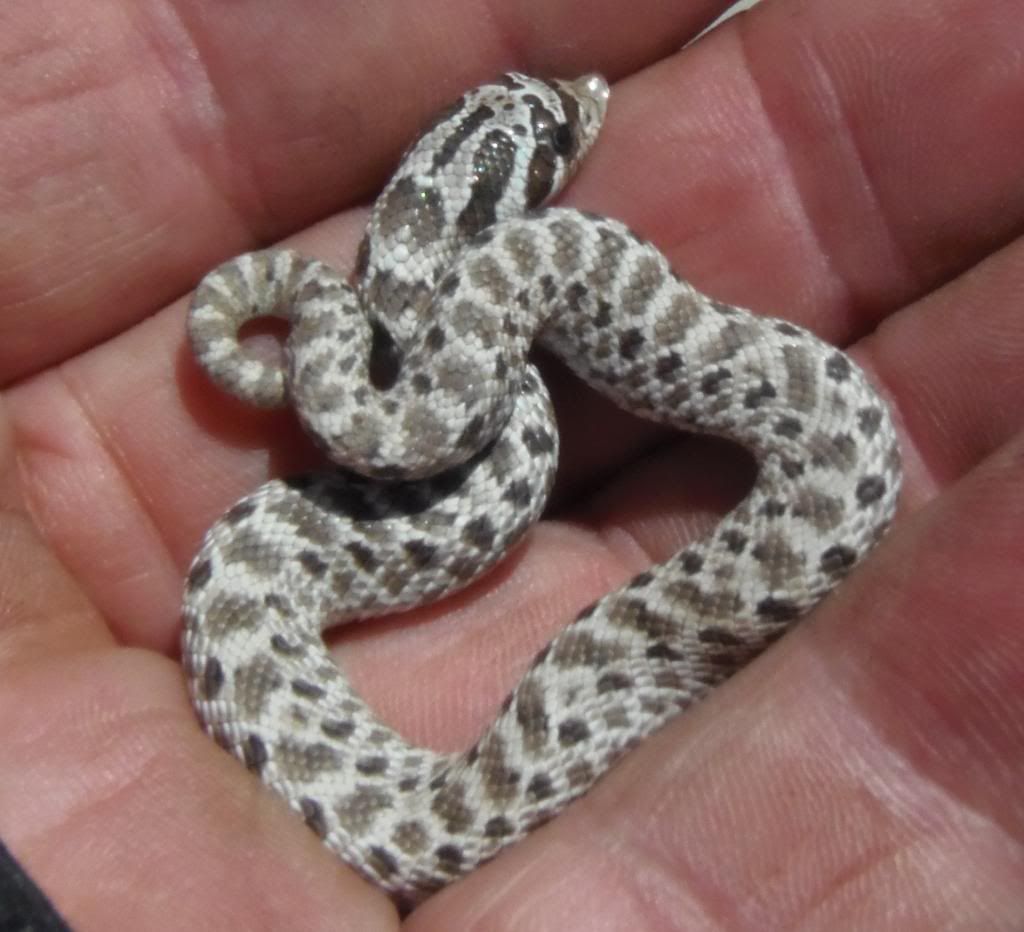
Sweet! Thanks for this info, going to have to try it. I work in Long Leaf Pine restoration, management, and education. A lot of the education involved gopher tortoises and yes, snakes. Me and my friend/co-worker are always really wanting to show students in 4th and 7th grade a hognose playing dead but of our three WC captive easterns (1 juv and 2 adults) and my one CB western, none play dead. Hopefully, ideally, this idea of raising temps will apply to my male eastern so that I can at a minimum, take a video with controlled lighting to get it to show up rather well. At the very least I can at least get my western based off of this finding.
My female I just recently rescued and she is JUST starting to improve so I don't want to stress her, and my friend likely won't let me use his juv eastern. My male eastern is very healthy and acclimated quickly when I first got him as well.
I believe that there is something to this without even having tested it myself. Most people keep easterns high end temps at low 80s because they don't hide during temps in 70s and low 80s as much as they do in high 80s and up. Also, because of being different species, could be a dif temp range. Again, hopefully it works out haha.
Also, how do you check the snakes temp? Do you use a special thermometer for them or just go by ground/air temp because they are ecto-therms?
I would think it would occur with those species as well, but who knows. Also, its behavior, I doubt if a longterm captive can be inticed to "play dead" unless you put a kingsnake or something its not use to, up to it.
Anyway, post what happens, it would be interesting. Best wishes
Yeah did not work with my western. As for my male eastern I can't get the basking spot over 87 Fahrenheit. Considering both snakes are also education snakes, and get handled A LOT, they are probably both very use to the "stress" because of captivity as you said. Guess I'm still going to have to hunt down a healthy wild specimen then, dang.
Don't get me wrong its fun and all, but the public land here has been so messed up by fire-suppression that its dang near impossible to find any snake, simply because ALL of the ground is ground cover about 3-4 inches deep. Takes forever to find an eastern that isn't out hunting, and southerns only occur around here on restricted areas of Eglin as far as I'm aware.
Hi again, hmmmm the problem with working or not is based on supporting the test in the same way. In you case, you mentioned basking spot of 87F, my test, as mentioned was elevating the room, the whole cage, as in, the ambient temps to 87F. or above.
Also, who knows what will wrong on any individual and longterm captives, its behavior. If you are no longer sensed by the snake as harmful, It won't do that display. your no longer a predator. Its behavior.
As mentioned so many times below, the temps the snakes are using in nature are far above what most are using in captivity.
In a street sense, common keeper sense. 95% of the hogs I see in nature, are warm or hot to the touch(hot reptile wise) My captives in a 87% room, are cool to the touch.
As mentioned below, the individuals that are really hot in nature, well, you can't get them to stop. hahahahahahaha
Also as mentioned, not all hogs in nature do this, no matter what the temps. So the behavioral trend is, the hotter they are, the more often and the more vigorously they do this behavior. The cooler they are, the less vigorously and a lower percentage utilize this behavior. In captivity, it proved out. But, let me mention, I do not have enough numbers to make a conclusive statements. But enough numbers to cause us and other keepers to question many things. Best wishes
Unfortunately the most I can do is the basking spot for now so I don't think it will work. I keep slimy salamanders which prefer cooler temperatures and from past experience obtain health issues when ambient temps are raised so the room its self can't go much higher than 80...sad face.
Also I think it may be slightly different for easterns than westerns as you speculated before and I certainly agree with. Easterns and more active in temperate weather and seek cooler refuge in root holes and tortoise burrows in summer months. This doesn't mean you wont find them in warm weather, I have from time to time, but they prefer more moderate temps from low 70s to mid 80s. Most that I find are in March, early April, late Sept, through Oct, and the start of Nov. Most wild easterns I see are cool to touch and do play dead when provoked to do so.
A point and an important point is, air temps have little to do with snakes. There is a relationship, but its loose. For instance, the coolest air temp when finding an active hog crossing the road was 54F and one at 58F. but that does not reflect the body temps of the snakes, they were much higher.(in the seventies) This is true across the board. Whats important is mass and reflective temps. Mass is how they regulate 95% of the time and reflective is basking to raise their temps above mass and air temps. Temps guns are perfect for understanding how reptiles use their environment and internal body temps.
With a temp gun, the reflective temps, pointing the gun at the snake, is very accurate, but not exactly. With neonates, its plus or minus a degree or two. with larger snakes, the internal body temps can be 4 or 5 degrees lower then the skin temps. Depending on how long they have been out.
Here and on my sites, grasslands, there is little shade, so sun temps are much higher then air temps. In shaded forest, thick foliage the temps are not so different. But, eastern hogs, prefer open sandy areas with sun exposure. I lived there too, hhahahahahahahaha I use to work at Ross Allens up to the last year he was there. My oldest daughters first snake capture was an adult southern in our driveway. She was 10 months old.
What I am saying is, use common sense, snakes biologically are pretty much all the same. That is, use the same range of temps etc. What is different if the ethology, that is, how they attain their needs.
Heres the thought for today, and I am not being mean. Its a real thought and a real question. Salamanders do utilize a much lower temp range then snakes and lizards, so why do you force your snakes to live at Salamander temps?
The truth is, theres a million ways to skin a cat, same for heating snake cages. You do not have to heat up the room and make the sallies suffer, but you still can heat up your cages and allow them to be snakes.
Interesting observation, Frank. I've kept Westerns for 8 years, and have never seen this behavior. I witnessed it in the first Mexican hog we came across in AZ.
The advice we were given from a friend who'd had a great deal of success observing them in the wild was that there was a temp related window for finding them (ground temp between 81 - 90F. Though we didn't have a temp gun, the air temp had been @ 78F for good while. We parked our car, and as we walked up to the snake it flipped over, doing its death-feigning display. The smaller female we encountered later, however, did not do this.
reako45
Thanks for the conversation. First off, nothing against your friend or you. But, hahahahahahahaha we have a huge habit of thinking we know something, which is why I get in fights here. Most think they know something. I on the otherhand, try to NOT know anything. I take data. Most herpers fall into bad habits of success. That is, here is how I find them, so that is how I look. Which is great, but it may not have much to do with the animals. It has something to do with the animals and a lot to do with the herper.
In this case, When I investigate something, I do not do what others tell me. I act like I know nothing and sometimes that is not easy to do. The key is, I investigated, year a round, and in all conditions. WHat I say here are REPORTS of what is observed. Or as with this subject, a behavior that was seen and what conditions supported it.
With behavior, its TRENDS, its not all or nothing. So its not about all do this or that, behavior does not work that way.
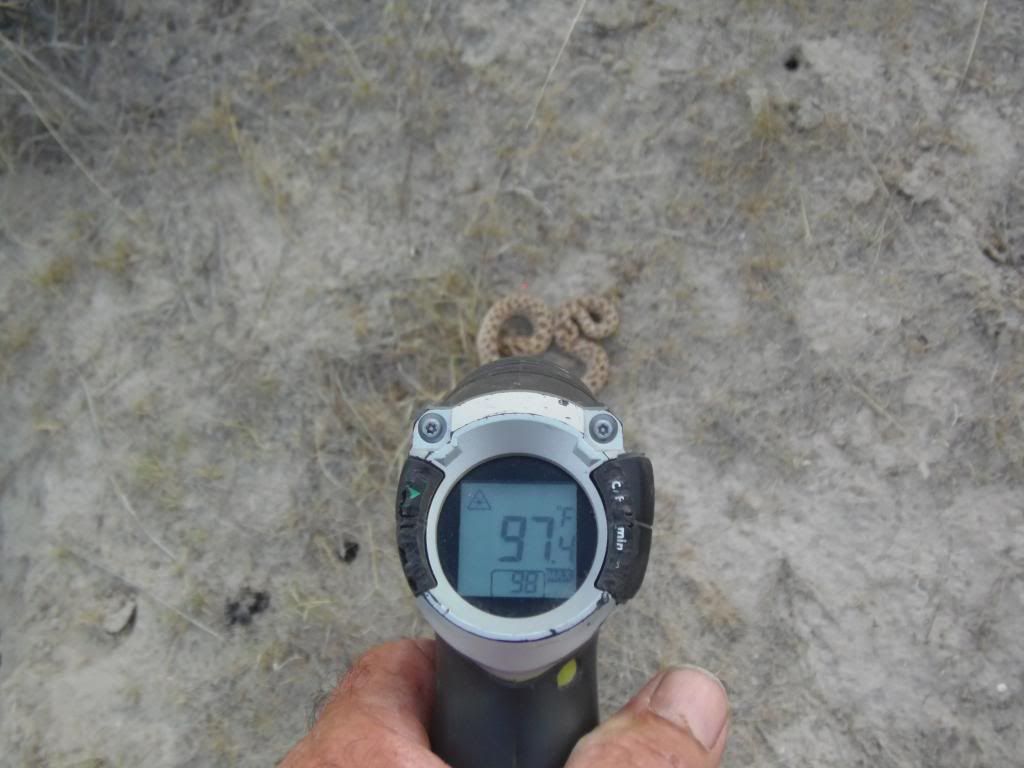
On this day, also recorded a 106F and a 103F. So while your friend is ok with his numbers, it does not include all they do. I even recorded a box turtle at 97F hahahahahahahaha that is really odd. The 106f was a neonate right in the middle of the road, so its body temps, had to be at or near that temp. I spend 18 years taking clocacal temps with quick read mercury thermometers. Then compared them to infra-red temp guns and the readings were so very close. The key is indeed body temps. As an adult can come out of the ground and have body temps much lower then ground temps. In the picture above, the ground temps were in the mid 130's. Also the opposite occurs, when the ground temps are cool, its common to record temps a few degrees above those ground temps. I hope this helps and please, I am sure your friend is a great field herper.
Now that you read that, I am sure, the data your friend told you is only to support him finding snakes.(I am guessing as I don't know him/her) Its not about the snakes or how predators utilize the hognose. The defensive reaction hogs use is aimed at their predators, not us or a easy way we find them.
Whats interesting is your numbers, two. That number cannot predict behavior in any way. Remember, Behavior is a trend, most do this, some do that, and others, well they are goofy and do none of the above. That's normal for behavior. In order to understand behavior, you must use numbers, then numbers in different conditions.
Behavior is not restricted to type of snake or even snakes. With snakes, this is very normal. They utilize different defenses, based on ability and ability is tied to temps. When cool, freeze(go cryptic) when hot, run like the wind, when inbetween, pick one and or, kiss your butt goodbye.
Hopefully next spring I'll have a good bit of time to get out to a hog spot and do more complete observations under varied conditions.
Your field observations of these snakes certainly provides alot of food for thought. Keep 'em comin'.
reako45
Not done yet. most species I have worked with, are active all year. Last year, I found hogs in every month, but the drier it gets, the fewer observations occur.
I post here in hopes people would think about the animals. But sadly, there are too few that do that. Most just think about themselves. Which by the way is normal behavior. A normal trend.
Whats funny is, as keepers, we worry to much. An example, I have upped my temps in captivity, and they are responding well. When I touch them, they are cool to the touch. Yet I worry its too hot. In the field, I can judge their temps(ball park guess) simply by touching them. All that are out crawling, are warm to hot to the touch(snake hot, not burn your hand hot) Individuals emerging from holes are cool to the touch or even cold.
This observation is not scientific, but its what keepers do. So its a great gauge for keepers to go by.
This year, I am going to not return to the field often until next summer. Then I plan on using cameras, I am going to place them over those hole systems and see how they use them. So off to the bush again. Later
