


Reptile & Amphibian Forums

Welcome to kingsnake.com's message board system. Here you may share and discuss information with others about your favorite reptile and amphibian related topics such as care and feeding, caging requirements, permits and licenses, and more. Launched in 1997, the kingsnake.com message board system is one of the oldest and largest systems on the internet.

Click for 65% off Shipping with Reptiles 2 You
HappyHeathen Nov 27, 2013 10:33 PM

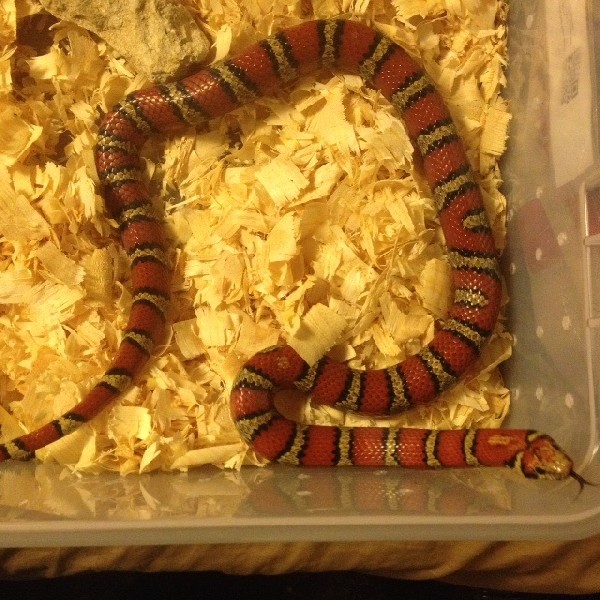
I made a show pickup of some ruthveni. These were 8-9 yo pair that were thrown in to sweeten a deal. After I got them I was talking to another friend at the show and he had some suspicions about the ruthveni claim.

I work with pituophis mainly and am certainly not an expert on var. mex. kings. So I thought I'd throw these pics up and see what feedback I get from you guys. I also picked up some yearling thayeri that look great from the same guy. He complained about taxonomy changing every other day and that these were definitely ruthveni.

They looked like ruthveni to me and still do but it's something that's been bugging me.

Is there something in these that I'm not seeing?
Replies (10)

Varanuskeeper Dec 04, 2013 02:50 AM

Sorry to say, they don't look like pure ruthveni to me. Maybe someone with more experience than me can give their opinion. Tyler.

Aaron Dec 07, 2013 05:11 PM

Those are definately not pure ruthveni, nor are they pure anything. I dont mean that in a bad way, I just mean they are definately a mix of some sort. They look like ruthveni x mexicana to me but its virtually impossible to say for sure. They are nice looking snakes though and as long as you represent them as hybrids/crosses I see no problem with them.

Most likely your friend had no idea they weren't pure because wild ruthveni have not been imported since the early 1980's and there are so many crosses around nowdays that it can be hard to find pure examples to compare to.

Here is one example of a pure ruthveni, just for reference. You can see that the black bands are wider and the white bands straighter than the ones you posted.

-----
www.hcu-tx.org/

HappyHeathen Dec 14, 2013 05:47 PM

Thanks for checking them out for me.

I kindve got the impression from him that maybe he was recently told they were not pure because he seemed a bit defensive when discussing them. (even though there was no need to be with me lol)

His comment about "I don't care what people say, I've seen ruthveni that look just like these." was what raised the flags for me. I will say that looking over the classifieds I have seen several that look VERY similar to these. This may just be testament to there being hybrids all over. Not to mention these have been pushing out offspring for several years too.

I'm working on a book for another genus of snake and during my research I ran across an account saying that ruthveni was the only known wild caught albino for a long time and people were crossing it with several others for many years in an attempt to spread the albino gene.

Oh well, I have them cooling now along with some thayeri I bought from shores enuff at the show in San Antonio and all my regular breeders.

Thanks for the help.

Aaron Dec 17, 2013 10:50 PM

I actually remember when the albino Ruthveni came out. The original amel ruthveni was born in captivity. I forget who actually produced it but Steve Osbourne partnerned with the originator to offer the first ones to the public for the quite reasonable(IMHO) price of $1,000ea. It's true that they were the first amel tricolor to emerge. Many pure ones were produced as well as many hybrids, some of which are amazingly beautiful. The amel ruthveni gene was most frequently used on Graybands and Thayer's Kings but was also probably used on San Luis Potosi Kings, Greer's King's because those are all montane and/or cold tolerant species, closely related and breed well. I believe it was also used on Pueblan Milksnakes.

I believe the 2nd amel tricolor to enter the hobby was the Nelson's Milksnake at $2,000ea and the 3rd was the amel Honduran/Atlantic Central American Milk at $3,000ea.
-----
www.hcu-tx.org/

FR Nov 04, 2014 09:01 AM

The albinos came from Bill Garska , a friend that I did field work with. He found the hets that produced the albinos, I believe he gifted some to a fellow teacher, then that person produced them. Bill was indeed an odd individual, and did not like albinos, so at first had nothing to do with them.
The first Q king was discovered in a lizard trap, and was called the missing link between milksnakes and montane kings. Bill and Ernie Wagner visited that local and found three more. I then visited that local and found 27 in a day and a half.
With numbers, we did observe wide grey animals, in the field. We also reported very large individuals. The first four were all mid sized. We located the full range from neonates to large adults.( 44inches)

Patton Nov 13, 2016 10:32 PM

Hey Aaron,
I've been out of the loop for quite some time. I had to sell most of my collection due to my wife orders to Germany, but due to a good friend in the Coast Guard who also keeps herps, I was able to hold onto a few of my favorite species. Namely the 2006 pair of Amelco, Mx. Ruthveni that I purchased from you. Here's an old pic of the pair. I'll post some newer ones when I have a chance.
-Phil

-----
Work is the curse of
the drinking class!

Ameron May 09, 2014 10:28 PM

Relatively new to the taxonomy dilemma (and sometimes raging side discussions), I have done a fair amount of research in recent months about both Milks, Mexicana complex snakes and the Jalisco Milk vs. Ruthveni dilemma.

I've also researched Google & other Internet images of dozens of specimens. What I've come to find is that the hallmark trait of Ruthveni snakes seem to be the *square jaw*, almost like that of a Russian Rat snake, or certain Cobras. Nuevo Leons, Thayeri, whatever you wish to call them, seem to have a much more *rounded & pointed snout*.

Mutant? Maybe, but I'm not as concerned that Leonis, Thayeri or related snakes are bred to others of different areas, as long as they are the same subspecies. (If you breed a Celtic man from Leeds with a Celtic wife from Darby, their kids are still Celts - if you know what I mean.) I don't vote for mixing different subspecies or species, however. I’ve always been a locale-specific man.

1.0 Boa constrictor imperator (Hog Island)
0.1 Lampropeltis mexicana thayeri
1.0 Agrionemys horsfieldii kazakhstanica

Aaron Jun 25, 2014 12:46 AM

Ruthven's are their own species(Lampropeltis ruthveni) and they have no subspecies so crossing them with anything would technically result in hybrids.

Ruthven's are closely related to the Mexican Kingsnake(Lampropeltis mexicana), which used to be considered 3 separate subspecies; namely the Thayer's Kingsnake(L. m. "thayeri", the Greer's Kingsnake(L. m. "greeri" and the San Luis Potosi Kingsnake(L. m. "mexicana".

Ruthven's are also closely related to the Gray Banded Kingsnake(Lampropeltis alterna).

I have kept and bred all of the above species(and former subspecies) since about 1994. I mean no offense but to suggest that the snakes posted by the OP are Ruthven's because they have a square jaw is an inaccurate assesment based on incomplete information and adds to the confusion.
-----
www.hcu-tx.org/

Aaron Jun 25, 2014 12:48 AM

I have no idea why there are smiley faces in my post.
-----
www.hcu-tx.org/

FR Nov 04, 2014 08:51 AM

As one of the founders of Ruthveni, Those are not ruthveni. They are indeed some sort of mix, mex mex as mentioned or greeri.
The description of hybrids given here was most entertaining. But missing the point, we are different races at most. A Celt is not even a race. Its a local type.
Call them what you will, but those animals are not Q-kings. Cheers

Site Tools
