

Reptile & Amphibian Forums

Welcome to kingsnake.com's message board system. Here you may share and discuss information with others about your favorite reptile and amphibian related topics such as care and feeding, caging requirements, permits and licenses, and more. Launched in 1997, the kingsnake.com message board system is one of the oldest and largest systems on the internet.

Click for 65% off Shipping with Reptiles 2 You

Friend having an Eastern Issue

OrangeHeterodon Feb 05, 2014 08:46 AM

One of my friends has been inspired to keep an eastern hognose snake because he fell in love with the ones I have.

His issue is that the snake is currently refusing toads. The temperature of warm side of the cage is 85 degrees Fahrenheit and the cool end is 71. The cage has a sand-EcoEarth mix loam to allow the snake to easily burrow and for the substrate to retain enough moisture to hold shape. It has plenty of areas to hide and a water dish large and deep enough for it to soak. It is a small female, sub adult or young adult, 18-20 inches long.

My friend has been offering southern toads and the snake hasn't even tried to eat one. The snake WAS out in the cold so probably is more focused on saving energy than eating right now but after 3 weeks in captivity I would have thought that it would be warm enough to be willing to eat by now.

I would just reduce temperature and wait until march and possibly get some toads that are a little bit smaller but my friend wants the hognose to feed as soon as it can because it is rather thin.

Any tips to get it to feed sooner or should I just tell him to try and reduce temps a while longer?

Replies (4)

FR Feb 05, 2014 10:19 AM

Raise the temps. When attempting to have snakes continue to feed and grow in the winter, you really need to convince the snake. Air temps are fairly worthless. As it has little to do with mass temps and snakes WORK with mass temps.
Temps like you mentioned, are great but the keeper needs to understand, they are guidelines, not rules. A place to start, not set of rules to not vary from.
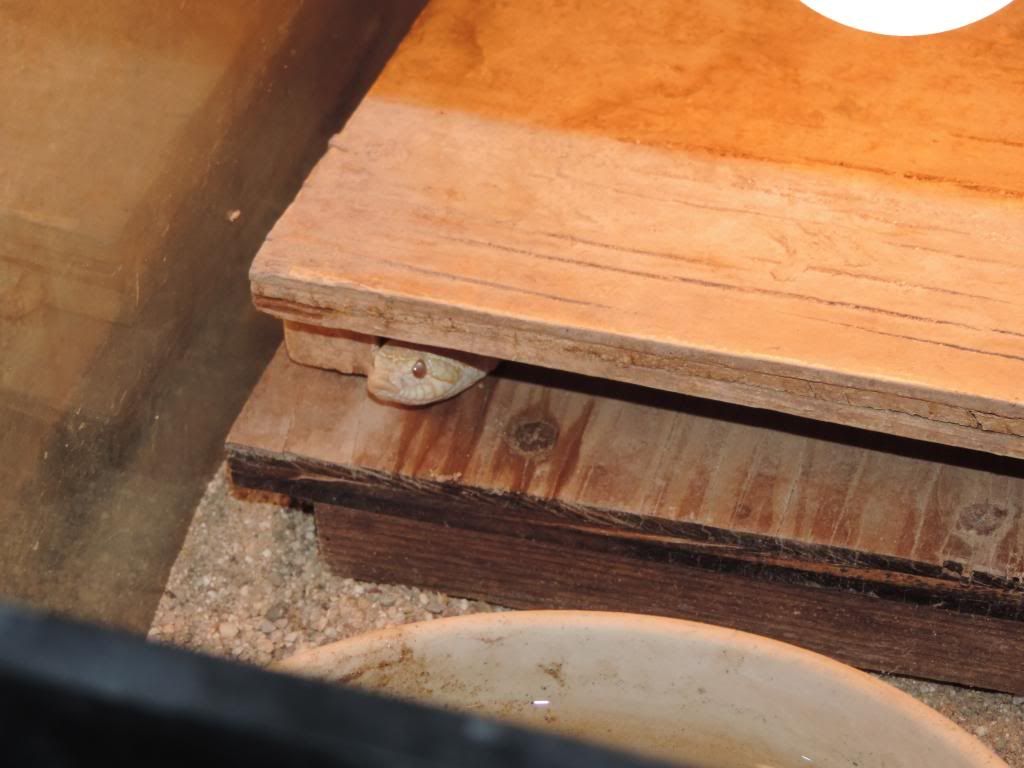
As one whos experienced(old) I do not even take temps, I go by the behavior of the animal. In winter, if the animal is not responding, then add heat(if all else is normal). You guys call me crazy because I use temps in excess of recipe. Yet, this is exactly whats its for, times, when its needed. If they don't need it, they simply do not have to use it. So if 80% of the time higher temps are not needed, I could care less. Its the 20% of the time when all the snake has to do is go to higher heat, that it becomes important. This example shows an albino hog under the first board. The top board has a temp of 108f, the next layer, 95F, the third layer, mid eighties. The snake just ate three fuzzies and went to mid level. Mid ninties.
[
Again, my sons hog. I would bury those boards while keeping the same temps. But as he says, its working with that hog. End part 1

FR Feb 05, 2014 10:45 AM

Conditions, in winter, the air is normally very dry inside houses. If this is the case, then dehydration could be a factor. Make sure there is suitable humidity in the cage.

Also, in my experience, snakes tend to sense if the prey is dehydrated and if marginal, will refuse to eat prey that's in poor condition. An example, when we use feed lizards, fresh recently caught lizards are taken readily, but after a few days to a week they are refused. That's is if we do not feed and care for the feeder lizards. So if all else is normal, then it could be poor quality feeders.

Then it could be about the condition of the snake, its skinny, maybe the reason its skinny is the problem.

Last is the "I" factor, I this and I that. You know, I want and I think and I the other. This is where you and I differ. Your friend made it about "I" and not the animal. Orange, You do not understand me, because I attempt to take me out of it when it comes to the wants and needs of reptiles. I attempt to cater to their wants and needs. Its not about what I think or I want. The reality is, if I cater to THEIR WANTS and NEEDS, they always fulfill my wishes. So your friend thinks 85F is important. Its not, Its limiting. It works just fine in an average way in average conditions. When things are not average, well 85F sucks. As I reported last summer, hogs use body temps over 100F and between 90 and 100F commonly. But they also can cool off when needed. In the end, Orange, you made a good recommendation, If your friend is not going to cater to the needs of the animal, then cool it down and wait until nature warms it up enough.

OrangeHeterodon Feb 05, 2014 01:48 PM

I guess he is going to need to add an UTH and get a stronger suspended heat source.

The reason I believe it is skinny is simply because of it being so cold for so long, although I think it may have to do with the snake too internally. Normally snakes that naturally brumate or go into reduced activity don't loose mass this rapidly. So it may have a genetic abnormality that has resulted in an accelerated metabolism of body mass. If this is true and he does get it eating I guess he may have prevented natural selection (genetic defects resulting in an animal dying to keep the bad genes from being passed on).

The toads are as healthy as the area around here allows them to be. If the snake doesn't eat the toad he lets it go after 2-3 days.

I am going to recommend that he increase temps for the next week or two and if that doesn't work I am going to recommend that he just save and fork up the money for a CBB Eastern Hognose - which may be better if he gets one that's on mice.

Also it could be dying from chemical poisoning because he found it right after a lawn service put various junk chemicals in his neighbors yard.

FR Feb 05, 2014 01:58 PM

Its wild caught, then why would you suspect genetics, that is a reach.

Its recently wild caught, then Flagellates may be a very good place to start. They are stress induced. And being captured is stressful. or lawn serviced.
I would also not suspect chemical poisoning, unless the snake had tremors or paralysis.
When working with the unknown, you want to work on the probable not the possible. As about anything is possible. Temps, a great place to start. That has the highest probability of success. Best wishes

Site Tools