Reptile & Amphibian Forums

Welcome to kingsnake.com's message board system. Here you may share and discuss information with others about your favorite reptile and amphibian related topics such as care and feeding, caging requirements, permits and licenses, and more. Launched in 1997, the kingsnake.com message board system is one of the oldest and largest systems on the internet.

Click for 65% off Shipping with Reptiles 2 You
https://www.crepnw.com/
Click here for Dragon Serpents

Intergrade ?'s

reako45 Feb 11, 2014 02:52 AM

Anyone aware of any research or info about intergradation (if that's the correct word between kennerlyi and nasicus. I was looking at species accounts of native New Mexico snakes, and according to the area maps on ONE website their ranges border or may even overlap. Just curious because the same site clearly shows territory where splendida and holbrooki intergrade.

reako45

Replies (9)

FR Feb 11, 2014 07:54 AM

First, the things we/humans, name animals, is to make it handy for us. It many cases, its not about the animals.

In the case of kennerlyi, not exactly sure why they made them separate species. In fact, goggle up the paper, the paper calls them semi species. Which is something I never heard of.

The paper that seperates them, does so with morphology, which is physical differences. In this case, it came down to two different type of head scales, azygous and loreals. It turned out, one was clinal, which means it had a constant change from north to south. The other, didn't, but a certain percentage was in the overlap zone, like 20%

Which means to me, this was a horrible reason to make them separate species, not only is it not accurate, but they, as you mention, express an area in intermediate characters. So basically, most northern hogs, have more azygous then kennerlyi. But some don't.

The truth is, naming species based on morphology is a thing of the past. Currently MTdna is the popular choice. Which as soon as someone gets the time to rework hogs, will change the entire landscape. While Dna does not care what the morphology is, the animals could be physically identical, genetics is a accurate measurable test. The problem is, its kinda useless to the casual user(us)
hogs were a perfect group for naming by morphology and using subspecies(like it was) They have a huge range and which include some very slight physical differences. But are indeed the same snake.
I do not like the term intergrade, as it indicates one pure species, breeding with another species, and resulting in animals that are part way one or the other. Intermediate, simply indicates individuals with morphology between the arbitrary differences we named them for. With Dna, that will not occur, as it does not matter what they physically look like. The will be what their barcode says they are. even if that too is arbitrary.

reako45 Feb 12, 2014 02:34 AM

Very interesting. I had no idea that morphology was used to separate the two groups. No DNA comparison info so far? I'm surprised. Is it the same for LG California, splendida, and nigrita?

reako45

FR Feb 12, 2014 10:00 AM

The recent work on Getula and milksnakes was genetics I believe. Heres a neat little page showing the difference.
Read this and I will post another
Link

FR Feb 12, 2014 10:32 AM

The link worked, so heres the real deal. Click on this link.

Also, Pay attention to the last two paragraphs, Kennerlyi was not separated on two scales, it was only separated by one scale, azygous. And that is also questionable.

I have not looked at wild westerns, and that is important. I have looked at captive produced westerns. And they're is lots and lots of overlap. But as mentioned in the previous link, there may be lots in hybrids in the trade. So in the hobby and please understand, that is where we LIVE. We are in the hobby. So for us, they are the same.
After looking at hundreds of kennerlyi in nature. They indeed have some visual differences. And not by what the paper states. Kennerlyi are a bit vertically flattened, both head and body, and the Nasal scale is completely different, not in number, but in shape and structure. Which places the eye closer to the nose, then with westerns. That difference is so small, it should not indicate a species difference. Not by morphology.
Genetics, well that's a totally different race horse. Realistically snakes are separated into pockets within their range. Not just hogs, but all snakes. This results in isolated pockets of unique genetics. Which means, theres going to be a bunch of separate species, that are morphologically similar/identical. As you can see in places like here, humans are not good with a bunch of choices. They are A or Z. So at this time, species definition is heading to pure genetics, which is useless to the intended user(us). People without knowledge. Morphology is useful to the intended user. By what it looks like, no need for a lab. Genetics tells us, how something evolved to what it is, but not WHAT IT IS. Morphology tells us, what it is. I am dumb as a stone as most know, but both would be wonderful. Morphology and genetics. Then we would know, WHAT IT IS(the snake in our hand) and how it got there. I am such a dreamer. As it starting to become, we can pick up a snake in the field, and not have any way to tell what it is. That sir, is useless for scientific nomenclature. I guess I am going to need a mobile genetics lab when I am in the field.
Link

reako45 Feb 13, 2014 03:15 AM

Thanks so much, Frank for sending me both links. My daughter is in Honors Biology (and also into herps), so they will provide interesting topics for discussion w/ us and maybe even her class.
Extremely interesting because it describes the process used to make or confirm the decision to separate them into semi-species, but still leaves you wondering what will happen if DNA tests are done.

reako45

FR Feb 13, 2014 09:41 AM

You will have lots to debate. I love genetics, but it is not "right" at this time. And as I mentioned, it tells us how an animal got here historically. Morphology tells us what the animal is now. And that is what I am interested in. Not how they got here, what they are now.

As you can see on here, I am interested in what hogs do as hognose, what makes them tick, How do they use the adaptions they have, how do those adaptions allow them to exist. What is sad is, there is so little known about living hognose. Yet there are many many people working on genetics and very few working on animals(without interference)

I am lucky, A past business/field partner and friend is a PHD in evolutionary biology, with a herp slant. My best friend is a Masters in biology with a real strong herp slant(Texas A&M under Dixon, I believe) Another friend and field partner, got his masters and PHD(?) under Cruiz at Harvard. He was the first one to produce albino L.ruthveni. So I do get to play with that side of herp. Only my Texas friend is good in the field. and strong with what herps are in reality, not academically. And please, again, its not A or Z. both are important.

I could go on and on, but I would rather hear what you and your daughter debate about. Thanks and your very welcome.
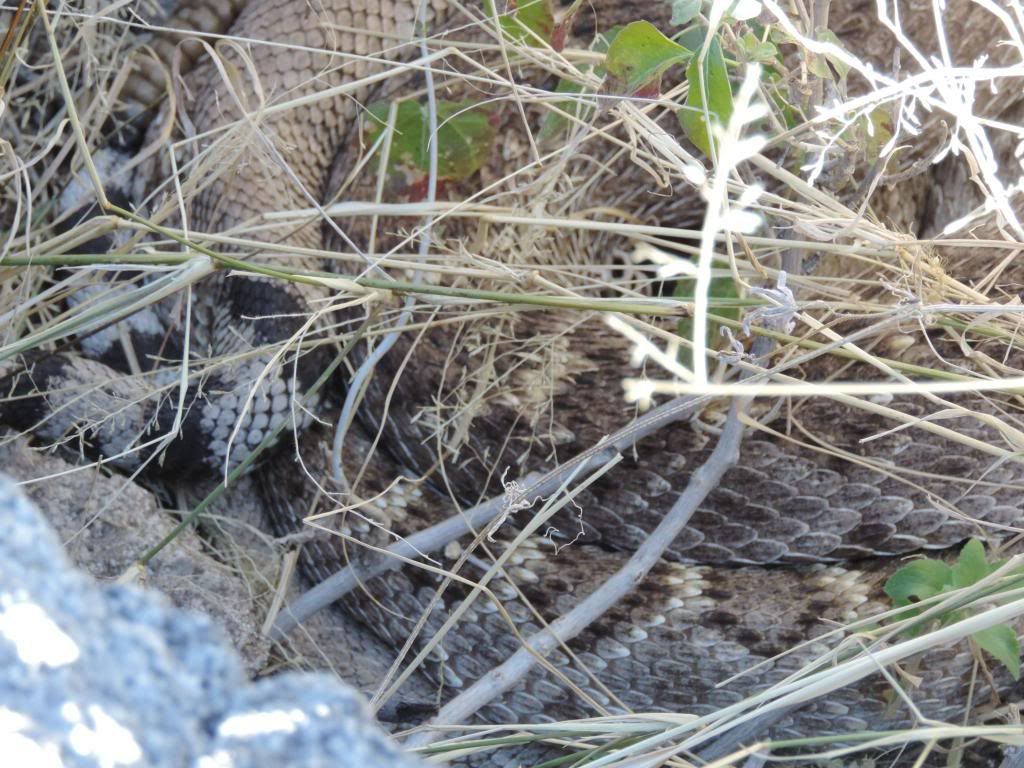
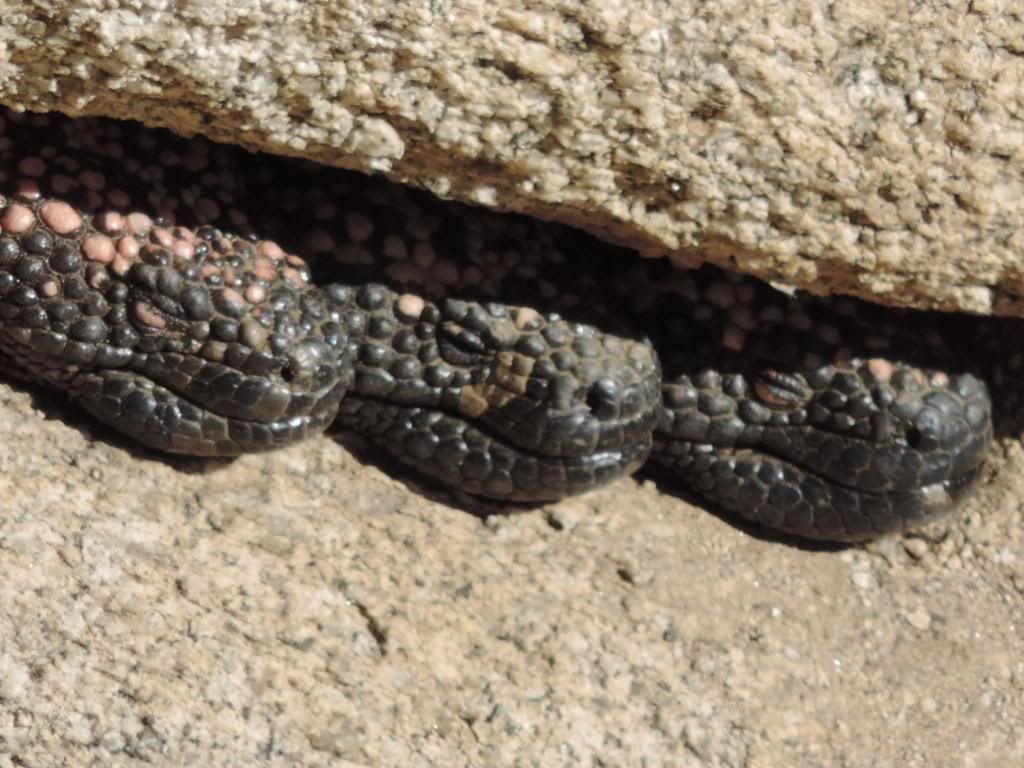
Heres two pics I took yesterday. I have been working these animals for 35 years. Study the rattlesnake pic and tell me about it.

reako45 Feb 13, 2014 11:58 PM

Is the rattler some sort of vanishing pattern atrox. Is that a real photo of those Gilas? From the picture it appears they are closely communal like Chuckwallas rather living an isolated existence over a range shared by other Gilas.

reako45

FR Feb 14, 2014 09:47 AM

Gilas are like most reptiles, including chucks. They live in pairs, that are in groups, which are part of a larger group. I have recorded as many as 8 individuals using one hole or main shelter. They normally have an area, where pairs leave the main shelter and use nearby shelters(privacy issues) Went I first located that hole and its only a hole, there were three in the hole and two on the ground, within 10 feet.

Normal colonies of reptiles including hogs, includes resident pairs, which live in tight groups, amoung a larger group with includes transient individuals, neonates and juviniles. With the longterm goal of being a resident pair. Resident pairs are the most stable and successful part of the group. And because these are the most experienced and successful, these areas have the most numbers. And they withstand the extremes(droughts etc) the best.
I have watched one of these pairs for 35 years, in the exact same place, EXACT. that tells us, its a very successful pattern of behavior and its reliable. End pt 1

FR Feb 14, 2014 10:25 AM

People want to make it all complicated and add or subtract names like social etc. When in fact, its far from complicated. Its all about reliable. All they do is remember and repeat what works, and remember and avoid, what does not. We mention pair bonding, Which is only a name. Yes, they keep the same mate, for as long as its reliable. The female when successful, follows a pattern of success, food, shelters, over lots of different conditions. The male, in order to be a pair bonded mate, must do the same. So it becomes reliable.
The situation you described is also part of a population. The transients. They do not have reliable shelters, mates, or food sources, they spend lots of time looking for that reliability. They are the individuals that are easiest to discover, as they cross roads and travel on the surface commonly. This is where the problem of understanding is. Science and hobbyist, studies these part of the population, and only because its EASY and surface. While residents, have no reason to spend lots of time on the surface. Or in the open.

What I observe is not common, I have to look far and wide for places where conditions allow me to see these animals. Once I find these areas, If you do not breach their behaviors(interfere or touch) or allow them to observe you to often. They are more reliable that big ben(clock). Their longevity is amazing, well past mine I am sure.

The Strox are an active breeding colony with all manner of color types, patternless, hypos, melanistic, normal etc. This is something odd, as all these types are in one group and in many groups. Locally we have two types of atrox. Hill populations and flat landers. The hill animals are extremely variable and large. The flatlanders are consistent in color and pattern and small.

In the above pic there is mock copulation. Which has nothing to do with reproduction directly. Its simply individuals talking to eachother. Its the language of WE, the group

Site Tools