I read with interest FRs post below about Black Kingsnake intergrades. However, after looking at Hubbs' range map in his Getula book I was a little confused because Hubbs doesn't show any pure MBKs in the U.S. He shows that area in AZ as an intergrade zone. Perhaps FR didn't have his glasses on when he looked at the map. I don't know.
Reptile & Amphibian Forums
Welcome to kingsnake.com's message board system. Here you may share and discuss information with others about your favorite reptile and amphibian related topics such as care and feeding, caging requirements, permits and licenses, and more. Launched in 1997, the kingsnake.com message board system is one of the oldest and largest systems on the internet.



FR's Mexican Kingsnake post
JoeBudro
May 31, 2014 09:08 PM
Replies (37)
reako45
Jun 01, 2014 10:57 AM
As both guys are AZ residents, I imagine both have got extensive experience herping that area. The few pics I have seen of WC snakes from down there seem different from the ones offered in the pet trade in that you can see traces of color and pattern, perhaps pointing to intergrade. I guess the only way to find out is to go down there and see for yourself. Sure is warm enough now.
reako45
JoeBudro
Jun 01, 2014 07:09 PM
The point Hubbs makes in his book is that there does not seem to be a definitive area in southern AZ where pure MBKs (WBKs according to the new terminology) occur. If FR knows where pure MBKs are in Az he needs to draw his own range map, and not misinterpret Hubbs' maps. Hubbs has a key to the colors on the map right on that page. Maybe Frank missed it. As for looking right now, that might work, but I think you need some rain also (maybe not). It's pretty dry in AZ.
FR
Jun 02, 2014 12:17 AM
I am not sure what your thinking, as if there are pure(only) black kings anywhere or something, there is not. Black kings are more common is some areas then others, but everywhere there is black kings, there is also splendida.
Even here in Az where the pure black ones(no banding or speckling) there is also normal kings. It appears to be a bit like stripe kings and banded kings in San Diego co. One kind of snake, several kinds of patterns.
I sat and looked at Hubbs map with him once, The map was not very accurate, not wrong, but a long way from right. My opinion was based on this area, where I have seen kings over many decades.
ALso Hubbs maps do not recognize the latest discriptions, which says all these are one snake. Best wishes
JoeBudro
Jun 02, 2014 01:12 AM
An intergrade zone is defined as having patterns of both parent subspecies and also intermediate patterns. See Blaney's paper on common kingsnakes (a classic). I find it interesting that you describe an intergrade zone perfectly, but do not seem to know what it is. Also, solid Black kings do not occur "everywhere". They only occur in certain places in AZ. You have mentioned "Black cal kings" around LAX, but show no proof of this statement.
You also said nothing about how you misinterpreted Hubbs' map. Is your ego getting in the way a little? I may be a lurker who seldom posts, but I see no reason to belittle another herper's point of view while you push your own and make erroneous statements about what Hubbs said...at least he showed pics to justify his map and explained how he examined 100s of specimens in museums. I just don't get you...
FR
Jun 02, 2014 09:41 AM
First, your not suppose to get me. Your suppose to attempt to get how the snakes work, or at least try.
If you do not grasp the subject, at least try. Like looking up the word. To intergrade
in·te·grate verb \ˈin-tə-ˌgrāt\
: to combine (two or more things) to form or create something
: to make (something) a part of another larger thing
: to make (a person or group) part of a larger group or organization
The use of the word, "intergrade" is often used wrongly. As I mentioned, it suggests the bringing together of two types. Which is not whats occurring, Whats happening is ONE TYPE, expressing many patterns. The kings in area, express colors and patterns of not one, or two, but even more types of kings, and without geneflow to any of those types. Hence, no intergration. For instance, in one spot, you can find black kings, splendida and banded kings. Even Chainking patterns are expressed. Yet, that population does not currently overlap any of the above kings.
You may want to look up genotype and phenotype. I guess it depends on if you want to understand snakes by reading, or by the actual snakes. The books are suppose to be the best understanding we have, but are never all or everything about any snake.
About authors, including Brian Hubbs, while a great friend. Hes attempting to gather information over the entire U.S. and with many many kinds of kings. I on the otherhand, specialize is small areas of kings and have done so, since before Brian was born. I met Brian when he was on his first trip to Az. He was a kid. No offense, but he doesn't investigate populations or kings, He samples them. He goes to collect other folks favorite sites all across the country. Reliable places where you can go at X time and find a king. He has not hunted So. Az. other then passing thru. You really should ask him. end part 1
FR
Jun 02, 2014 09:56 AM
His books are great, he is doing well, he is trying to give you a general idea. A better general idea of kings then other books. But it surely is not exacting. You have popular books, down to specific papers on tiny subjects. And a huge area in the middle.
Once you learn the general information such as whats in these type books, you can then investigate deeper, then lastly into the animals themselves. Even today the animals are constantly revealing new and exciting information.
You may want to look up polymorphic or polymorphism as many species do this, including ground snakes, they can be banded, striped, or unicolor, in one spot, just like kings. having a snake species utilize many patterns in order to utilize different micro habitats or changing habitats is not new or restricted to kings.
The word INTERGRADE indicates one type of king currently breeding another type, that results in intergrades, that is NOT WHATS OCCURING. Kings are polymorphic and can utilize any one of or combinations of patterns to best survive in areas where conditions are not stable. Best wishes
JoeBudro
Jun 02, 2014 12:20 PM
One correction and then I will be done trying to reason with you. The word intergrade is not used in herpetology like you use it. It refers to past intergrading or blending, not current. Your kings in SE AZ that display so many patterns are nothing more than animals expressing the collision of genes from 3 different parent patterns (subspecies) which all collided in that area a long time ago. That's what is REALLY happening. You can call it what you want, and use your own made-up terminology, but it is just a large intergrade zone.
Alas, I feel the frustration of all those who have ever tried to reason with you...
thomas davis
Jun 02, 2014 01:16 PM
collision?! AHHHAHAHAHAHAHAHAHAAA
COLLIDED?!?! AHAAAAAHAHAHAHAHAHAHAHAHAHAAA
yeah
completely and wholly clueless.
getula IS getula IS getula.
,,,,,,,,,thomas davis
-----
Morphs... just like baseball cards BUT ALIVE, how cool is that???
my website www.barmollysplace.com
JoeBudro
Jun 02, 2014 01:35 PM
Hmmm...very astute response.
FR
Jun 02, 2014 02:08 PM
The first thing I would consider is, who cares what I think, If your so smart, then you really should ignore anything I say. That you fight me, is very telling about you. You are free to believe what ever you want.
Lastly, terms such as subspecies, are no longer popular and used. As Mtdna keeps progressing, all these terms like intergrade or intermediate, and subspecies, become terms of the past. So if my usage of the word intermediate(patterns) bothers you, your in for being really upset. Things are a changing. Best wishes
JoeBudro
Jun 02, 2014 07:53 PM
Yes, they are changing-for the worst. Freer and Hebronville, TX splendida are now holbrooki according to the new getula species split (check their map). The cal kings along the little colorado river in northern AZ are now splendida. MBKs are now Cal Kings. If all this becomes the norm, we are doomed as far as really understanding these snakes. I really don't see the DNA magic bullet...I see a bunch of garbage.
Aaron
Jun 02, 2014 11:59 PM
I think the question is, is the melanism in the Cal Kings of coastal southern California, the Central Valley, the Sacramento Delta and Baja(and possibly "yumensis" too) caused by the same genetic mechanism as the melanism in Mexican Black Kings/splendida?
-----
www.hcu-tx.org/
JoeBudro
Jun 03, 2014 01:28 AM
I think you might have to ponder that question while floating in a canoe...
JoeBudro
Jun 03, 2014 01:31 AM
...while paddling under serene skies and still forest...not in this aggravating environment.
FR
Jun 03, 2014 09:36 AM
Great point Aaron, but its already proven not to be, thru captive breeding.
The point is still good, its not how these snakes are dark or black, its why that is important. Even striping like San Diego's and Newporter stripers are carried on different genes. Same for banding.
Lastly, how we think of these animals is based on assumption. That is, we have no idea what the original getula looked like, the one that colonized the current habitat. We do know that the conditions then must have been much different then today. It must have been a much wetter grasser habitat. Does that colored animal exist today? There is no reason to think so, as the habitat is complelely different now.
Also a great question would be, how much of what we see today is influenced by man. The draining of marshlands(the black types) The pumping of ground water and farming, etc. have indeed played a role in what colors and patterns we see today.
In this, MBK's were first found just north of Nogales, under a hay bale to be exact by Dr. Lowe and Bill Wooden. The funny part is, Nogales is a staging area for Mexican produce. ITs trucked from farms in Mexico, unloaded from Mexican trucks and reloaded on American trucks, then transported all over the States. Once I found a Cat eyed snake crossing the road in that very area. Thanks for the thoughts Aaron
FR
Jun 01, 2014 11:08 PM
no offense, but the map sucks. Sorry and intergrades is an odd word when talking about polymorphic snakes such as getula.
There are indeed pure black with no hint of pattern kings in So Az. The problem is, My good friend Hubbs, has a somewhat different idea of what black is. To me its simple, one with no banding or speckling. And they are here.
Hubbs and I have different ideas how these kings work. He somehow things there is geneflow currently and there is not. The maps are actually hundreds of currently isolated populations of getula kings. And they do not intergrade. Many locales have a wide genotype that expresses in a range of patterns we recognize of one type or another.
There are indeed corridors along river valleys where the most current geneflow occurs, but there are thousands of isolate populations.
When thinking of getula kings, the pattern types are often intermediate not intergrade. AND THESE PATTERN type are useful in areas of constantly varying conditions. Dry conditions express certain color/pattern types, wet conditions other. And all in one area. The funny part is, we have no idea of what the ancestor or mother king that occupied the U.S. looked like. My bet is, nothing like any of the current kings. Best wishes. And I really like Hubbs. Hes just trying hard to make the snakes fit his stype of books and not make his books fit the current snakes that exist in nature.
JoeBudro
Jun 02, 2014 01:22 AM
" the pattern types are often intermediate not intergrade"
THAT is the definition of an intergrade. Perhaps you use a different dictionary from everyone else. You seem to be saying the same thing Hubbs is, but you don't even know it. I doubt you've really read the book slowly enough to get the jist of his message, if at all. You definitely do not understand the maps, and you think intergrade means current gene flow. It does not. It means ancient gene flow. That means a long time ago, not now. I have e-mailed Hubbs and asked him about this and he does not believe genes are currently intergrading. He believes that took place long ago. I think you misunderstand a lot about your friend Hubbs. Maybe you should talk to him again and quiet the chatter in your own mind and listen to what he says.
JoeBudro
Jun 02, 2014 01:29 AM
Oh, and before you go off on the intermediate thing, I was referring to intermediates between subspecies, not patterns alone. An aberrant cal king is just an aberrant cal king, not an intergrade, but when an intermediate shows up in an area where several subspecies ranges intersect, it is an intergrade.
Also, as i see it, Hubbs never claims his map is perfect, just based on the specimen locations he examined. Where is YOUR map?
FR
Jun 02, 2014 10:00 AM
You just want to argue, so I will say, good luck with that. Bye bye
JoeBudro
Jun 02, 2014 12:24 PM
Not arguing, just trying to share my point of view and Hubbs'. You are evidently not open to differing points of view or facts...Bye, Bye.
FR
Jun 02, 2014 05:37 PM
how about this, you prove there are intergrades, you know, one kind, mating in nature with another kind to make intergrades. It can be proven genetically. Or even a pic of wild animals copulating would be a start. Please understand, proof of what they are, not what they look like. If you or Hubbs could do that, I would be all ears. You see, in order for me to listen, you have to provide something of interest. Which you have not done. If you want me to believe, then your going to have to prove it to me. Then I will believe.
You must have some experience with this, so how about you posting some evidence that you have personally seen in nature. Thank you so much
JoeBudro
Jun 02, 2014 07:58 PM
The proof you seek is in your own pics. Not every intermediate is an intergrade, but every intermediate in an "intergrade zone" is an intergrade. Aberrant cal kings in San Diego county are not intergrades, because they are not the result of two subspecies meeting historically, just two morphs or color patterns meeting historically. You really have some far out confused ideas. Perhaps too much breeding is the result and not enough sampling of wild populations across their ranges. Or, maybe too much ego...
FR
Jun 02, 2014 10:13 PM
That's surely not the proof you want. All those kings come from one area. Its in their genotype. That area produces what it takes to survive. Its not influenced by out breeding or intergrading.
You want to call them by color and pattern. Which is wrong. Color and pattern are weak taxom characters. Particularly with polymorphic species. Oddly, you can find, blotched, banded, speckled, and striped getula from coast to coast.
What proof I ask for was genetic proof of current intergrades. The product of Two types. Not a bunch of color morphs that occur in one area. Best wishes
JoeBudro
Jun 02, 2014 10:35 PM
Unbelievable...
FR
Jun 03, 2014 09:12 AM
Heres the deal, your not interested with what actual snake populations are doing, you only want to play silly games. See FR will not change his mind, etc. Which is super stupid, I would if you or anyone could prove your point. As it is, its saying the same thing only one allows the understanding of what snakes are. The other intergrades, is only a method to call a inbetween pattern and nothing to do with kingsnakes.
You mentioned you do not like or see any value in MTdna work. Which really tells where your understanding is. The reality is, the snakes in nature are exactly the same, no matter what we call them, It doesn't matter if anyone changes their scientific name 100 times. They are what they are, and will change to what they will evolve to, not matter what we think or call them.
In this entire thread, you did not mention one thing about the snakes, not from personal experience or from what you read. All you want is to argue. Truth is, that would be fun, but you indeed must have a point to argue, then support that point. Which you don't. All you know how to do is call folks names. And that is what you care about, you do so in some odd notion that it will make you substantial. And it could, if you only offered something important about the snakes. As it is, your only acting stupid.
JoeBudro
Jun 03, 2014 05:07 PM
You're right, I am not interested in your assumptions about what snake populations are doing. I am interested in facts, and I have stated facts backed by museum specimens and Hubbs' own field work and the field work of others all across the U.S. YOU seem to be the only one arguing with the facts. I've just tried to present them. You seem hung up on breeding outcomes of mixing gene pools and looking at the results. I only pay attention to locality gene pools.
As for name calling, you are guilty of the same thing, although you make it less obvious...calling Hubbs confused, delusional, misguided, etc. all the while mis-interpreting his maps. Open the book and look at the map again. My original point was that he made no claim for MBKs in AZ in pure form, and he even stated that MBKs might be just dark versions of splendida. I never intened to argue with you, just correct you on an obviously wrong conclusion. You really ought to read the book and stop trying to interpret his ideas based on picture captions and an erroneous map conclusion. I'm done, you are obviously unable to carry on a two-sided discussion or even prove any of your points...
FR
Jun 04, 2014 08:57 AM
I think you need to seek help, you have so much anger. I never called Hubbs names. Just because I do not agree with him(and only on one tiny subject, you think its about hate and anger. There is something the manner with you. Hubbs and I have sat down and discussed this very subject and no one gets mad or upset or even does anything more then talk.
Also you really need to grow up, science is to question, its not about right or wrong. Its to question the animals, papers and existing books. That's how it grows. It does not grow by believing or making it about right or wrong. Science is to attempt to add to, not believe in a subject.
Also, you may want to question Hubbs about Black kings. I am not sure he ever found one in Az. Not a real black one. ALso, he has not made a study of them. He does gather data and its this I question. He told me a person who lives in Noggie, found 20 MBK's on a particular road and that all the kings on that road were MBK's. I had found kings there and many were splendida. So from the time of our conversation, I have seen 4 or 5 more from the spot in question. None were pure black, they were all dark splendida.(as adults) To compare that, theres another area that does indeed have Black kings with no visable pattern. So his idea of what is a black king differs from mine.
What gives me an opinion on subject is, I was a big time Cal King guy(like Hubbs) and I live right here where this is occurring. So every year I get to see these animal, and what I see does not express what Hubbs ideas are. Lastly, as mentioned, Both my idea and Hubbs ideas, are a thing of the past. As now, its all About Mtdna and not a thing to do with morphology(what they look like) The reality is, Someday dna will paint a picture of what is actually occurring. My bet is, each isolated population and there are hundreds to thousands, will be unique. Which may mean its own species. So stop with your stupid anger and get with it. try to keep up. Bye bye
FR
Jun 04, 2014 09:02 AM
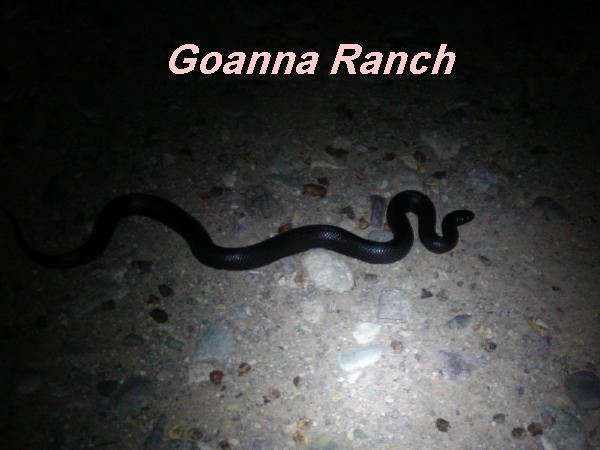
A Black king in situ from So. Az.
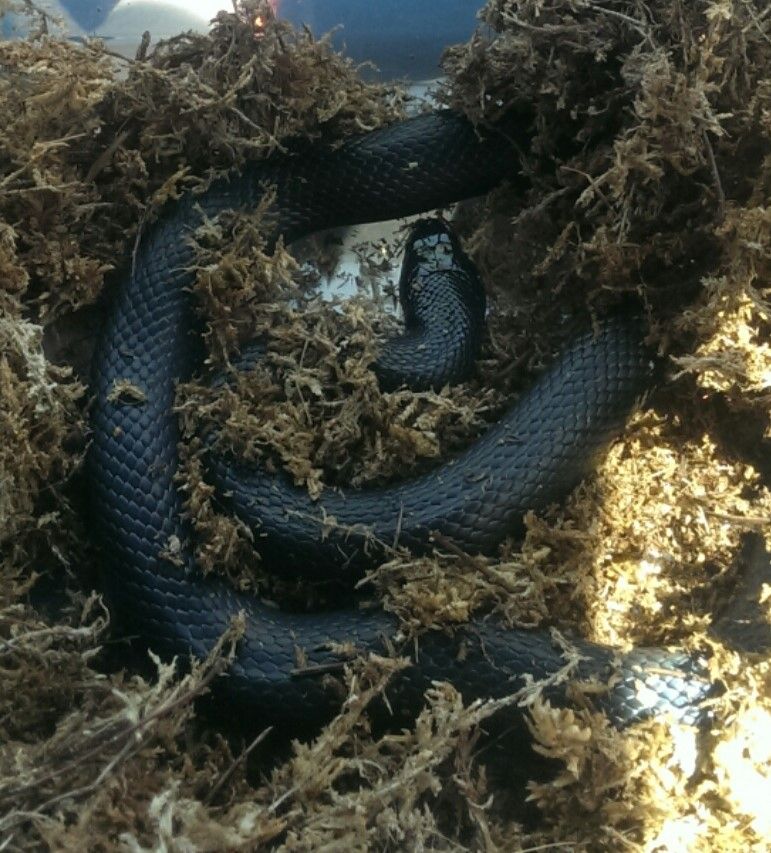
A black king from central texas
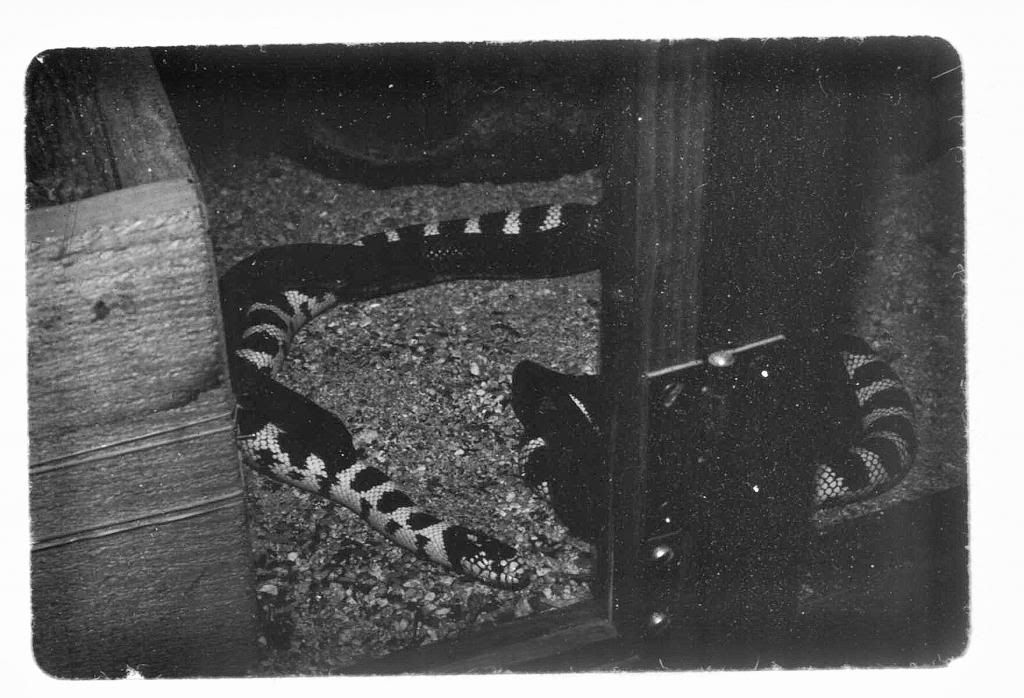
A black king from the L.A. area in SoCal.
So Budro, what do you have for me?
reako45
Jun 05, 2014 03:29 AM
Very interesting, esp the central TX subject. I'd GUESS melanistic splendida, but would love to see the results of a DNA comparison between it and TX splendida, AZ splendida, and your southern AZ black King. I really need to be rich enough to be able to throw $$$ at these sort of projects.
reako45
FR
Jun 05, 2014 11:08 AM
From what I have been told, that would reveal very little, like nothing. If they were naturally occurring, you would need dna from their parents etc to say anything.
Again from what I am told, MTdna is still in a unsettled state. You can take different dna in a single snake and come up with different relationships.
Color and pattern are not good genes to work with as they change so quickly and not necessarily tied to genes. An example would be, a clone does not have to have the same color as the parent.
Again, I am no expert what have questioned a number of people who are.
Our problem and surely Budro's is, we name them by what they look like, not considering important characters like scale counts, structure, and recently Mtdna. Even band count is more important then color. That can show a cline from one area to another. Color, not so much.
There are so many species of snakes that express melanism, such as hognose, gardersnakes, rattlesnakes, coachwhips, pines, etc and in all cases does not make them separate species. These have different degrees of expression, from being rare to being common. Melanism seems to compete well with normal patterned snakes.
AaronBayer
Jun 05, 2014 10:29 AM
I'd like to add here that I recently found out of another black splendida being found about 15 miles outside of Lubbock, TX. it wasn't 100% black... had a few small yellow flecks on the throat and chin, but i'd be comfortable saying it was 97% black. looked like what i would call a "B-grade MBK", but it came from rural TX so the chance of it being a displaced MBK are incredibly slim.
i was talking about my black splendida at snake days and got to see a pic of one somebody caught years ago.
so they are out there... might be rare, but the black/ melanistic/ hyper-melanistic kings do pop up all over the place.
FR
Jun 05, 2014 11:50 AM
As mentioned above. Melanism occurs in kings. Where Joe goes silly is, He believes in what he read. And to believe that, he HAS to believe in the range maps Hubbs published. So if anyone disagrees, its an attack on Hubbs and Joe. The problem is, Hubbs maps are not great. They are average shaded maps, the problem with that is, they do not show exceptions and there are lots and lots of exceptions. Particularly with So called MBK's which is pretty much a deli cup name. Todays interpetation of MBK is based on deli cups, not the animal in nature.
The original description was poor and no one actually studied the animals. Which was commonplace in the old days, you found a different looking snake, publish it.
The majority of black kings came from the Ortiz area and the majority of those have neonates that were splendida patterned, Of those, some turned black, some did not. In the Ortiz area, there are also adult splendida patterned animals. In fact, the farthest south animal from Coastal Sinaloa was a splendida type.
Black neonates from MBK's were selectively bred in order to better sell them. As folks did not like buying speckled black kings and hoping they would turn black. In a nutshell, todays black kings are deli cup based on selective breeding, but do not represent what was in the field. What is in the field is always right, what is in books is sometimes right. Or not. The truth is, its the exception to rules that define the rule. In this case, there are too many exceptions. Cheers
Aaron
Jun 06, 2014 02:04 AM
If you look hard enough everything is just dots, only some are closer than others.
-----
www.hcu-tx.org/
JoeBudro
Jun 07, 2014 02:35 PM
THAT is profound, Sir...
thomas davis
Jun 02, 2014 01:07 PM
yeah....
you are confused VERY confused indeed and apparently ignorant as well. pure huh? guess what they are pure, pure getula and ya know what?.... some are black.
and for all the ignorant splitters mbk are simply melanistic splendida but make no mistake BUDRO they are pure snake, regardless of what ANY range map says.
hubbs no doubt misunderstood FR when recording his data.
,,,,,,,,,,thomas davis
-----
Morphs... just like baseball cards BUT ALIVE, how cool is that???
my website www.barmollysplace.com
JoeBudro
Jun 02, 2014 01:27 PM
Wow...you're spelling and punctuation is amazing...just like your thoughts on getula...
Nice talking with you. Happy breeding.
This is why I usually lurk.
thomas davis
Jun 04, 2014 01:18 PM
thanks for confirming exactly how clueless you really are.
-----
Morphs... just like baseball cards BUT ALIVE, how cool is that???
my website www.barmollysplace.com
