This is my normal holdback from the failed ghost project just after shedding. I like the brownish tones on it. One pic is with flash, one without. I am not given to naming my snakes, but am calling this one 63 for what I think is an obvious reason.


Welcome to kingsnake.com's message board system. Here you may share and discuss information with others about your favorite reptile and amphibian related topics such as care and feeding, caging requirements, permits and licenses, and more. Launched in 1997, the kingsnake.com message board system is one of the oldest and largest systems on the internet.


This is my normal holdback from the failed ghost project just after shedding. I like the brownish tones on it. One pic is with flash, one without. I am not given to naming my snakes, but am calling this one 63 for what I think is an obvious reason.
THAT IS TOO COOL!! I LOVE IT.
--Dennis
Thanks! What's nuts is that I didn't even see the 63 till I took and looked at the pics--I held the snake back because of the coloring. I'm attaching pics of the grandparents and the father as a hatchling.


Yeah, great name. I dig the head pattern.
reako45
63, outrageous! What are the odds of that happening.
I suck at math, but I think in this case, the odds were one in eleven!
If you breed them next season and get one with 3.14, will you sell it to me?
Very nice looking snake. Reminds me of an Eastern Milksnake. Beautiful.
Very nice king. I love the name too. soixante-trois
that's really neat! I have never seen one with such perfect numbers.
congrats andy
,,,,,,,,,,,,,,thomas
-----
Morphs... just like baseball cards BUT ALIVE, how cool is that???
my website www.barmollysplace.com
Thanks, Thomas!
Hey Andy, that normal looks like a "hypo" but just a dark one...
The term "hypo" used in floridana morphs is an incorrect one in reference to what the mutation is actually doing... The "hypo" gene does not take black away, it enhances colored pigments but black is still there
Nice snake either way, take some more shots of it if you can?
Z
Thanks, Zenny, and will get more pics up soon.
Are you saying that there are degrees of hypo? In other words, some hypos will mask more melanin than other hypos? If so, can that be the case with all recessive genes? I ask because there was a nice hatchling I got that looked anery until you noticed a faint blush of yellow and red on its side. Could that have been a "lesser" degree of anery? Due to space/time limitations, I only held back three . . . "63", the lighter hypo, and the definite anery.
Hopefully I didn't misread what you were saying, and thanks for chiming in! Really sucks that I didn't get a ghost!
There is a natural variety in hypo specimens, just like there is variety in normals. Just as some normals are darker or lighter, some hypos are darker or lighter depending upon what they would have looked like if they were normally colored.
-----
www.hcu-tx.org/
understand What the Anery gene does... it takes away red/orange so the result u end up w/ is a black and white animal... if the animal comes from a high yellow lineage the anery will develop yellow pigments as it matures...
as far as degrees of a mutation... not really... floridana are highly variable as a whole, when you add genes to natural variations you end up with a spectrum of morphs. you will see more variation in a morph like "hypo" because the colored pigments are not eliminated by this gene... what you end up with what various lines of floridana look like if you INCREASED the colored pigments that are present within that line... not a reduction in black pigment as the term "hypo" suggest... what is a genetic hypomelanistic is the "peanutbutter" mutation... it reduces the color black to lavender/brown... the "PB" mutation has potential to be as variable as the "hypo" mutation because it does not tamper with the colored pigments within a particular line it only reduces black.
Axanthics even, vary quite a bit depending on the lineage, i have a dirty dark axanthic female and then i have a NE axan male that looks almost ghost... but then there are lemke line axanthics I've produced that grow up to look better than my NE axanthics!
here is a clutch of "hypos" i produced from two "flame" lines; notice how much BLACK is visible:
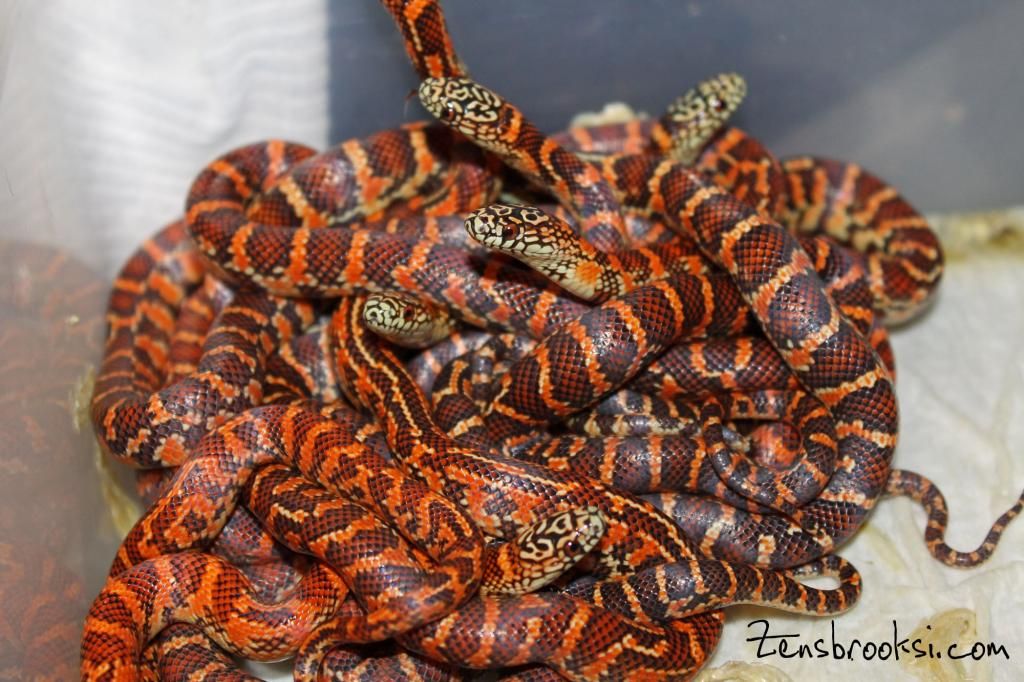
Axanthics even, vary quite a bit depending on the lineage, i have a dirty dark axanthic female and then i have a NE axan male that looks almost ghost... but then there are lemke line axanthics I've produced that grow up to look better than my NE axanthics!
I think what you may have had was a Lemke that was outcrossed to another line to create a lighter axanthic. I have never seen a light axanthic when I was at Lloyds and I saw a lot of the original stock.
The original Axanthics from Lloyd Lemke all were dark as adults. They came out nice and blue as babies (he referred to them as looking like "blue wax" on his price list. But these blue babies soon muddied up with growth. The opposite is true of the the pure line New Englands which the babies were not as pretty as the Lemkes but turned into nice light colored beats..almost resembling a ghost.
The New England line is a line trait which is more preserved through the years . Unless someone outcorssed them and still called the New Englands, but then they would not be new englands anymore!
As soon as you outcross a NE axanthic to another line it is no longer considered a NE axanthic. So all the prodgeny have to trace back to the original "old canal" wildcaught stock found by it founders. You could say the same thing when referring to a Lemke line.
Since Lloyd had fertility issues with his original stock (and people did not treat them the same as the NE axanthic (by keeping the line pure) they outcrossed them early on and probably still called them "Lemke axanthics". My guess is that is what you had and why you had a light "Lemke" axantics. But it would not technically be correct calling it a Lemke axanthicjust as if you called a New England axanthic that was outcrossed still a New England.
Bottom line to this discussion is phenotypes have an effect on mutations such as the hypos, anerys , PB ect. which means we have variety or color AND PATTERNS within those recessive traits.

-----
FR quote:
"Doing the same things over and over expecting to learn something else, is the definition of insanity"
The whole outcrossing thing you just stated doesn't really make sense, to me. In any other reptile market, ball pythons, leopard gecks, or whatever, when you outcross a recessive animal, like an axanthic ball python, the name of the line you started with, stays with the animal. For example : A TSK line axanthic ball bred to a clown, those offspring are all Het TSK Axanthic and clown , those animals you breed back each other and let's say you produce an axanthic clown. It's a TSK line axanthic clown.Not just an Axanthic clown.
So people only breeding Lemke's to Lemke's and NE to NE lines just to keep them "pure" doesn't hold true in any other market. The het Lemke's that were outcrossed and bred back , are still Lemke's when they finally produce the visual form, Lemke axanthic. Unless the Florida king market is vastly different than any other reptile market out there, I don't see the why you would nitpick over an outcrossing from a verifiable visual form, like a Lemke or NE line.
Am I right or wrong ? I may not even have touched on the subject at hand, but I think I did. I haven't read each and every post. I just think it's confusing the issues for new comer's to say , "You don't have pure lines of Axanthics "( or whatever they are called ), just because they have been outcrossed maybe into prettier, lighter or darker normal animals.
All axanthic genes in floridana are the same gene, producing the same result (blocking yellow and red)... So the names of different lines mean absolutely nothing really.... From what I've seen you can line breed any line (morph or wild type) to be more desirable... The catchy names will always be associated as one "breeder" hopes to different his stock from other lines
Help, tips & resources quick links
Manage your user and advertising accounts
Advertising and services purchase quick links
