Reptile & Amphibian Forums

Welcome to kingsnake.com's message board system. Here you may share and discuss information with others about your favorite reptile and amphibian related topics such as care and feeding, caging requirements, permits and licenses, and more. Launched in 1997, the kingsnake.com message board system is one of the oldest and largest systems on the internet.

Click for 65% off Shipping with Reptiles 2 You

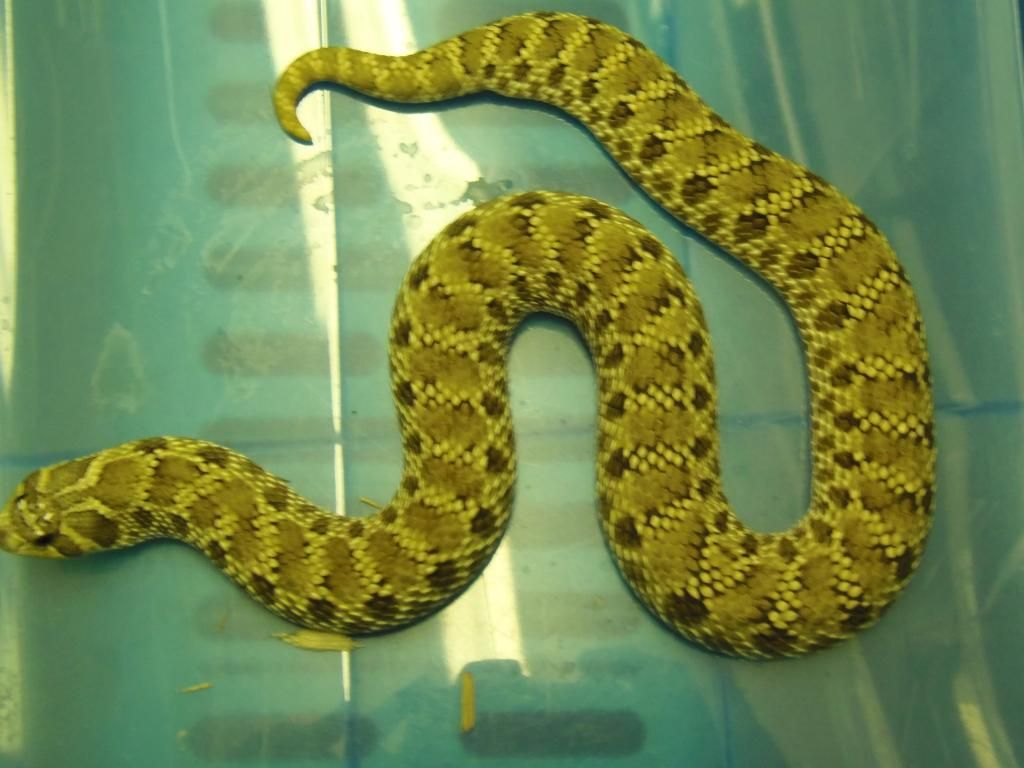
difference in jmg and normals for frank

Jonrice Mar 27, 2015 12:44 AM

this is the difference in the jmgs and the normals from the same clutch to show the variation. I love these hoggies!!!! Pics of the only other species in my snake room. Transpecos ratsnakes. Male albino and female het. I hope for some eggs from them this year also.

Replies (5)

FR Mar 27, 2015 09:00 AM

Hi Jon, First, I love those subox, I was there the night the first albino was collected. I have seen them way into mexico as well.
Thanks for the pics, I do understand the variation, which is what I question(I question everything) As a newbie, its odd to me. Most of my hognose work is in the field. In the field, there are normal individuals that for all intent and purpose are axanthic. I understand I could easily breed them to eachother a couple of generations and express Axanthic looking animals. But they would not be true genetic(recessive) axanthics.
I am asking because I am attempting to understand how this hognose stuff is used in the trade(not nature)
I have found yellow hogs, and finally kept one. They are actually less common then axanthics. The one I kept is a female and I raised her from aa neonate. I do have a really lite male that is kind of yellowish/tan ish, as well, that will be one of my pairings this year. Hopefully I find a male. I did find one, but did not keep it.
As far as I understand it, the use of co dom and polygenic is sort of overlapping. I guess it would be better if I knew how those co dom axanthics were developed.
Lets say, I breed my yellow to that tan ish male. Normally what occurs is a blending, with extremes that normally exceed both the parents. I then take the yellow extremes out of a few clutchs and within a couple generations, I would have extreme yellow co doms that when bred together produce supers(what ever that would be)
The point is, these line bred animals would perform like co doms, Or what I am told is the definition of co dom. Maybe what I need to ask is what is, polygenic?
Anyway, got to hit the bush. Going to see if this wet year had any effect on hogs in the field.

Jonrice Mar 27, 2015 05:33 PM

The jmgs came from a lemon ghost pairing breeding for yellow hogs. They popped up in the offspring and were proved codom. The difference between codom and polygenic is that u can breed the codom and get a desired result in two generations as with the super form. But with polygenic or line breed traits to get to something that looks like that super jmg would take a crazy amount of generations. It would I think take a lifetime instead of a codom or resessive trait.

Gregg_M_Madden Mar 27, 2015 06:45 PM

There seems to be some confusion on what co-dominance is and how it works. We need to keep in mind that the word "super" is not term recognized in genetics. That is just something reptile people made up.

Frank,
Polygenic and co-dominance do not overlap on any spectrum. You can not take a genetic trait and turn it into a co-dom by breeding it.

In simple terms co-dominance acts the same way a recessive gene works only in co-dominance, the heterozygous (gene carrier) form can be distinguished from non-heterozygous animals. What we call the "super form" is the homozygous form.

Gregg_M_Madden Mar 27, 2015 06:53 PM

Polygenic is exactly what the word indicates. It means many genes. A polygenic trait needs numerous genes to align in order to be displayed. They are not as simple as a simple recessive or co-dom.
Some polygenic traits are strong or more simplistic and easy to replicate while others are much more involved and not easily reproduced. In other words, some are more reliably reproduced than others and do not need copies of the genes from both parents. One parent can pass the genetics down to its offspring.

A polygenic trait can act almost like a recessive or co-dominant but the mode of inheritance is way different.

Jonrice Mar 27, 2015 08:44 PM

Agreed

Site Tools


