Gents, this is an interesting one and a topic that put me in strife from all sides and one that's been raised in e-mails again of late.
In my papers of 1998-and later I used the name as given by Wells and Wellington for the NW West Australian Death Adders.
Ken Aplin and others slated me for doing so, claiming the name to be nomen nudem on the basis that Wells and Wellington failed to provide a diagnosis of the species in the form as required under ICZN rules.
Another variable of note is the similarity of this taxa to the New Guinean/Irian Jayan A. rugosa which some claim is the same species and hence gets priority as per the ICZN's rules over A. lancasteri, the latter being a synonym of the former.
Then there's the NT subspecies named in 1998 as A. l. bottomi, which Aplin says should be applied to the Australian specimens assigned to A. lancasteri. - in i\other words, A. bottomi.
What do the others here think (please provide a substantive basis for your thoughts).
ALL THE BEST
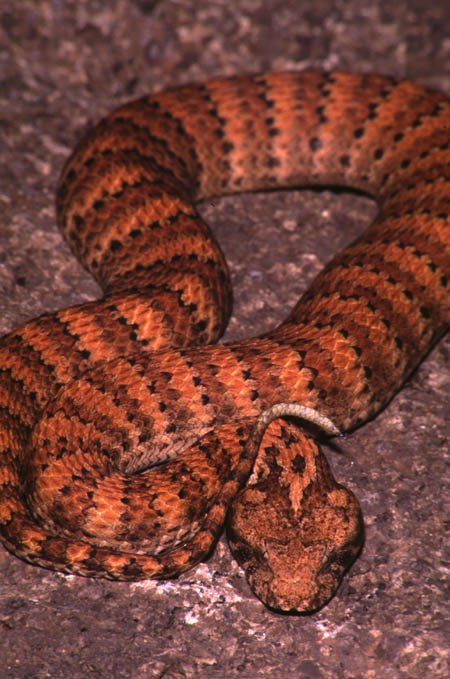
Death Adder Taxonomy
Reptile & Amphibian Forums
Welcome to kingsnake.com's message board system. Here you may share and discuss information with others about your favorite reptile and amphibian related topics such as care and feeding, caging requirements, permits and licenses, and more. Launched in 1997, the kingsnake.com message board system is one of the oldest and largest systems on the internet.


Is Acanthophis lancasteri a valid taxa? and/or is the name available?
Replies (10)
Did Wells and Wellington provide a type specimen, a type locality and/or a description of their species?
Ray,
I do not have my copy of W&W with me. Could you copy in what they wrote about this species? It won't be much I expect. I have never looked at their snake stuff in detail and do not remember what they said.
Cheers, Scott
Gents, as requested:
The exact text from the W AND W paper:
From Wells and Wellington 1985 pages 43-44
Acanthophis lancasteri sp. nov.
Holotype: An adult specimen in the Western Australian Museum R70960. Collected at 45 km NNE of Halls Creek, Western Australia.
Diagnosis: A member of the Acanthophis antarcticus complex most closely related to Acanthophis praelongus, and readily identified by the description in Storr (1981:209-210) the material utilized by Storr, excluding those specimens from the Northern Territory is referrable to Acanthophis lancasteri rather than A. praelongus). Acanthophis lancasteri is believed to be confined to Northwestern Australia and across the 'top end' of the Northern Territory. Acanthophis praelongus is confined to Cape York Peninsula, Queensland. Excellent diagnostic illustrations of Acanthophis lancasteri appear in Storr (1981, Fig. 4), Cogger (1983, plate 764 cited as "Acanthophis praelongus), in Gow (1977: plate 22 cited as "Acanthophis antarcticus" and in Gow (1982: plate 3, cited as Acanthophis praelongus). Etymology: Named for Actor and Philosopher Burt Lancaster.
Acanthophis praelongus Ramsay 1877
Acanthophis pyrrhus Boulenger 1989
Acanthophis schistos sp. nov.
Holotype: An adult specimen in the Western Australian Museum R64698. Collected at Canning Dam, Western Australia.
Diagnosis: A short bodied thick set, highly venomous snake of the genus Acanthophis, most closely related to Acanthophis antarcticus and readily distinguished by the data given by Storr (1981:206-207: fig 2). Cogger (1983:24-23, Figs 185, 763) provides an adequate diagnostic description of it's nearest relative Acanthophis antarcticus.END
Note: Aplin's argument is that the cited publications by W and W do not separate the WA populations and hence are not diagnosis of the taxa as "identified" by W and W.
Frankly I don't care one way or other what is the final view on these names, but it'd be nice to get some sort of common view so that we can then move foreward and without confusing lay people.
ALL THE BEST
Acanthophis taxonomy
Hi Ray,
thanks for that more than I thought it would be sorry.
Anyway based on that I would say it is a Nomen Nudem because you cannot refer to a figure as a diagnosis. This is the same arguments that Iverson, myself and Georges used to sink most of the turtles descibed in the papers and has been used by Shea and Saddlier as well. So it has precidence when dealing with this paper.
Aplins argument as you put it is wrong, it does not matter how inadequate the desciption is it just has to be there. However it would appear it is not. The only caveat I must put is that I have not seen the Storr paper. W&W are referring to a couple of figures, if the captions of those figures contain any textual written information that diagnoses the taxa then the name is valid. This happened with Elseya purvisi where the caption of the figure that W&W referred to said it had a yellow stripe, yeah thats all it said but its enough.
As a generalisation the type material W&W referred to was failrly accurate so I will assume this has extended to this case so there are no problems there.
Off the top of my head I think the reference in the rules is that it does not meet Article 13 i or ii (a description must meet one or the other to be valid) but check this against Iverson et al., 2001 to be sure if you wish (John Iverson, Earlham College is corrosponding author for reprints). It was published in J. of Herp.
Basically these are saying that a description must (i) contain a description that "purports" to diagnose the taxon or (ii) contain a reference to such a description. Descriptions must be written, not pictures. By purports the rules are meaning that they claim it diagnoses the taxon, does not actually have to work..
So next opportunity declare it a nomen nudem citing the code. Then its finished with.
Cheers, Scott
I do not have a copy of the code of the ICZN in front of me, only a draft of the 4th edition. Assuming no changes are made to Article 13a between the draft and final publication, these are my interpretations:
From your quotation of their publication, one can certainly argue that Wells and Wellington "purported to differentiate" (which is what the ICZN requires) their taxon, even if they may not succeed in doing so. They provided both some "word characters" and a "bibiographic reference," thus they appear to satisfy the requirements of Article 13a (i and ii) of the ICZN's Code. In my opinion, the name they erected appears to meet the rules of the ICZN for availability and are thus "available" sensu the ICZN.
Alpin is apparently arguing that neither Wells and Wellington (1985) nor the literature they cited actually succeed in differentiating their taxon from other known species. But this argument is irrelevant because it does not affect the availability of the name.
Availability, however, does not equal validity. Another systematist may decide that the specimen to which this name refers may be conspecific with a species for which an available older name already exists. In that case Wells and Wellington's name may become a junior synonym or at best a subspecies name.
"From your quotation of their publication, one can certainly argue that Wells and Wellington "purported to differentiate" (which is what the ICZN requires) their taxon, even if they may not succeed in doing so. They provided both some "word characters" and a "bibiographic reference," thus they appear to satisfy the requirements of Article 13a (i and ii) of the ICZN's Code. In my opinion, the name they erected appears to meet the rules of the ICZN for availability and are thus "available" sensu the ICZN."
There are no "word characters" defining the species in that quote the description fails to meet Art 13a(i) of the ICZN. However, I did misread it earlier and you would need to check Storr 1981 to see if Storr described characters that Storr states are diagnostic of the taxon. (He does not have to say its a species just that the population has diagnosible characteristics and defines them.)
So this will depend on the Storr paper as referenced. So you need the paper and two examine the pages mentioned. If they contain a diagnosis that "purports" to differentiate the taxon then its valid. Purports basically means a written claim that the characters work, they don't have to hold up at all. If Storr did not diagnose the taxon or this reference is to figures (which are disallowed under the Code) then the description fails to meet Art 13a(ii) of the code and is hence Nomen Nudem.
When someone cites another paper you need to check what the other person said as its there words that are now relied on. Supplying a reference does not automatically meet the code.
I do not have the Storr paper Ray, sorry or I would look.
Cheers, Scott
Scott, (and others), I've scanned the 1981 Storr paper in via OCR in terms of the descriptions of A. antarcticus and A. praelongus.
Based on what you (and Aplin) say, there is no separation of WA snakes from the rest, ... hence nomen nudem as even technically speaking this means that the W and W paper does not even purport to separate the taxa.
I've placed it below for you to look at - but excuse the typo errors that I did not correct.
Also, what are the views of you and the others in terms of NW WA Acanthophis as differentiated from Irian Jaya Rugosa and/or other northern Acanthophis?
FROM: G.M. STORR (1981)
GENUS ACANTHOPHIS
Acanthophis antareticus Shaw, 1794
Fig. 2
Boa antaretica Shaw, 1794, The Naturalist's Miscellany, pi. 535. Type locality presumAbly vicinity of Sydney, N.S.W.
Diagnosis
Avery stout Acanthophis with upper head shields smooth or slightly rugose ' anterior dorsal scales weakly keeled or smooth, posterior dorsal scales smooth or very weakly keeled, head deeper than in other species and upper lips more boldly patternc4.
Description
Snout-vent length (mm): 132-585 (N 34, mean 414.8). Length of tail (% SVL): 14.7-25.2 (N 33, mean 20.3).
Prefrontals 2 (N 16), 3 (3) or 4 (3). Preoculars 1 (N 28) or 2 (3). Post-oculars 2 (N 30) or 3 (1). Suboculars 2 (N 17) or 3 (14). Upper labials 6 (N 32). Temporals: primaries 3 (N 33); secondaries 3 (N 26), 4 (5) or 5 (1). Dorsal scale rows: 21 (N 34) or 23 (1) at midbody; seldom reducing on neck, i.e. usually not changing or increasing by 2 rows; usually reducing to 17 before vent. Ventrals 110-124 (N 25, mean 116.6). Subcaudals 36-50 (N 33, mean 45.4), 16-31 single (mean 23.6), 17-26 paired (mean 21.8).
Dorsal ground colour dark greyish-brown or dark brownish-grey. Back and tail with 40-50 pale grey or pale brown cross-bands; on posterior edge of bands usually a series of black spots (apices and Posterior edges of scales). On back of head 1 or 2 pale oblique streaks, converging anteriorly. Snout pale brown peppered with blackish-brown. Often a broad blackish streak from orbit back through lower temples. Lips whitish barred with black or brown. Rest of lower surfaces whitish except for black or dark brown centres to gulars, anterior ventrolaterals (dorsals nearest to ventrals) and sub-caudals, and occasionally for brown flecks on ventrals.
Distribution
Patchily distributed in southern Western Australia: the northern Darling Range, central Wheat Belt, Esperance district (including the Archipelago of the Recherche) and southern edge of Nullarbor Plain (Fig. 1).
Material
South-West Division (W.A-): Cadoux(19124); Lion Mill (248); Crystal Falls, Lesmurdie ok (58779); Bwtons Mill (8823); K@a-ing Dam (5948, 19804,
Byford (13693, 20577)
ngelin (8646); 14-rnile
Bucia Division (W.A.): Esperance (28096); Boxer 1. (10102-3); North Twin Peak I.
(53096); Caiguna (40197) and 22 km 5 (51814); Twilight Cove (44975); Euela (2160).
Acanthophis praelongus Ramsay, 1877
Fig. 4
Acanthophis praelongus Ramsay, 1877, Proc. Linn. Soc. N.S.W. 2: 72. Cape York, Qld.
Acanthophis antarcticus rugosus Loveridge, 1948, Bull. Mus. Comp. Zool. 101: 392.
Merauke, south-eastern West Irian.
Diagnosis
A moderately stout Acanthophis, intermediate between A. antarcticus and A. pyrrhus in several respects (coloration, habit, rugosity of head shields, keeling of dorsals and number of ventrals and subeaudals). Distinguishable from A. pyrrhus by darker coloration, stronger colour pattern, smooth or nearly smooth posterior dorsals, undivided prefrontals, and more numerous midbody scales (usually 23, v. usually 19 or 21). Distinguishable from A. antarcticus by head shields more rugose, strongly keeled anterior dorsals, free edge of supraocular often raised, lower fourth labial (not much higher than wide), and dorsal scale rows usually fewer on neck than at midbody.
Description
Snout-vent length (mm): 166-492 (N 14, mean 361.1). Length of tail (% SVL): 19.0-25.2 (N 13, mean 21.5).
Prefrontals 2 (N 13). Preocular single (N 13). Postoculars 2 (N 11) or 3 (2). Suboculars 2 (N 9) or 3 (4). Temporals: primaries 3 (N 13) or 4 (1); secondaries 3 (N 11), 4 (2) or 5 (1). Upper labials 6 (N 14). Dorsal scale rows: 21 (N 2) or 23 (12) at midbody; usually reducing by 2 or 4 rows on neck; usually reducing to 17 before vent. Ventrals 122-134 (N 12, mean 126.9). Subeaudals 47-57 (N 15, mean 50.5), 19-39 single (mean 28.3), 14-29 paired (mean 22.2).
Dorsal ground colour dark brown to dark reddish-brown. Body and tail with about 50 cross-bands; scales mostly pale reddish-brown but sometimes intermixed with brownish-white scales; bands occasionally edged with very dark brown. Upper lips dark brown or dark reddish-brown, the lower halves of scales sometimes edged with brownish-white. Lower surfaces whitish except for black, blackish-brown or dark reddish-brown spot on mental, lower labials, two or three lowest scale rows on side of neck, lowest scale row on body and lateral edge of each ventral and subcaudal.
Distribution
Subhumid and semi-arid zones of Kimberley Division, south to the Yampi Peninsula and nearly to Halls Creek (Fig. 1). Also north of Northern Territory, northern Queensland and southern New Guinea.
Remarks
A. praelongus has hitherto been considered conspecific with A. antarcticus. However, A. praelongus appears to be no closer to A. antareticus than to A. pyrrhus. As the latter is almost certainly a full species, it seems advisable to treat A. praelongus too as a full species until hybrids or intergrades are found between it and other species.
Material
Kimberley Division (W.A.): Gibson Point, Pany Harbour (70968); Kalumburu (34078-g); Bigge I. (41457); Prince Regent River Reserve in 15020'S, 124056'E (46836); Kunmunya (5709); Koolan 1. (37761-4); Wotjulum (11241); Wyndham (10628); 45 km NNE of Halls Creek (70690).
Northern Territory: Yirkala (13517a-b); Ranken River (21519).
ACKNOWLEDGEMENTS
I am grateful to Dr S.B. MCDowell for information on Acanthophis in New Guinea.
Feeding Death Adders
Ok based on the material I can see in your posts I would concur it is a Nomen Nudem.
My reasons are as follows:
1. There is no characters presented in W&W that "purport to diagnose the taxon" hence the description does not meet Art 13a(i) of the ICZN 4th Edition.
and
2. The paper referred to for diagnosis and desciption (Storr, 1981) describes and defines the species A. praelongis, and this is said to be based upon material that is clearly not what is intended by the name A. lancasteri. Hence although Storr's description clearly includes what the later name is referring to it does not present information that delineates in any way what characters are referring to which form. Even if the characters were wrong it would not matter. Hence that description must be restricted to the authors intent. Therefore the paper (W&W, 1985) fails to meet Art 13a (ii) of the code. As such it is a Nomen Nudem and cannot be used.
As has been stated by both myself and CKing, Aplin's arguments are wrong. Also I will reiterate what CKing said which is very correct. All I have said here is about the availability of a name. Of course the taxon to which it was referred may be valid. I would not know, as you well know my specialty is Turtles. If there are other names available for the taxon I do not know this either.
I would like to make one comment on all this Ray. If you wish to continue your aims of describing various taxa, do so, you have every right to it. But I would ask you to think about the consequences of taxonomic change. Therefore it is in everyones interest (including your own) to make sure you do it well. When I work out where I am going to publish a paper I am not looking for someone who will publish it no questions asked. I look for the best journals in the world. So publish taxonomic changes in leading journals relevant to the field. In herpetology, Journal of Herpetology, Copeia, Biol. J. of the Linneaen Society, and others are worth while.
If you want to be sure of this I would recommend you run this by Glenn Shea and Hal Cogger, both know the squamates better than me.
Cheers, Scott
I have read with interest all that "CKING" has said in a number of posts on this forum and his most recent response to Hoser's attempt at sinking lancasteri only confirms what I have begun to suspect. I don't know who the hell he is but in my opinion he is among a very select few that has any understanding at all of taxonomy, nomenclature, systematics and classification.
As for you Ray...why don't you complete your transformation and turn into a CLADIST...then we shall all see that you have truly entered the realm of the Gods of Modern Taxonomy...Bla Bla Bla
Richard Wells
Good to see you online Richard.
I am the bunny who's used the name "lancasteri" and am in the poo for it.
At the end of the day, what I say or do makes no difference to whether or not A. lancasteri W and W. stands as either a species or a name. The snake itself will do the former and your 1985 paper will do the latter.
I am of the view it is a species and hence we agree so far.
In terms of the name "lancasteri", I have doubts and always have done so.
It is a pity that this revolves around "technical" issues, but ultimately blame for this must rest in your description and it's ambiguity, not with myself or others who have questioned it.
I have no agenda to "sink" any name, but I do have an agenda to get the nomenclature right, if only to shut up my critics.
But while I've got you there, what's your views on the relationships between NW WA Acanthophis and the others from that part of the world.
ALL THE BEST

Feeding Death Adders
