Who was the first Author(s) – and which is the paper where is stated – to add the viridis taxon to the Morelia genus instead of the original Chondropython?
Thanks a lot guys
Steno
Welcome to kingsnake.com's message board system. Here you may share and discuss information with others about your favorite reptile and amphibian related topics such as care and feeding, caging requirements, permits and licenses, and more. Launched in 1997, the kingsnake.com message board system is one of the oldest and largest systems on the internet.


Who was the first Author(s) – and which is the paper where is stated – to add the viridis taxon to the Morelia genus instead of the original Chondropython?
Thanks a lot guys
Steno
Ciao Steno,
have a look at EMBL (http://www.reptile-database.org)
Synonyms:
Python viridis SCHLEGEL 1872: 54
Chondropython azureus MEYER 1874: 134
Chondropython pulcher SAUVAGE 1878: 37
Chondropython viridis - BOULENGER 1893: 90
Chondropython viridis - DE ROOIJ 1917: 29
Chondropython viridis - STIMSON 1969
Morelia viridis - KLUGE 1993
Morelia viridis - MCDIARMID, CAMPBELL & TOURÉ 1999: 175
Chondropython viridis - COGGER 2000: 603
Morelia viridis - KIVIT & WISEMAN 2000
my notes:
* De Rooij was not a taxonomic paper, but only a catalouge (but a very nice one, indeed!). The names she used were the ones used by Boulenger.
* I guess you've got Kluge's phylogenetic study? I sent it to you ages ago 
Cheers,
Wulf
-----
http://www.leiopython.de ,
http://www.herpers-digest.com
I'm still thanking you for your last year unvaluable postal pack, but my question is related to some readings of mine:
1) Wells and Wellington in their work of 1985 stated that the viridis taxon is not to add at the Morelia genus and they resurrect for this pourpose the Chondropython one...Well who stated that before Kluge (1993)?
2) Underwood and Stimson (1990...3 years before Kluge) reached the same position preferring the Morelia genus instead of the original one...
I'm a little confused...or what?
Cheers
Steno
Ciao Steno,
well, I guess Richard will tell something about the thoughts they had in those years.
2) Underwood and Stimson (1990...3 years before Kluge) reached the same position preferring the Morelia genus instead of the original one...
As far as I remember their work (don't have it in front of me now), Underwood & Stimpson's basic thought was that australasian pythons have one ancestor, the african ones have another. They separated them into two tribes "Moreliini" for all of the australasian ones and "Pythoniini" for all the african ones. Then they placed almost every australasian python into "Morelia" and all the africans into Python. This sure was an interesting ideology, but obvious was not the right phylogeny, as Kluge (1993) later showed. Kluge's phylogentic arrangement seems quite robust anyway.
Have a look at Morelia fusca, Morelia childreni, Morelia amethistina, Morelia olivacea and others. The external morphology - in my opinion - does not allow to lump them into one genus Eventhough they might have the same ancester (as we actually all have the same microbes as ancestor *smile*).
Underwood and Stimpson did not examine much specimens other than the ones stored at the BMNH, and therefore they didn't have represenative samples from around the distributions of these specimens. They acutally didn't look at some species, but only took their data from literature. This in fact may have led to the phylogenetic results they came up with. Comparing Underwood & Stimpson (1990) with Kluge (1993) you will find that Kluge contradicts much of their work.
Hope this isn't that wrong and I could help a little bit 
Cheers,
Wulf
-----
http://www.leiopython.de ,
http://www.herpers-digest.com
Gents, since about the year "dot" the similarity between the two named genera has been known and that may in part explain the stated connection between the two by various authors.
Sam McCDowalls papers from the 1970's and 1980's spoke at length about this and he referred to the former as merely an extreme form of the latter (in those sorts of terms).
In the mid 1980's the McDowall papers were widely referred to indeed and may have played a part in the mindset of the other author's you've named, BUT perhaps you may wish to direct the questions their way. Most have e-mail addresses.
BTW Wulf, thanks for your agreement that the idea of lumping the various Australiasian pythons into a single genus is wrong. That corroborates the mindest of both myself and Richard Wells, who on this point (I think) speak with a united front.
ALL THE BEST
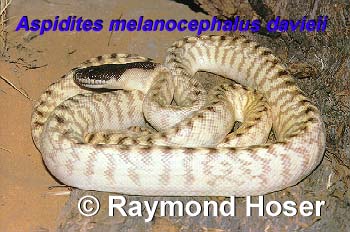
A REVISION OF THE AUSTRALASIAN PYTHONS (2000)
Hi Ray,
BTW Wulf, thanks for your agreement that the idea of lumping the various Australiasian pythons into a single genus is wrong. That corroborates the mindest of both myself and Richard Wells, who on this point (I think) speak with a united front.
Your welcome Ray!
I'm happy I could bring you both together in this particular case as in other respects you more tend to smash each others heads I never have agreed to Underwood & Stimpson's arrangement though and some of their character sets for specific taxa are simply identified wrong due to the unsuitable samples and limited sample size.
Ray, as I told you before, I tend to partly accept the arrangements you've made, but you use the wrong scientific methods and support no evidence in most parts of your papers. So they aren't really convincing (not only to me). It's nothing personal anyway.
Cheers,
Wulf
-----
http://www.leiopython.de ,
http://www.herpers-digest.com
Wulf, you are fitting the profile of those who attacked me when I produced evidence of corruption in the NSW National Parks and Wildlife Service (NPWS)(Australia).
Even after I produced two books that detailed the whole of it for all to read, with sources, the lot, my detractors claimed I had "no evidence" of this corruption.
In 1996 after winning yet another vexatious defamation claim against me by NPWS people, the then minister in charge of NPWS, Ms. Pam Allen told a press conference that I had "no evidence" to back up my claims of danger on the NSW Ski slopes, where I'd named some ski lodges as being in immediate danger. This rebuttal was (as planned) widely reported in the NSW Press as had similar denials at Christmas 1993, following publication of the book Smuggled.
That (end 1996) information, I'd received from several separate sources within NPWS and had corroborated independently. See not all who worked there were bad people.
Anyway, 9 months later "the evidence" was there to see in 18 bodies buried under the rubble of the Thredbo landslide, under two ski lodges I'd named 9 months earlier.
A later inquest by Derek Hand, confirmed everything I'd been saying for more than 20 years!!!
The rules for those (evil people) who shoot the messenger, attack a whistleblower or have some other (generally undisclosed) agenda is as follows.
A/ Never disclose your true agenda or motive, then
1/ Ignore, ignore and ignore, and then when this becomes impossible,
2/ Deny, deny, deny, (including by irrelevant argument such as "oh he has no evidence" or "he is a pedophile" and then when this becomes no longer possible, to
3/ Deride the original whistleblower (or scientist) for merely stating the obvious.
This appears the tack, you Wulf (and some others) are taking with my pythons classification.
Deny all you want, but that facts are obvious.
I had the same problem in the 1980's when I went against Cogger and declared "Liasis perthensis" a separate species to "L. childreni", which was like declaring the world round a thousand years back.
My detractors used this (now obvious fact) to allege I'd totally lost the plot!
After vilification for a decade or so, I was later derided by these same low-life's for "merely stating the obvious".
In other words I never got the credit due!
Wells and Wellington, incidentally suffered the same with their own papers in the 1980's and while I disagree with Richard on many things, including some of his descriptions (or lack of them), certain taxonomic or nomenclatural acts, etc, , the fact is that he deserves credit where due and that is why I am almost alone among his peers in Australia who accept and acknowledge his work and as a result named taxa after him and his co-author.
Who knows, maybe you Wulf will eventually give me credit for taking the bull by the horns and doing a consistent reclassification of Australian pythons in 2000 (which was well overdue) and maybe Wulf, you will actually accept the facts and the evidence as detailed in the paper … if in fact you actually read the detail and the relevant sources cited.
Armchair criticism is always welcome, but I only take heed of it's content if it is soundly based.
Otherwise I merely consign the rants to the trash can.
ALL THE BEST
Hoser 2000 (Python taxonomy - Australasia)
Kluge's phylogeny is based on morphology (although his classification is not), and quite often phylogenies that are derived from morphology differ considerably from those that are derived from molecules. Specifically what a morphologist may think is a "monophyletic" (i.e. one ancestor and all of its descendants) group often turns out to be paraphyletic (i.e. some fast evolving members have been excluded because they differ so much from their other close relatives morphologically). Therefore the verdict is still out on Kluge's phylogeny. We must await DNA data before we know how robust Kluge's morphology based phylogeny is.
Kluge tends to be a lumper. Instead of erecting/resurrecting names for contrived taxa that are morphologically indistinguishable from one another, Kluge has taken the exact opposite tact. He has lumped taxa regardless of morphological disparity. Examples of his tendency to lump include putting Chondropython viridis in the genus Morelia and Lichanura trivirgata and Calabaria reinhardtii in Charina. Unfortunately for the cladist, excessive lumping or excessive splitting are their only choices, since lumping taxa morphologically would create paraphyletic groups, which are considered unacceptable by the cladists (or Hennigians). Since cladists usually automatically support the taxonomic proposals of other cladists, it is quite amusing to see that some cladists accept both the excessive splitting of Utiger et al.'s proposal and the excessive lumping of Kluge's proposal. Personally I reject both proposals, not because they are based on Hennigian taxonomy, but because they do not do any good. None of the names erected/resurrected by Utiger et al. tells us anything new about the relationship between the ratsnakes. In fact all these new names obscure the fact that the ratsnakes are a slowly evolving group that shares a common ancestor. Kluge's excessive lumping ignores the morphological disparity between Morelia and Chondropython and also the disparity between Lichanura and Charina. It is thus not surprising to see the names Lichanura and Chondropython still being used a decade or so after Kluge attempted to invalidate them.
Because cladists like Kluge and Utiger et al. ignore morphological disparity in their classification, their proposals have generated lots of criticism and controversy. Not surprisingly, many of the cladists' proposals have been ignored or in some cases even reversed by other cladists.
Help, tips & resources quick links
Manage your user and advertising accounts
Advertising and services purchase quick links
