<?xml version="1.0" encoding="UTF-8"?>
<rdf:RDF xmlns:dc="http://purl.org/dc/elements/1.1/" xmlns:h="http://www.w3.org/1999/xhtml" xmlns:hr="http://www.w3.org/2000/08/w3c-synd/#" xmlns:rdf="http://www.w3.org/1999/02/22-rdf-syntax-ns#" xmlns="http://purl.org/rss/1.0/">
<channel rdf:about="https://forums.kingsnake.com/rss/?catid=20">
  <title>Kingsnake.com - Herpforum - Taxonomy Discussion</title>
  <link>https://forums.kingsnake.com/forum.php?catid=20</link>
  <description><![CDATA[Welcome to the Taxonomy Forum! Taxonomy is the science of identifying and naming species, and arranging them into a classification. The field of taxonomy, sometimes referred to as "biological taxonomy", revolves around the description and use of taxonomic units, known as taxa (singular taxon). A resulting taxonomy is a particular classification ("the taxonomy of ..."), arranged in a hierarchical structure or classification scheme. Here you may post messages or questions pertaining to all aspects and issues regarding Reptile and Amphibian Taxonomy. If you are a new user to this forum, please take the time to review the rules first before posting: Terms of Service.]]></description>
  <items>
    <rdf:Seq>
      <rdf:li rdf:resource="https://forums.kingsnake.com/view.php?id=2113214" />
      <rdf:li rdf:resource="https://forums.kingsnake.com/view.php?id=1959928" />
      <rdf:li rdf:resource="https://forums.kingsnake.com/view.php?id=1950320" />
      <rdf:li rdf:resource="https://forums.kingsnake.com/view.php?id=1874997" />
      <rdf:li rdf:resource="https://forums.kingsnake.com/view.php?id=1806814" />
      <rdf:li rdf:resource="https://forums.kingsnake.com/view.php?id=1781458" />
      <rdf:li rdf:resource="https://forums.kingsnake.com/view.php?id=1780280" />
      <rdf:li rdf:resource="https://forums.kingsnake.com/view.php?id=1774991" />
      <rdf:li rdf:resource="https://forums.kingsnake.com/view.php?id=1774989" />
      <rdf:li rdf:resource="https://forums.kingsnake.com/view.php?id=1774431" />
      <rdf:li rdf:resource="https://forums.kingsnake.com/view.php?id=1753519" />
      <rdf:li rdf:resource="https://forums.kingsnake.com/view.php?id=1748961" />
      <rdf:li rdf:resource="https://forums.kingsnake.com/view.php?id=1740797" />
      <rdf:li rdf:resource="https://forums.kingsnake.com/view.php?id=1610422" />
      <rdf:li rdf:resource="https://forums.kingsnake.com/view.php?id=1599101" />
      <rdf:li rdf:resource="https://forums.kingsnake.com/view.php?id=1596637" />
      <rdf:li rdf:resource="https://forums.kingsnake.com/view.php?id=1540262" />
      <rdf:li rdf:resource="https://forums.kingsnake.com/view.php?id=1532411" />
      <rdf:li rdf:resource="https://forums.kingsnake.com/view.php?id=1524595" />
      <rdf:li rdf:resource="https://forums.kingsnake.com/view.php?id=1498367" />
    </rdf:Seq>
  </items>
</channel>

<item rdf:about="https://forums.kingsnake.com/view.php?id=2113214">
  <title>Controlled Vocabulary/Taxonomy for Still</title>
  <link>https://forums.kingsnake.com/view.php?id=2113214</link>
  <description><![CDATA[<div class="rss-post"><p><strong>Original post</strong> by MichaelSmith &mdash; 2018-05-11 03:37:46 GMT</p><p>Hi,</p>
<p>I'm working on a personal project applying a digital asset tool to organize digitized photos, scans, etc. of early film ephemera. I'd rather not reinvent the wheel. Is there a taxonomy or controlled vocabulary in use for describing such material? Anything agreed upon by libraries, museums, archives?</p>
<p>Any help will be apprecited.</p>
<p>I didn't find the right solution from the Internet.</p>
<p>References:<br />
https://www.nitrateville.com/viewtopic.php?f=7&t=25364<br />
<a href="https://jobs.vidzzy.com/hire-business-video-animation-company/" target="_blank">Business video animation company</a></p>
<p>Thank you.</p></div>
<p><a href="https://forums.kingsnake.com/view.php?id=2113214">View full thread on Kingsnake.com</a></p>]]></description>
  <dc:date>2018-05-11T03:37:46+00:00</dc:date>
  <dc:creator>MichaelSmith</dc:creator>
</item>
<item rdf:about="https://forums.kingsnake.com/view.php?id=1959928">
  <title>Morelia clastolepis</title>
  <link>https://forums.kingsnake.com/view.php?id=1959928</link>
  <description><![CDATA[<div class="rss-post"><p><strong>Original post</strong> by sfprior &mdash; 2011-12-27 23:26:07 GMT</p><p>Hey! Can anyone help me decipher the conflicting info I see about the Moluccan Python?? I read, and have seen pics that show they are the only Morelia with subocular scales...Yet, most available &quot;Moluccans&quot; and those ID'd by breeders, don't have suboculars...???</p></div>
<div class="rss-post"><p><strong>Reply</strong> by UKEssayPapers &mdash; 2017-11-15 14:43:46 GMT</p><p>Now Officially Best Custom Online Essay Help and Affordable Essay Writing Services UK by essay help with expert writers. Essay Writing Help services offers 100% plagiarism free Online Essay Helping UK at cheap and affordable rates.</p>
<p><a href="http://ukessaypapers.co.uk/" target="_blank">Cheap Essay Writing Services UK - UKEssayPapers</a></p>
<p><a href="http://www.ukessaypapers.co.uk/">Education</a></p></div>
<div class="rss-post"><p><strong>Reply</strong> by sfprior &mdash; 2011-12-30 06:29:14 GMT</p><p>Got it!</p></div>
<p><a href="https://forums.kingsnake.com/view.php?id=1959928">View full thread on Kingsnake.com</a></p>]]></description>
  <dc:date>2017-11-15T14:43:46+00:00</dc:date>
  <dc:creator>sfprior</dc:creator>
</item>
<item rdf:about="https://forums.kingsnake.com/view.php?id=1950320">
  <title>Elaphe or Pantherophis?</title>
  <link>https://forums.kingsnake.com/view.php?id=1950320</link>
  <description><![CDATA[<div class="rss-post"><p><strong>Original post</strong> by apeltes &mdash; 2011-10-19 15:17:23 GMT</p><p>My fingers are raw from googling, and I can't get a definitive answer.  What does the ICZN currently recognize for North American rat snakes?  _Pantherophis_ or _Elaphe_?  I know there's plenty of debate, but I need to know which one is official right now.</p>
<p>Thanks!</p></div>
<div class="rss-post"><p><strong>Reply</strong> by CKing &mdash; 2012-09-03 08:23:03 GMT</p><p>&gt;&gt;The ICZN is simply a set of rules governing the correct publication of names and various related matters. It does not decide between alternative classifications.</p>
<p>Yes I agree with this, since the ICZN is not setup to decide whether any single taxonomic proposal has scientific merit or not.</p>
<p>&gt;&gt;If you want to know if you should call a corn snake &quot;Pantherophis guttatus&quot; or &quot;Elaphe guttata&quot;, that's a question the ICZN does not answer. You have two basic choices in answering it: 1) &quot;go with the flow&quot; and use whichever name is typically used by the people you associate with or is advocated by a particular herpetological society; 2) read the publications and make up your own mind.</p>
<p>I also agree with this.</p>
<p>&gt;&gt;Following option &quot;2&quot;, my own opinion is that &quot;Pantherophis&quot; is the correct genus for the various U.S. critters recently placed in Elaphe (except Senticolis triaspis, Bogertophis subocularis, and Bogertophis rosaliae). This opinion seems to be shared by most professional herpetologists as well, although I'm not sure how widespread it is in the hobbyist community.</p>
<p>Since you apparently claimed to have read this paper, it is unfortunate that you did not tell us why Utiger et al. is correct in resurrecting Pantherophis.  As to whether other herpetologists think it is a valid proposal, that becomes option &quot;1&quot;.  Personally I oppose the proposal because Utiger et al. did not even attempt to define each genus morphologically.  If someone were to find a new species of ratsnake somewhere in China, or perhaps the Balkans, there is no way to figure out which of Utigers dozen or so genera this new species rightfully belong.  A new phylogenetic analysis would need to be performed. Depending on the results of the new analysis, there can be wholesale changes to Utiger's taxonomy.  We may need to disqualify some of their genera, rearrange the others and name new genera.  Taxonomy based on a religious intolerance of paraphyletic taxa is not the best way to classify organisms.</p></div>
<div class="rss-post"><p><strong>Reply</strong> by CKing &mdash; 2012-09-03 08:08:26 GMT</p><p>&gt;&gt;Why and who thought it should be changed Pantherophis (what does it mean?) V</p>
<p>A few years ago, Utiger et al. published a paper using a curious mix of taxonomic characters.  They used mtDNA and hemipenis morphology to come up with a tree.  Then they base their taxonomic proposal on that particular tree and carved it up so that only holophyletic groups (groups that consist of a single common ancestor and all of its descendants) are recognized.  Since the recognition of such genera as Lampropeltis, Pituophis and Arizona renders Elaphe paraphyletic (i.e. does not include all of the descendants of a common ancestor), they then split up Elaphe into about a dozen genera, without ever defining these genera morphologically nor did they inform us how these genera differ from one another.  The generic name for most North American species is Pantherophis, according to Utiger et al.'s proposal.  Since many practicing taxonomists belong to the school of cladistics and since they share Utiger et al.'s intolerance of paraphyletic taxa, they immediately embraced the new proposal. Other, less knowledgeable people, also embraced the new proposal because they automatically assumed that the newest names must be the most correct.  Since the name Pantherophis was published in one of those lists of &quot;current scientific names&quot;, even more uninitiated people who have never read Utiger et al.'s proposal immediately assumed that Pantherophis must be the correct name.</p>
<p>The fact of the matter is that there is no official list of scientific names, because science is not a popularity contest, and there is no committee that decides whether one theory or another is proven.  The ICZN is also not in the business of arbitrating which taxonomic proposals are correct or incorrect.  Therefore the ICZN is not in any position to rule whether Pantherophis is the correct name for the North American ratsnakes like the corn snake, black ratsnake, fox snake, or Texas ratsnake.</p></div>
<div class="rss-post"><p><strong>Reply</strong> by emysbreeder &mdash; 2012-06-07 04:48:47 GMT</p><p>Why and who thought it should be changed Pantherophis (what does it mean?) V</p></div>
<div class="rss-post"><p><strong>Reply</strong> by aspidoscelis &mdash; 2012-01-13 03:39:26 GMT</p><p>Well, the answer to your question is &quot;both&quot;.</p>
<p>The ICZN is simply a set of rules governing the correct publication of names and various related matters. It does not decide between alternative classifications. Both &quot;Elaphe&quot; and &quot;Pantherophis&quot; and, for particular species, &quot;Elaphe guttata&quot; and &quot;Pantherophis guttatus&quot;, &quot;Elaphe obsoleta&quot; and &quot;Pantherophis obsoletus&quot;, etc., have, from the point of view of the rules of the ICZN, precisely equal validity.</p>
<p>If you want to know if you should call a corn snake &quot;Pantherophis guttatus&quot; or &quot;Elaphe guttata&quot;, that's a question the ICZN does not answer. You have two basic choices in answering it: 1) &quot;go with the flow&quot; and use whichever name is typically used by the people you associate with or is advocated by a particular herpetological society; 2) read the publications and make up your own mind. Following option &quot;2&quot;, my own opinion is that &quot;Pantherophis&quot; is the correct genus for the various U.S. critters recently placed in Elaphe (except Senticolis triaspis, Bogertophis subocularis, and Bogertophis rosaliae). This opinion seems to be shared by most professional herpetologists as well, although I'm not sure how widespread it is in the hobbyist community.</p></div>
<div class="rss-post"><p><strong>Reply</strong> by millsgotskills &mdash; 2012-01-10 00:51:49 GMT</p><p>99% sure its elaphe.  I assume you mean a 'black rat snake' or a 'chicken snake' as is common in the southeast usa where I live.  I do think its elaphe, though. It always used to irritate me when I'd see cornsnakes such as okeetee corns, elaphe guttata, being put into the same exaxt category as ratsnakes such as the elaphes. I might be totally wrong tho.</p></div>
<p><a href="https://forums.kingsnake.com/view.php?id=1950320">View full thread on Kingsnake.com</a></p>]]></description>
  <dc:date>2012-09-03T08:23:03+00:00</dc:date>
  <dc:creator>apeltes</dc:creator>
</item>
<item rdf:about="https://forums.kingsnake.com/view.php?id=1874997">
  <title>Manouria research.</title>
  <link>https://forums.kingsnake.com/view.php?id=1874997</link>
  <description><![CDATA[<div class="rss-post"><p><strong>Original post</strong> by emysbreeder &mdash; 2010-11-17 16:18:12 GMT</p><p>I am in need of close up profile Head pictures of adult Manouria emys emys and M.e. phayrei for a paper on a revised description of the two subspecies. email for details or respond here. Thanks Vic Morgan<br />
<img class="img-fluid" src="http://gallery.kingsnake.com/data/12367PA075837abc-med.jpg"></p></div>
<p><a href="https://forums.kingsnake.com/view.php?id=1874997">View full thread on Kingsnake.com</a></p>]]></description>
  <dc:date>2010-11-17T16:18:12+00:00</dc:date>
  <dc:creator>emysbreeder</dc:creator>
</item>
<item rdf:about="https://forums.kingsnake.com/view.php?id=1806814">
  <title>Basilisk in Mindo (Ecuador) - ID?</title>
  <link>https://forums.kingsnake.com/view.php?id=1806814</link>
  <description><![CDATA[<div class="rss-post"><p><strong>Original post</strong> by LGphotography &mdash; 2010-04-17 14:31:50 GMT</p><p>Hi,<br />
I've photographed a Basilisk in Mindo (Ecuador), could you help me ti ID it? What are the sepecies which occur there?</p>
<p>Here it is:</p>
<p>http://pic.atpic.com/1773069</p>
<p>Thanks!<br />
<img class="img-fluid" src="http://188.40.123.85/atpic2/5562/34709/0/1773551/0.jpg" alt="Image"></p></div>
<div class="rss-post"><p><strong>Reply</strong> by HaroldD &mdash; 2010-04-27 20:46:34 GMT</p><p>This is Basiliscus galeritus. Nice photo</p></div>
<p><a href="https://forums.kingsnake.com/view.php?id=1806814">View full thread on Kingsnake.com</a></p>]]></description>
  <dc:date>2010-04-27T20:46:34+00:00</dc:date>
  <dc:creator>LGphotography</dc:creator>
</item>
<item rdf:about="https://forums.kingsnake.com/view.php?id=1781458">
  <title>Scinax fuscovaria or Scinax x-signatus?</title>
  <link>https://forums.kingsnake.com/view.php?id=1781458</link>
  <description><![CDATA[<div class="rss-post"><p><strong>Original post</strong> by LGphotography &mdash; 2010-01-24 11:25:14 GMT</p><p>Hello,</p>
<p>Could you help me to ID this small frog found in the bathroom in Jericoacoara (Ceará, North-eastern Brazil).<br />
It is about 2 or 3 cm long.</p>
<p>http://88.198.21.167/atpic2/5562/31024/ppjdsuwflrijfnxictll/1684994/0.jpg<br />
http://88.198.21.167/atpic2/5562/31024/ppjdsuwflrijfnxictll/1684998/0.jpg</p>
<p>I guess it could be Scinax fuscovaria or Scinax x-signatus but I am not sure...</p>
<p><img class="img-fluid" src="http://88.198.21.167/atpic2/5562/31024/ppjdsuwflrijfnxictll/1684994/0.jpg" alt="Image"><br />
<a href="http://88.198.21.167/atpic2/5562/31024/ppjdsuwflrijfnxictll/1684998/0.jpg">Image</a></p></div>
<div class="rss-post"><p><strong>Reply</strong> by LGphotography &mdash; 2010-01-27 19:20:00 GMT</p><p>Thanks for your answer. I would agree, but I did not know there were in the very North-Esat of Brazil...</p></div>
<div class="rss-post"><p><strong>Reply</strong> by HaroldD &mdash; 2010-01-27 18:59:11 GMT</p><p>This appears to be Scinax fuscovarius.  Note the specific name is now fuscovariUS, Scinax being masculine.</p></div>
<p><a href="https://forums.kingsnake.com/view.php?id=1781458">View full thread on Kingsnake.com</a></p>]]></description>
  <dc:date>2010-01-27T19:20:00+00:00</dc:date>
  <dc:creator>LGphotography</dc:creator>
</item>
<item rdf:about="https://forums.kingsnake.com/view.php?id=1780280">
  <title>Fish &amp; Wildlife to add pythons to Lacey</title>
  <link>https://forums.kingsnake.com/view.php?id=1780280</link>
  <description><![CDATA[<div class="rss-post"><p><strong>Original post</strong> by PHFaust &mdash; 2010-01-21 17:09:31 GMT</p><p>In yet another attack on the reptile community, today Secretary of the Interior Ken Salazar announced that the U.S. Fish and Wildlife Service will look to list the &quot;Big 9&quot; from the USGS survey published in October on the Lacey Act as injurious species:</p>
<p>Secretary of the Interior Ken Salazar today announced the U.S. Fish and Wildlife Service will propose to list the Burmese python and eight other large constrictor snakes that threaten the Everglades and other sensitive ecosystems as &quot;injurious wildlife&quot; under the Lacey Act.</p>
<p>Salazar made the announcement at the Port of New York, which serves as the largest point of entry in the nation for imports of wildlife and wildlife products. Last year, U.S. Fish and Wildlife Service Inspectors at John F. Kennedy International Airport handled more than 27, 000 separate wildlife shipments valued at more than $1 billion, or 16 percent of all U.S. wildlife imports.</p>
<p>The proposal, which will be open to public comment before Salazar makes a final decision, would prohibit importation and interstate transportation of the animals.</p>
<p>&quot;The Burmese python and these other alien snakes are destroying some of our nation’s most treasured – and most fragile – ecosystems,&quot; Salazar said. &quot;The Interior Department and states such as Florida are taking swift and common sense action to control and eliminate the populations of these snakes, but it is an uphill battle in ecosystems where they have no natural predators. If we are going to succeed, we must shut down the importation of the snakes and end the interstate commerce and transportation of them.&quot;</p>
<p>This allows us yet another opportunity to refute the bad science involved with both HR2811 and S373. The FWS will publish the proposed rule change in the federal register in early February.</p>
<p>Once it's published, the public will have sixty days to offer comment, after which the waiting game begins again.</p>
<p>As soon as the comment period opens, we'll let you know what action to take, and where.</p>
<p>Even now, it's not too late -- or too early! -- to make calls, reach out to your senators and representatives. Let them know this proposal is based on bad science, that you're part of the reptile community and that you vote!<br />
<a href="http://www.pethobbyist.com/sitenews/index.php?/archives/470-Fish-Wildlife-to-add-pythons-to-Lacey-Act.html">Fish &amp; Wildlife to add pythons to Lacey act</a></p>
<p>-----<br />
Cindy Steinle<br />
<a href="mailto:phfaust@pethobbyist.com">phfaust@pethobbyist.com</a><br />
PHFaust<br />
<a href="http://www.facebook.com/pages/kingsnakecom/56444808084?ref=ts" target="_blank">Visit kingsnake on Facebook!</a><br />
<a href="http://twitter.com/kingsnake_com" target="_blank"> Follow Kingsnake on Twitter!</a></p></div>
<p><a href="https://forums.kingsnake.com/view.php?id=1780280">View full thread on Kingsnake.com</a></p>]]></description>
  <dc:date>2010-01-21T17:09:31+00:00</dc:date>
  <dc:creator>PHFaust</dc:creator>
</item>
<item rdf:about="https://forums.kingsnake.com/view.php?id=1774991">
  <title>Help ID - Toad or Frog</title>
  <link>https://forums.kingsnake.com/view.php?id=1774991</link>
  <description><![CDATA[<div class="rss-post"><p><strong>Original post</strong> by LGphotography &mdash; 2010-01-06 22:44:04 GMT</p><p>Hi again,<br />
Thanks for your help to ID the toad I asked for...</p>
<p>There is one more I need to ID, photographed in the same place (Maranhão, North-eastern Brazil).</p>
<p>It is small (about the length of a finger), and was found on the bathroom of a simple house...</p>
<p>Thank you for your help!<br />
<img class="img-fluid" src="http://88.198.21.167/atpic2/5562/31024/ppjdsuwflrijfnxictll/1673674/0.jpg" alt="Image"><br />
<a href="http://88.198.21.167/atpic2/5562/31024/ppjdsuwflrijfnxictll/1673674/0.jpg">Image</a></p></div>
<p><a href="https://forums.kingsnake.com/view.php?id=1774991">View full thread on Kingsnake.com</a></p>]]></description>
  <dc:date>2010-01-06T22:44:04+00:00</dc:date>
  <dc:creator>LGphotography</dc:creator>
</item>
<item rdf:about="https://forums.kingsnake.com/view.php?id=1774989">
  <title>Help ID - Lizard</title>
  <link>https://forums.kingsnake.com/view.php?id=1774989</link>
  <description><![CDATA[<div class="rss-post"><p><strong>Original post</strong> by LGphotography &mdash; 2010-01-06 22:36:49 GMT</p><p>Hello,<br />
Can you help me ti ID this lizar, photographed in Maranhão, North-eastern Brazil:</p>
<p>Thanks!<br />
<img class="img-fluid" src="http://88.198.21.167/atpic2/5562/31024/ppjdsuwflrijfnxictll/1673478/0.jpg" alt="Image"><br />
<a href="http://88.198.21.167/atpic2/5562/31024/ppjdsuwflrijfnxictll/1673478/0.jpg">Image</a></p></div>
<p><a href="https://forums.kingsnake.com/view.php?id=1774989">View full thread on Kingsnake.com</a></p>]]></description>
  <dc:date>2010-01-06T22:36:49+00:00</dc:date>
  <dc:creator>LGphotography</dc:creator>
</item>
<item rdf:about="https://forums.kingsnake.com/view.php?id=1774431">
  <title>Help ID - huge toad</title>
  <link>https://forums.kingsnake.com/view.php?id=1774431</link>
  <description><![CDATA[<div class="rss-post"><p><strong>Original post</strong> by LGphotography &mdash; 2010-01-05 16:38:23 GMT</p><p>Hello,</p>
<p>Can anyone help me to ID this big toad, photographed at night in maranhão (North-Eastern brazil)?</p>
<p>An other image here: http://pic.atpic.com/1673480/ppjdsuwflrijfnxictll</p>
<p>If not, can you indicate an other forum where I could ask?<br />
<img class="img-fluid" src="http://u5562.direct.atpic.com/31024/ppjdsuwflrijfnxictll/1673479/0.jpg" alt="Image"><br />
<a href="http://pic.atpic.com/1673480/ppjdsuwflrijfnxictll">Image</a></p></div>
<div class="rss-post"><p><strong>Reply</strong> by LGphotography &mdash; 2010-01-07 12:03:46 GMT</p><p>As I've been given various possible names for it, I had one more photo, maby could help to ID:</p>
<p>(thanks for the MP!)<br />
<img class="img-fluid" src="http://u5562.direct.atpic.com/31024/ppjdsuwflrijfnxictll/1673679/0.jpg" alt="Image"></p></div>
<div class="rss-post"><p><strong>Reply</strong> by LGphotography &mdash; 2010-01-06 21:56:26 GMT</p><p>Thanks a lot!</p></div>
<div class="rss-post"><p><strong>Reply</strong> by gila91 &mdash; 2010-01-06 20:06:05 GMT</p><p>Rococo toad (Bufo schneideri) formerly known as Bufo paracnemis.</p>
<p>http://amphibiaweb.org/cgi-bin/amphib_query?query_src=aw_lists_genera_&table=amphib&where-genus=Bufo&where-species=schneideri</p></div>
<div class="rss-post"><p><strong>Reply</strong> by lep1pic1 &mdash; 2010-01-06 05:23:18 GMT</p><p>Is that a rococo toad nice<br />
-----<br />
Archie Bottoms</p></div>
<div class="rss-post"><p><strong>Reply</strong> by oid &mdash; 2010-01-06 01:58:39 GMT</p><p>Bufo marinus? Bufo paracnemis(sp?)?</p></div>
<p><a href="https://forums.kingsnake.com/view.php?id=1774431">View full thread on Kingsnake.com</a></p>]]></description>
  <dc:date>2010-01-07T12:03:46+00:00</dc:date>
  <dc:creator>LGphotography</dc:creator>
</item>
<item rdf:about="https://forums.kingsnake.com/view.php?id=1753519">
  <title>Origin of snakes</title>
  <link>https://forums.kingsnake.com/view.php?id=1753519</link>
  <description><![CDATA[<div class="rss-post"><p><strong>Original post</strong> by CKing &mdash; 2009-10-23 22:55:49 GMT</p><p>Those who are interested in the origin of snakes may be interested in the following paper:</p>
<p>http://www.kingsnake.com/aho/pdf/menu3/rickshine/originofsnakes.pdf</p>
<p>This paper investigates eye anatomy and found that snake eyes share many characteristics with those of aquatic vertebrates, suggesting and corroborating earlier phyologenetic analyses and fossil data linking snakes with marine reptiles called mossasaurs.  The oldest known snake fossils had legs, and they were marine animals.  These snakes also had the macrostomatan condition.  Therefore the microstomatan snakes likely evolved their fixed jaws and small gapes secondarily from a macrostomatan condition.  Indeed, detailed investigations of different microstomatan snakes show that their jaws are highly speciliazed and differ markedly from those of lizards, and therefore supportively of derived, rather than primitive conditions.  Snakes therefore appeared to have evolved in the marine environment and the blind and burrowing snakes evolved later from marine ancestors.</p></div>
<div class="rss-post"><p><strong>Reply</strong> by CKing &mdash; 2009-12-22 08:22:38 GMT</p><p>&gt;&gt;If you do not mind me asking, how many &quot;nails&quot; are there?  I do remember one of the many squamata clades having snakes and mosasaurs together, but then with a &quot;?&quot; in another.  What other papers would you suggest reading?<br />
&gt;&gt;<br />
&gt;&gt;I have also heard that some genetic data has snakes closest to Lacertiforms....  I need to find that source though...<br />
&gt;&gt;-----<br />
&gt;&gt;-Bradley</p>
<p>Yes indeed, some DNA studies find snakes closest to the Iguanians. Here is an example:</p>
<p>TED M. TOWNSEND,ALLAN LARSON, EDWARD LOUIS, AND J. ROBERT MACEY 2004.  Molecular Phylogenetics of Squamata: The Position of Snakes, Amphisbaenians, and Dibamids, and the Root of the Squamate Tree.  Syst. Biol. 53(5):735–757</p>
<p>These authors found that &quot;Snakes are grouped with iguanians, lacertiforms, and anguimorphs, but are not nested within anguimorphs.&quot;</p>
<p>However, a more recent paper, based on highly reliable SINE data, shows that anguimorph lizards is the sister group of snakes.  See fig. 4 in the link below:<br />
<a href="http://www.museum.lsu.edu/Austin/PDFs%20Austin/Squamate%20SINEs%20JME%202006.pdf">Sauria SINEs: Novel Short Interspersed Retroposable Elements That Are Widespread in Reptile Genomes</a></p></div>
<div class="rss-post"><p><strong>Reply</strong> by bskinner88 &mdash; 2009-12-21 20:39:22 GMT</p><p>If you do not mind me asking, how many &quot;nails&quot; are there?  I do remember one of the many squamata clades having snakes and mosasaurs together, but then with a &quot;?&quot; in another.  What other papers would you suggest reading?</p>
<p>I have also heard that some genetic data has snakes closest to Lacertiforms....  I need to find that source though...<br />
-----<br />
-Bradley</p></div>
<div class="rss-post"><p><strong>Reply</strong> by CKing &mdash; 2009-12-07 08:16:57 GMT</p><p>&gt;&gt;Good paper.  It added another perspective, but did not help with snakes relationship to everything else.  Finding out that scolecophidia may not be the most primitive is interesting.  This is going to give me something to talk about with my classmates and professor, thank you.<br />
&gt;&gt;-----<br />
&gt;&gt;-Bradley</p>
<p>Quite the contrary. The eye anatomy is another nail in the coffin of the burrowing origin of snakes.  Since the oldest known snakes, with legs, are of marine origin, one must look naturally at marine reptiles as the possible ancestor of snakes.  The marine mosasauroid lizards, closely allied to the monitor lizards, are perfectly positioned as the prime candidates for snake ancestor.</p></div>
<div class="rss-post"><p><strong>Reply</strong> by bskinner88 &mdash; 2009-11-28 16:18:15 GMT</p><p>Good paper.  It added another perspective, but did not help with snakes relationship to everything else.  Finding out that scolecophidia may not be the most primitive is interesting.  This is going to give me something to talk about with my classmates and professor, thank you.<br />
-----<br />
-Bradley</p></div>
<p><a href="https://forums.kingsnake.com/view.php?id=1753519">View full thread on Kingsnake.com</a></p>]]></description>
  <dc:date>2009-12-22T08:22:38+00:00</dc:date>
  <dc:creator>CKing</dc:creator>
</item>
<item rdf:about="https://forums.kingsnake.com/view.php?id=1748961">
  <title>VNM Press: New species of snake unveiled</title>
  <link>https://forums.kingsnake.com/view.php?id=1748961</link>
  <description><![CDATA[<div class="rss-post"><p><strong>Original post</strong> by  &mdash; 2009-10-11 16:16:06 GMT</p><p><u><b>VIETNAM NET</b></u> (Hanoi) 29 September 09  <i>New species of snake unveiled in Lam Dong </i><br />
Russian and Vietnamese scientists have announced the discovery of a new species of snake in Loc Bac forest in the Central Highlands province of Lam Dong.<br />
The new species is named <i>Coluberoelaps</i> and belongs to the water-snake family and has neither fangs nor poison.<br />
This snake looks like a cross between a water snake (<i>Coluber</i>) and copperhead (<i>Elaps)</i> so its Latin name is the combination of the two – Coluberoelaps.<br />
Its species name is named after Dr. Nguyen Van Sang, from the Institute for Ecology and Creature Resources, who found the specimen and to honor his great contribution in research of reptile and amphibians in Vietnam.<br />
The Vietnamese name of this snake is <i>nguyen van sang</i> snake and its full scientific name is <i>Coluberoelaps nguyenvansangi Orlov, Kharin, Ananjeva, Nguyen & Nguyen</i>, 2009.<br />
The standard specimen of this snake was collected in Lam Dong in 2003 in a biodiversity survey funded by the World Wildlife Fund Indochina.<br />
<a href="http://english.vietnamnet.vn/tech/2009/09/871137/">New species of snake unveiled in Lam Dong</a></p></div>
<div class="rss-post"><p><strong>Reply</strong> by CKing &mdash; 2009-11-05 07:37:13 GMT</p><p>&gt;&gt;CK;<br />
&gt;&gt;Not split but totally new and overlooked.   I suspect that the new species of snake in the genus Contia could be considered as 'cryptic' in the sense that unless one is aware of how to distinguish the Forest Sharp-tailed Snake from the Common Sharp-tailed Snake (Contia tenuis), superficially they appear to be identical.  That is the reason that since the late 1800's, the newly described species was overlooked by many herpetologists.<br />
&gt;&gt;</p>
<p>Perhaps, but this species was once considered rare, and therefore not too many specimens were available in museum collections.  Besides, it is not one of those glamorous species that attract the attention of both hobbyists and professionals alike.  Hence it is not as well studied as large and flashy species like Lampropeltis, Elaphe and Pituophis.</p>
<p>&gt;&gt; When the sexes are treated separately, there is no overlap between the two species in two traits, relative tail length and in number of caudals.  Although there is overlap in the number of ventrals between the two species, there is a very significant difference between the two species in that character as well.  All other differences are more subtle.  In addition, DNA testing demonstrated considerable divergence between the two species.<br />
&gt;&gt;</p>
<p>Yes, according to the following paper, the two Contia clades diverged from each other for about 5 million years.</p>
<p>http://www.cnah.org/pdf_files/647.pdf</p>
<p>I think one scenario for their divergence may be through plate tectonics.  The area occupied by the coastal Contia clade was originally in Southern California 5 million years ago.  As this piece of land move north, it probably isolated these snakes from the rest of the population, and they may not have met until quite recently, just like the rubber boas of the Northwestern and Sierra Nevada subclades.  In the rubber boa, the Northwestern subclade appeared to have invaded the northern Sierra Nevada.  In Contia and Lampropeltis zonata, the Sierra Snakes have invaded the coastal areas.</p>
<p>Interestingly, both L. zonata and the coastal clade of Contia are absent from Marin County. Unlike L. zonata, however, the Santa Cruz and Mendocino Co. populations of Contia are the same, whereas the Mendocino and Santa Cruz populations of L. zonata are not.</p>
<p>&gt;&gt;Our paper will report on a third group (subspecies?) of Sharp-tailed Snake that occurs in the southern Sierra Nevada Mts. of Tulare County.<br />
&gt;&gt;<br />
&gt;&gt;As you are aware, the use of SVL has been a` time honored convention in herpetology.  I have long held the view that such a convention is flawed in that for the most part, many herpetologists have ignored the tails of snakes as if the appendage was immaterial.  I would go further by stating that it likely the Forest Sharp-tailed Snake was overlooked for so long due to the SVL convention.  <br />
&gt;&gt;<br />
&gt;&gt;Richard F. Hoyer</p>
<p>SVL is useful because in many lizards and salamanders, tail autotomy is prevalent.  In these species, if we measure only TL (total length) then it could be misleading since the tail may be lost or in the process of being regenerated.  However, I disagree with you that herpetologists have ignored the tail, because tail lengths and the number of caudals are routinely reported in the literature.  Of course, the short-tailed snake (Stilosoma) is named for its tail.  Rather, I believe that the sharp-tailed snake was overlooked by many herpetologists because it was once considered rare, it was not well represented in museum collections and because it is not a glamorous species.</p></div>
<div class="rss-post"><p><strong>Reply</strong> by RichardFHoyer &mdash; 2009-11-02 16:49:14 GMT</p><p>CK;<br />
Not split but totally new and overlooked.   I suspect that the new species of snake in the genus Contia could be considered as 'cryptic' in the sense that unless one is aware of how to distinguish the Forest Sharp-tailed Snake from the Common Sharp-tailed Snake (Contia tenuis), superficially they appear to be identical.  That is the reason that since the late 1800's, the newly described species was overlooked by many herpetologists.</p>
<p>When the sexes are treated separately, there is no overlap between the two species in two traits, relative tail length and in number of caudals.  Although there is overlap in the number of ventrals between the two species, there is a very significant difference between the two species in that character as well.  All other differences are more subtle.  In addition, DNA testing demonstrated considerable divergence between the two species.</p>
<p>Our paper will report on a third group (subspecies?) of Sharp-tailed Snake that occurs in the southern Sierra Nevada Mts. of Tulare County.</p>
<p>As you are aware, the use of SVL has been a` time honored convention in herpetology.  I have long held the view that such a convention is flawed in that for the most part, many herpetologists have ignored the tails of snakes as if the appendage was immaterial.  I would go further by stating that it likely the Forest Sharp-tailed Snake was overlooked for so long due to the SVL convention.</p>
<p>Richard F. Hoyer</p></div>
<div class="rss-post"><p><strong>Reply</strong> by CKing &mdash; 2009-10-23 09:14:57 GMT</p><p>&gt;&gt;Sometime next year, there should be a paper in Copea which will describe a new species of snake discovered here in N. Am.  <br />
&gt;&gt;<br />
&gt;&gt;Richard F. Hoyer</p>
<p>That is interesting.  Is it a cryptic species (perhaps the sharp-tailed snake being split into two) or is it a totally new species that has never been described before?</p></div>
<div class="rss-post"><p><strong>Reply</strong> by RichardFHoyer &mdash; 2009-10-15 16:29:51 GMT</p><p>Sometime next year, there should be a paper in Copea which will describe a new species of snake discovered here in N. Am.</p>
<p>Richard F. Hoyer</p></div>
<p><a href="https://forums.kingsnake.com/view.php?id=1748961">View full thread on Kingsnake.com</a></p>]]></description>
  <dc:date>2009-11-05T07:37:13+00:00</dc:date>
  <dc:creator></dc:creator>
</item>
<item rdf:about="https://forums.kingsnake.com/view.php?id=1740797">
  <title>Help ID - American or Southern Toad?</title>
  <link>https://forums.kingsnake.com/view.php?id=1740797</link>
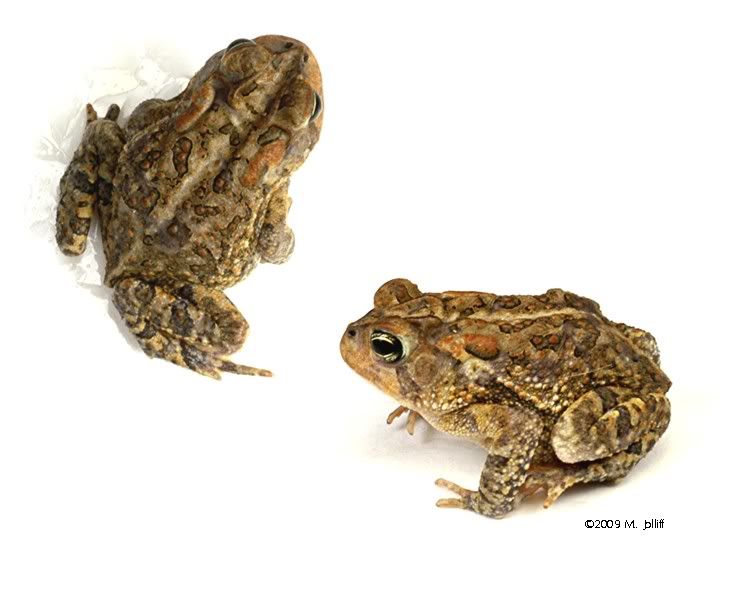
  <description><![CDATA[<div class="rss-post"><p><strong>Original post</strong> by SurfinSerpents &mdash; 2009-09-18 01:39:31 GMT</p><p>A 50's guide described this an American but it was found on an island south of Charleston, SC within the range of the Southern Toad. I am not familiar with Toads and haven't found an updated source to classify this critter. Any help would be appreciated PLUS there's a surprise ending for the the correct answer(s). Thankssss....<br />
<img class="img-fluid" src="http://i107.photobucket.com/albums/m287/Thesnakemachine/snake/Toadoverview11x14750.jpg"></p></div>
<div class="rss-post"><p><strong>Reply</strong> by docop &mdash; 2010-01-06 03:12:29 GMT</p><p>Southern Toad (Bufo terrestris).</p></div>
<p><a href="https://forums.kingsnake.com/view.php?id=1740797">View full thread on Kingsnake.com</a></p>]]></description>
  <dc:date>2010-01-06T03:12:29+00:00</dc:date>
  <dc:creator>SurfinSerpents</dc:creator>
</item>
<item rdf:about="https://forums.kingsnake.com/view.php?id=1610422">
  <title>C. bottae taxonomy</title>
  <link>https://forums.kingsnake.com/view.php?id=1610422</link>
  <description><![CDATA[<div class="rss-post"><p><strong>Original post</strong> by RichardFHoyer &mdash; 2008-10-13 16:46:47 GMT</p><p>A week ago Sunday, I spoke to the grad student that preformed a second and more comprehensive mtDNA study on the Rubber Boa.  He indicated it would OK to reveal the major findings.  I am throwing them out so perhaps others can hash over just what may have transpired with respect to the biogeographical history of the species and the taxonomic implications.</p>
<p>Along with incorporating the 38 samples used in the first mtDNA study published by Rodriguez-Robles, Stewart, and Papenfuss, Rick (who is Glenn Stewart's last grad student as Glenn is now retired) ran tests on 74 additional samples with much greater geographical representation that in the first study..</p>
<p>If I have my information correct, Rick ran the same type of mtDNA tests used by Javier Rodriguez-Robles.  And as expected, he ended up finding two major clades, the Southern and Northern clades with the latter being composed of two major groupings, the Northwestern and Sierra Nevada subclades.  However, there were three major new developments that emerged.</p>
<p>1)  Beside occurring in the San Bernardino and San Jacinto Mts., a boa population of the Southern clade also occurs on the Southern Kern Plateau in southern Tulare County.  <br />
2)  There is likely to be no break between the Sierra Nevada and Northwestern subclades as two specimens well south of the Mt. Lassen region from Butte County aligned with the Northwestern subclade.<br />
3)  Thirty-two samples with the same haplotype were dispersed from northern California to Oregon, Washington, B.C., Montana, Idaho, Utah, and I believe Nevada.</p>
<p>The ramifications of point #1 above are extensive and intriguing.</p>
<p>Richard F. Hoyer</p></div>
<div class="rss-post"><p><strong>Reply</strong> by CKing &mdash; 2008-12-18 14:09:36 GMT</p><p>&gt;&gt;CK<br />
&gt;&gt;Too busy to comment at this time.  Will get back to this thread later.<br />
&gt;&gt;<br />
&gt;&gt;RF Hoyer</p>
<p>Happy Holidays, Richard.</p></div>
<div class="rss-post"><p><strong>Reply</strong> by RichardFHoyer &mdash; 2008-12-15 16:59:35 GMT</p><p>CK<br />
Too busy to comment at this time.  Will get back to this thread later.</p>
<p>RF Hoyer</p></div>
<div class="rss-post"><p><strong>Reply</strong> by CKing &mdash; 2008-12-11 14:04:16 GMT</p><p>&gt;&gt;CK,</p>
<p>&gt;&gt;But unless the raw mtDNA data somehow can ascertain the relative ages of populations, then I have to concede that perhaps my original views were in error and there exists the possibility that the dwarf morph evolved from the large morph.  <br />
&gt;&gt;<br />
&gt;&gt;I know so little about mtDNA research but I can envision one potential piece of evidence that may indicate the relative age of populations.  You can give me your thoughts about the following:   If a large number of mtDNA haplotypes exist in a relatively small geographical region, wouldn't that indicate that over time, a large number of mutational events had occurred?   In contrast, if there are much fewer mtDNA haplotypes in a geographical region, would that possibly indicate a much younger age?&gt;&gt;</p>
<p>Hi, Richard, I gave a pretty long winded and convoluted answer in my original answer to your post.  So I will try to be more coherent, if not more concise, this time.  Since life began some 3.5 billion years or so ago, it has evolved into the present bewildering variety.  Since all life can be traced back to a single ancestor, all organisms have the same absolute age.  When we talk about the age of a population, we are really talking about how long ago a population has diverged from a common ancestor, either with another population of the same species or a different species.  To measure how long ago two organisms last shared a common ancestor, biologists turn to something called genetic distance.  Genetic distances are best measured using molecules because the rates of morphological evolution vary greatly.  Some organisms change very little morphologically over hundreds of millions of years, and living individuals look almost identical to fossils that are hundreds of millions of years old.  The coelacanth is a good example.  Some organisms can change drastically over a short period of time.  So it is not possible to know how long since two organisms last shared a common ancestor by measuring morphological disparity.</p>
<p>Molecules, however, evolve more or less in a clock like manner, because chance mutations occur randomly and the probability of a mutation during DNA/RNA replication is quite similar for a vast majority of organisms.  Of course many molecules change very little over the eons because changes can make them non-functional. The chlorophyll molecule is a very good example of an adaptive and slowly evolving molecule that resists changes.  Other molecules are less vital and they can change more rapidly.  The late Allan Wilson of UC Berkeley, a pioneer in molecular systematics, realized this.  He and his students contributed a great deal to the understanding of the relationships and relative ages of divergence among different living organism by measuring molecular distance using more or less neutral molecules.  To do this, he searched for molecules that are not vital to an organism's survival. One of those molecules he found was serum albumin, a protein with no known function, and which can mutate rather freely.  Another molecule he found is mtDNA.</p>
<p>By measuring or estimating the genetic distance (i.e. the number of differences in their nucleotide sequences) using mtDNA or other molecules, the amount of time that has elapsed since two organisms last shared a common ancestor can be estimated.  The theory is that when two organisms share the same parent, their mtDNA molecules are identical.  As these organisms become separated geographically and evolved, the number of nucleotide differences would increase through time.  Of course, the molecular clock must be calibrated using fossils, so there are disagreements among biologists as to how fast a molecule may have evolved over time, if their calibrations are different.</p>
<p>The genetic distance between umbratica and the northern subclades (Northwestern plus Sierra Nevada subclades) is the greatest within C. bottae.  The distance between the Northwestern subclade and the Sierra Nevada subclade is much smaller.  And of course the genetic distance between any two populations within the Sierra Nevada subclade is among the smallest seen within this species. The distances between any 2 population of umbratica is also very short, suggesting a relatively recent common ancestor.</p>
<p>The last common ancestor of umbratica and the 2 northern subclades is the ancestor to all of the C. bottae populations existing today.  Was this common ancestor found in southern California or the southern Sierra Nevada?  We may never know the answer to that question because we cannot observe history but we can only infer it.  Chances are, however, that this ancestor lived in southern California because the likely ancestor of both C. bottae and Lichanura trivirgata is the Mexican dwarf boa.  Therefore it is a simpler (but not necessarily correct) and more likely explanation is that Exiliboa gave rise to C. bottae in Southern California before retreating south into Mexico due to climatic and geological changes occurring in the area of northwestern Mexico.</p>
<p>If umbratica is ancestral to the 2 northern subclades, then the ancestral form of C. bottae is more likely to be the dwarf form.  Again, this would be the simpler (but again not necessarily correct) and more likely explanation, since Exiliboa is a small snake that thrives in mesic environments.  If the large morph is ancestral, then we would need Exiliboa to give rise to a large morph snake that is perhaps better adapted to xeric environments (like those boas found in eastern Oregon for example), and from this large morph animal, a small morph snake adapted to a more mesic environment re-evolved.  Evolutionary biologists call this an evolutionary reversal.  Reversals are of course possible and in some instances they are even probable.  In most other cases, they are less likely because for biological organisms, it is often not possible to &quot;go home again.&quot;  For an organism like a whale, an evolutionary reversal back to life on land is probably not possible because whales have become so well adapted to living in the sea and because they have lost almost all traces of their hindlimbs.</p>
<p>Therefore, on the basis of genetic distance, biogeography and the fact that reversal is less likely, I believe that the dwarf morph is the ancestral form of C. bottae.</p></div>
<div class="rss-post"><p><strong>Reply</strong> by CKing &mdash; 2008-12-10 22:55:51 GMT</p><p>&gt;&gt;CK,<br />
&gt;&gt;Just to add a bit more to our 'brainstorming'.session.<br />
&gt;&gt;The sample of vouchers I examined from the Santa Cruz Mts. indicates that population belongs to the large morph.  So due to geographical proximity, up to now I too considered it likely that the boa population in Monterey County (and San Luis Obispo Co.) would belong to the large form as well.   Yet I always try to remain open to alternative explanations.<br />
&gt;&gt; <br />
&gt;&gt;When I went through my folders on the vouchers I had examined from the Smithsonian, CAS, and MVZ collections, I found just the three Monterey Co. females all of which were somewhat small.  Not much can be gleaned from such a small sample so here we have another region that needs to be explored.  <br />
&gt;&gt;<br />
&gt;&gt;Seems to me that at one time, the mountainous areas of Santa Cruz and Monterey Counties were separate by intrusion of the sea into the central valley.  So I wonder if that barrier may have any implication on the nature of those two populations.&gt;&gt;</p>
<p>The mountains of Monterey and Santa Cruz Counties are separated by the Salina Valley, which is probably an effective barrier to the dispersion of some species.  For example, the northern and southern newts currently assigned to Taricha torosa are allopatric, separated by the Salinas Valley, with one population to the north and the other to the south, without any evidence of mixing.  On the other hand, this area appears to be ineffective in isolating L. zonata populations from one another.</p>
<p>&gt;&gt;And like yourself, I originally 'assumed' that the dwarf morph was ancestral.  After confirming that the San Bernardino boa population was indeed a dwarf form of the species, in about 1996, I gave considerable thought to the issue large and dwarf morphs.  I devised a hypothesis to explain the likely selection factors whereby the large morph evolved from the dwarf form.  At the time, I passed those thoughts on to Glenn Stewart and Dr. Robert Mason here at Oregon State U. but haven't concerned myself with that aspect since.&gt;&gt;<br />
&gt;&gt;But unless the raw mtDNA data somehow can ascertain the relative ages of populations, then I have to concede that perhaps my original views were in error and there exists the possibility that the dwarf morph evolved from the large morph.&gt;&gt;</p>
<p>It is highly unlikely, but certainly possible, that the large morph is ancestral.  MtDNA data can in fact ascertain the relative ages of populations.  It is a rather neutral molecule, which means nucleotide substitution is due almost entirely to chance, much like radioactive decay. The molecular clock is of course not as accurate as the atomic clock, and of course the molecular clock must be calibrated with the fossil record, which is highly fragmentary.  What we see in the rubber boa is that the umbratica lineage is the oldest.  How do we know?  Basically we know because we see a large number of differences in the mtDNA compared to other rubber boa populations.  The greater the number of these mutations, the greater the amount of time has elapsed since two populations last shared a common ancestor.  All of the populations within umbratica, OTOH, share very few differences.  That means all umbratica populations share a very recent common ancestor.  That is how I came to the conclusion that umbratica almost became extinct in the recent past.</p>
<p>Similarly, if you take two boas from, say, the Sierra Nevada subclade, you will see that they are also very similar to each other in their mtDNA, suggesting again that these populations share a relatively recent ancestor.  But if you compare the mtDNA of the Sierra Nevada subclade and Northwestern subclade, you will see a greater number of differences.  The greatest number of differences in mtDNA can be found if you compare the mtDNA of an umbratica with the mtDNA of a Northwestern subclade boa, or if you compare umbratica with the Sierra Nevada subclade.  It shows that the umbratica lineage has been isolated from other boas forthe longest period of time.  This lineage has accumulated a large number of mutations in its mtDNA that are unique to itself and not shared with any other lineage.  It is this large number of nucleotide substitutions that has enabled Rodriguez-Robles to estimate the age of the rubber boa as a species.  It takes time to accumulate all of these mutations.  Therefore umbratica appears the oldest lineage. Other lineages, such as the Sierra Nevada subclade, are younger, because they share a number of mutations with the Northwestern subclade.</p>
<p>&gt;&gt;I know so little about mtDNA research but I can envision one potential piece of evidence that may indicate the relative age of populations.  You can give me your thoughts about the following:   If a large number of mtDNA haplotypes exist in a relatively small geographical region, wouldn't that indicate that over time, a large number of mutational events had occurred?   In contrast, if there are much fewer mtDNA haplotypes in a geographical region, would that possibly indicate a much younger age?  &gt;&gt;</p>
<p>See above for how lineage age is determined.  If you see a large number of haplotypes in an area, it may simply mean that the populations within a particular area are isolated from each other, so that they are unable to mix freely.  For example, there are several distinct mtDNA haplotypes within Ambystoma tigrinum californiense within its relatively limited range.  That only indicates that A. t. californiense from different parts of its range has been prevented from interbreeding freely probably because of geographical barriers.  To measure lineage age, one must examine the number of nucleotide substitutions that have occurred, not the number of haplotypes that may be present.</p>
<p>&gt;&gt;Should there be a large number of different mtDNA haplotypes and few identical haplotypes in the San Bernardino and San Jacinto Mts. in relation to other regions, then perhaps relative age can be inferred.  Perhaps the ratio of unique to identical haplotypes per given region is such a clue.  The existence of 32 identical haplotypes from N. Calif. to B.C. to Montana, Utah and Nevada may suggest such a scenario. &gt;&gt;</p>
<p>The haplotypes of the Northwestern subclade are not identical.  The differences in mtDNA sequence between populations within this subclade are relatively large. If you look at fig. 4 of Rodriguez-Robles, you will see that the branch lengths between different populations are much longer within this subclade than in either the Sierra Nevada subclade or in umbratica. That means there are many more mtDNA sequence differences between a boa from Santa Cruz County and Berkeley than there are differences between  a boa from El Dorado County and Madera County.  All of the boas of the Northwestern subclade, however, do share a more recent common ancestor with each other they they do with either the Sierra Nevada subclade or umbratica.</p>
<p>&gt;&gt;If the frequency of different and identical haplotypes per geographical area can be interpreted as an indication of age, then here again is another argument for testing much larger samples per any geographical area.&gt;&gt;</p>
<p>Unfortunately it cannot.  If you go to New York City, you will see a lot of different mtDNA haplotypes among the human beings living there.  It does not mean that New York City has one of the oldest human populations in the world.  If you go to Africa, however, you will see that the mtDNA differences between two Africans from different parts of Africa are often much greater than the mtDNA differences between two non Africans anywhere else in the world.  That means all non-Africans in the human species share a more recent common ancestor with each other than many Africans do with each other.  Normally, we would expect to see the same in umbratica.  We should see lots of old lineages within umbratica, comparable to what we see among Africans.  But instead we only see a single ancient umbratica lineage with lots of newly evolved branches at the top.  That is indicative of a recent bottleneck, or population crash within umbratica.  Without the presence of the umbratica lineage, scientists may have concluded that C. bottae is a much younger species than it really is.</p>
<p>&gt;&gt;As a side note, as I was looking up the information on the specimens I have examined from Monterey County, I ran across three more old vouchers that originated within the Mt. Lassen area.  One specimen from the Smithsonian was collected along Mill Creek in northeastern Tehama County due south of Lassen Peak.  Then the CAS collection has two specimens collected in 1926 and 1949 with the former coming from the Lake Almanor peninsula and the other from near Westwood.  This latter specimens is just about half way between the Northwestern subclade Eagle Lake specimen and Sierra Nevada subclade Quincy specimen in Javier's study.<br />
&gt;&gt;<br />
&gt;&gt;It would be my guess that Javier and others entertained the notion of a break in the distribution of the species based on the distance of 120 km they thought occurred between the two subclades, the specimen from Eagle Lake in Lassen County and specimen from Nevada County.  Had they realized that their specimen from near Quincy in Plumas County<br />
&gt;&gt;cut that distance about in half, I don't think they would have indicated a break occurred in the distribution of the species.<br />
&gt;&gt;<br />
&gt;&gt;I get a sense they may have rushed the publication a bit.  And it still strikes me odd that none of the reviewers caught that error.  I suspect the reviewers were versed in aspects of molecular research and not in natural history.<br />
&gt;&gt;<br />
&gt;&gt;Richard F. Hoyer</p>
<p>Well, biology is a highly specialized discipline nowadays.  It is often difficult for one researcher working on one species to judge the work of another researcher working on another species.  Besides, professional biologists are often very busy, teaching, doing research, and so on, so reviewing papers often does not get the amount of time or attention that it deserves.</p></div>
<div class="rss-post"><p><strong>Reply</strong> by RichardFHoyer &mdash; 2008-12-10 19:09:56 GMT</p><p>CK,<br />
Just to add a bit more to our 'brainstorming'.session.<br />
The sample of vouchers I examined from the Santa Cruz Mts. indicates that population belongs to the large morph.  So due to geographical proximity, up to now I too considered it likely that the boa population in Monterey County (and San Luis Obispo Co.) would belong to the large form as well.   Yet I always try to remain open to alternative explanations.</p>
<p>When I went through my folders on the vouchers I had examined from the Smithsonian, CAS, and MVZ collections, I found just the three Monterey Co. females all of which were somewhat small.  Not much can be gleaned from such a small sample so here we have another region that needs to be explored.</p>
<p>Seems to me that at one time, the mountainous areas of Santa Cruz and Monterey Counties were separate by intrusion of the sea into the central valley.  So I wonder if that barrier may have any implication on the nature of those two populations.</p>
<p>And like yourself, I originally 'assumed' that the dwarf morph was ancestral.  After confirming that the San Bernardino boa population was indeed a dwarf form of the species, in about 1996, I gave considerable thought to the issue large and dwarf morphs.  I devised a hypothesis to explain the likely selection factors whereby the large morph evolved from the dwarf form.  At the time, I passed those thoughts on to Glenn Stewart and Dr. Robert Mason here at Oregon State U. but haven't concerned myself with that aspect since.</p>
<p>But unless the raw mtDNA data somehow can ascertain the relative ages of populations, then I have to concede that perhaps my original views were in error and there exists the possibility that the dwarf morph evolved from the large morph.</p>
<p>I know so little about mtDNA research but I can envision one potential piece of evidence that may indicate the relative age of populations.  You can give me your thoughts about the following:   If a large number of mtDNA haplotypes exist in a relatively small geographical region, wouldn't that indicate that over time, a large number of mutational events had occurred?   In contrast, if there are much fewer mtDNA haplotypes in a geographical region, would that possibly indicate a much younger age?</p>
<p>Should there be a large number of different mtDNA haplotypes and few identical haplotypes in the San Bernardino and San Jacinto Mts. in relation to other regions, then perhaps relative age can be inferred.  Perhaps the ratio of unique to identical haplotypes per given region is such a clue.  The existence of 32 identical haplotypes from N. Calif. to B.C. to Montana, Utah and Nevada may suggest such a scenario.</p>
<p>If the frequency of different and identical haplotypes per geographical area can be interpreted as an indication of age, then here again is another argument for testing much larger samples per any geographical area.</p>
<p>As a side note, as I was looking up the information on the specimens I have examined from Monterey County, I ran across three more old vouchers that originated within the Mt. Lassen area.  One specimen from the Smithsonian was collected along Mill Creek in northeastern Tehama County due south of Lassen Peak.  Then the CAS collection has two specimens collected in 1926 and 1949 with the former coming from the Lake Almanor peninsula and the other from near Westwood.  This latter specimens is just about half way between the Northwestern subclade Eagle Lake specimen and Sierra Nevada subclade Quincy specimen in Javier's study.</p>
<p>It would be my guess that Javier and others entertained the notion of a break in the distribution of the species based on the distance of 120 km they thought occurred between the two subclades, the specimen from Eagle Lake in Lassen County and specimen from Nevada County.  Had they realized that their specimen from near Quincy in Plumas County<br />
cut that distance about in half, I don't think they would have indicated a break occurred in the distribution of the species.</p>
<p>I get a sense they may have rushed the publication a bit.  And it still strikes me odd that none of the reviewers caught that error.  I suspect the reviewers were versed in aspects of molecular research and not in natural history.</p>
<p>Richard F. Hoyer</p></div>
<div class="rss-post"><p><strong>Reply</strong> by CKing &mdash; 2008-12-07 17:50:44 GMT</p><p>&gt;&gt;I also have examined that specimen which measured 496 mm.  It also was a female with a scarred tail tip.  Factoring in a 10% shrinkage factor, the specimen's live stretched length would have been 551 mm and below the est.. maximum length of dwarf form females.  So at this point, it is not known if either the San Luis Obispo or Monterey County boa populations are of the large or dwarf form.  The only known is that the one Monterey Co. specimen tested aligned with the Northwestern subclade.&gt;&gt;</p>
<p>On second thought, Richard, there is of course the possibility that some of the basal lineages of the Northwestern clade has retained the small morph genotype/phenotype of umbratica.</p>
<p>If that is the case, then the large morph may have evolved much farther north than San Luis Obispo or Monterey County.  If that is the case, it would be one more piece of evidence that the small morph is the ancestral condition in C. bottae.  This would not be a surprise since the basal most members are small morph, and the likely ancestor of C. bottae, namely Exiliboa, is a small snake.  If it is indeed the case, it also further supports the theory that the large morph genotype and phenotype evolved at least twice within C. bottae, once in the Northwestern subclade somewhere north of San Luis Obispo County and a second time in the area of Tulare County.</p>
<p>Therefore I shouldn't have taken for granted that the Monterey and/or San Luis Obispo County specimens are large morph boas simply because they belong to the Northwestern subclade.  Thanks for the heads up.</p></div>
<div class="rss-post"><p><strong>Reply</strong> by CKing &mdash; 2008-12-06 20:07:35 GMT</p><p>&gt;&gt;CK.,<br />
&gt;&gt;You mention the large morph Northwestern Clade 'no doubt' migrated west to the San Luis Obispo area and northward to Monterey Co. and beyond.  If that scenario were true, then a number of events needed to take place in order to explain the current situation in which the dwarf morph of the Sierra Nevada subclade currently occupies extreme southwestern Kern County.&gt;&gt;</p>
<p>Yes, there is no doubt about it because the Central Valley is not the route of this migration, and because the Sierra Nevada appears to be closed to the migration of both L. zonata and C. bottae until after the coastal populations of both of these species have migrated north.  The Sierra Nevada populations of both C. bottae and L. zonata have very little differences in their mtDNA over the entire range of this mountain from north to south, suggesting a recent divergence from their respective common ancestors and a rapid expansion of their ranges for both species.</p>
<p>After L. z. multifasciata and Northwestern subclade C. bottae made their ways north along the coast, the area around Kern, Ventura, Los Angeles, Orange, San Diego, and Santa Barbara Counties probably experienced climatic changes that made them uninhabitable for both C. bottae and L. zonata. The absence of C. bottae from Ventura and Santa Barbara Counties would support this scenario.  There is also geological evidence that the San Francisco Peninsula moved north from southern California due to plate tectonics. Perhaps this movement isolated the coastal populations of both species from their southern Sierra Nevada relatives.</p>
<p>As I said before, the current Kern County Populations of C. bottae (samples 30-32) are rather recent lineages, derived from the ancestor of sample #26, which is located in Tulare County.  This is evidence of a past contraction of the range of C. bottae in this area.  Otherwise, we would see the exact reverse: the Tulare County boas should have been derived from the Kern County boas instead.</p>
<p>&gt;&gt;Also, nothing is known about San Luis Obispo population  --- whether it belongs to the Northwestern or Sierra Nevada subclade or if it is of the dwarf or large form.  As a matter of fact, very little is known about the boas that occur in Monterey County. &gt;&gt;<br />
&gt;&gt;My printout from CAS shows only 5 boas from that county, all collected from near Carmel in the early 1900s.  Three boas collected in 1904 and 1905 were lost to the earthquake and fire in S. F.  I have examined the other two specimens that were collected in 1908 and 1915.  &gt;&gt;</p>
<p>The Monterey area is probably little different from the nearby Santa Cruz County.  Both C. bottae and L. zonata are known from this area.  I am surprised so few specimens come from this county.  Where L. zonata has been recorded in this area, C. bottae should also be present.</p>
<p>&gt;&gt;Both boas were females of 466 mm and 425 mm stretched lengths respectively.  The preservation process shrinks specimens to varying degrees with larger specimens incurring a greater percentage of shrinkage than smaller specimens.  If those two specimen incurred 10% shrinkage, their stretched live lengths would still be below the lengths of the largest dwarf females estimated to be about 558 mm (22 inches).   Not having them in hand now, there is no way of determining whether those females were subadults, adults, or older adults.  The only  clue is that both had scarred tail tips suggesting they were adults.   But even some subadult boas incur scarring of their tail tips.&gt;&gt;</p>
<p>If you like you can probably make a trip next year to the area and find your own specimens to determine their morph.</p>
<p>&gt;&gt;The only specimen in the MVZ collection from Monterey County was the DOR specimen found on Hwy. 1 in 1998 used in Javier's study.  Depending on where specimens from Monterey County occur in other institutional collections (Smithsonian?), that particular boa my have established a new southerly distribution of the species in Monterey County.  As best as I can determine from my de Lorme atlas software map, that specimens was found about 40 miles south of the CAS Carmel specimens and about 30 miles north of the San Luis Obispo County line. &gt;&gt;</p>
<p>C. bottae has also been reported in the Landels-Hill Big Creek Preserve, operated by UC.  If you contact the biology department of UC Santa Cruz, perhaps they may have some specimens from this preserve, whether they are live or pickled. Students from UC Santa Cruz make frequent trips to this Preserve to conduct field research.</p>
<p>&gt;&gt;I also have examined that specimen which measured 496 mm.  It also was a female with a scarred tail tip.  Factoring in a 10% shrinkage factor, the specimen's live stretched length would have been 551 mm and below the est.. maximum length of dwarf form females.  So at this point, it is not known if either the San Luis Obispo or Monterey County boa populations are of the large or dwarf form.  The only known is that the one Monterey Co. specimen tested aligned with the Northwestern subclade.&gt;&gt;</p>
<p>Perhaps a bigger sample will show that they belong to the large morph.</p>
<p>&gt;&gt;There is a distance of about 70 miles between the specimen Javier tested in Monterey County and the San Luis Obispo County boa population.  A distance of about 90 miles exists between that population and the nearest known boa population to the southeast on Mt. Abel west of Mt. Pinos.  Almost a tossup as to which boa population the San Luis Obispo boas are related although it would be my guess that the more likely scenario is they would align with the Northwestern subclade. <br />
&gt;&gt;<br />
&gt;&gt;Richard F. Hoyer</p>
<p>Even though the distances are about the same, one must not forget that the Kern County boas have only recently (geologically speaking) arrived at their current positions from their ancestors' at Tulare County.  At one time the gap between the Tulare County dwarf morph boas and any Northwestern subclade boa wer probably much greater.  Further, the lack of boas between San Luis Obispo and southern Monterey Counties may be due to patchy nature of suitable habitat, difficult terrain (for human collectors), lack of roads in suitable areas and the remoteness of the area.</p></div>
<div class="rss-post"><p><strong>Reply</strong> by RichardFHoyer &mdash; 2008-12-06 17:44:43 GMT</p><p>CK.,<br />
You mention the large morph Northwestern Clade 'no doubt' migrated west to the San Luis Obispo area and northward to Monterey Co. and beyond.  If that scenario were true, then a number of events needed to take place in order to explain the current situation in which the dwarf morph of the Sierra Nevada subclade currently occupies extreme southwestern Kern County.</p>
<p>Also, nothing is known about San Luis Obispo population  --- whether it belongs to the Northwestern or Sierra Nevada subclade or if it is of the dwarf or large form.  As a matter of fact, very little is known about the boas that occur in Monterey County.</p>
<p>My printout from CAS shows only 5 boas from that county, all collected from near Carmel in the early 1900s.  Three boas collected in 1904 and 1905 were lost to the earthquake and fire in S. F.  I have examined the other two specimens that were collected in 1908 and 1915.</p>
<p>Both boas were females of 466 mm and 425 mm stretched lengths respectively.  The preservation process shrinks specimens to varying degrees with larger specimens incurring a greater percentage of shrinkage than smaller specimens.  If those two specimen incurred 10% shrinkage, their stretched live lengths would still be below the lengths of the largest dwarf females estimated to be about 558 mm (22 inches).   Not having them in hand now, there is no way of determining whether those females were subadults, adults, or older adults.  The only  clue is that both had scarred tail tips suggesting they were adults.   But even some subadult boas incur scarring of their tail tips.</p>
<p>The only specimen in the MVZ collection from Monterey County was the DOR specimen found on Hwy. 1 in 1998 used in Javier's study.  Depending on where specimens from Monterey County occur in other institutional collections (Smithsonian?), that particular boa my have established a new southerly distribution of the species in Monterey County.  As best as I can determine from my de Lorme atlas software map, that specimens was found about 40 miles south of the CAS Carmel specimens and about 30 miles north of the San Luis Obispo County line.</p>
<p>I also have examined that specimen which measured 496 mm.  It also was a female with a scarred tail tip.  Factoring in a 10% shrinkage factor, the specimen's live stretched length would have been 551 mm and below the est.. maximum length of dwarf form females.  So at this point, it is not known if either the San Luis Obispo or Monterey County boa populations are of the large or dwarf form.  The only known is that the one Monterey Co. specimen tested aligned with the Northwestern subclade.</p>
<p>There is a distance of about 70 miles between the specimen Javier tested in Monterey County and the San Luis Obispo County boa population.  A distance of about 90 miles exists between that population and the nearest known boa population to the southeast on Mt. Abel west of Mt. Pinos.  Almost a tossup as to which boa population the San Luis Obispo boas are related although it would be my guess that the more likely scenario is they would align with the Northwestern subclade.</p>
<p>Richard F. Hoyer</p></div>
<div class="rss-post"><p><strong>Reply</strong> by CKing &mdash; 2008-12-04 17:44:17 GMT</p><p>&gt;&gt;CK,<br />
&gt;&gt;Actually, the two specimens I cited from the MVZ collection are old.   The specimen from Silver Lake in Lassen county is MVZ 18187 collected in 1935 and the Morgan Springs (Ranch) specimen from Tehama County is MVZ #14946 collected before I was born in 1932.<br />
&gt;&gt;<br />
&gt;&gt;Richard F. Hoyer</p>
<p>Then obviously they overlooked the evidence.  I don't know when the MVZ computerized its records, but back in the mid 1990's computer literacy was not very widespread, and the Internet was not available to the general public until the mid-1990's. Back then most people were surfing the Net with 14.4K modems.</p>
<p>In Lord Kelvin's case radioactivity was not discovered until half a century or so after he made his famous calculation of the age of the earth.  Of course he also ignored all the geological processes which must have taken much longer than his calculations would suggest.</p></div>
<div class="rss-post"><p><strong>Reply</strong> by CKing &mdash; 2008-12-04 14:09:39 GMT</p><p>&gt;&gt;CK.,<br />
&gt;&gt;Of interest is the notion you proposed that at some point in time, the Rubber Boa may have dispersed southward in part of its range. &gt;&gt;</p>
<p>Yes, the rubber boa probably dispersed southward to northern Baja California and probably occupied the mountains of San Diego County, Orange County, Coastal Los Angeles County (Santa Monica and San Gabriel Mountains) as well as Ventura County and Santa Barbara County in the past.  The large morph Northwestern subclade no doubt migrated from southern Kern County to coastal San Luis Obispo and Monterey Counties via the Sierra Madre but currently there is a distributional gap between the Northwestern subclade and the Kern County boas.</p>
<p>The Rosy Boa originated in northern Baja California according to a recent mtDNA paper, and IMO, this population was once indistinguishable from the rubber boa.  Climatic changes probably caused most populations of the rubber boa in Southern California to become extinct.  Similarly, we see evidence of such extinction in L. zonata.  There almost certainly were L. zonata in the mountains of San Diego Co., Los Angeles Co., San Bernardino County and Orange County at the time the rubber boa occupied this same area, but they all became extinct along with the rubber boa in these mountains.</p>
<p>Instead of seeing L. zonata lineages that rival those of L. z. agalma and L. z. multifasciata in lineage age, which is what is expected if there were no past extinction event, all of the Southern California populations assignable to L. z. parvirubra and L. z. pulchras are very recent lineages derived from L. z. agalma.  In fact, the extinction of L. zonata in southern California was even more complete than Charina bottae.</p>
<p>C. bottae managed to hang on, but barely, in the San Bernardino or San Jacinto Mountains.  All of the C. bottae populations of these two mountain areas have only recently diverged from a single common ancestor according to mtDNA, suggesting that C. bottae was reduced to a very small population in one of these mountains in the relatively recent past.  If biologists think that the southern Rubber boa is endangered now, they might have thought that it was extinct if they can travel back in time when there was probably just a single small population hanging on for dear life.</p>
<p>&gt;&gt;  Going one step further, perhaps at one time, all of the mountainous regions in Kern, Ventura, Los Angeles, San Bernardino, and Riverside Counties (and south into Mexico) of S. Calif. may have been too warm and dry for the existence of C. bottae. &gt;&gt;</p>
<p>That is probable.  Not only C. bottae, but L. zonata, as well as the blotched form of Ensatina, show signs that they had at one time became extinct or have severely limited distributions in these areas.</p>
<p>&gt;&gt;Could it be possible that the only remaining refuge for the species was in the high elevations of the southern Sierras in Tulare and Inyo Counties (Mt. Whitney region) and it was from there that the species then expanded in all directions when suitable environmental conditions returned to the mountainous regions to the south.&gt;&gt;<br />
&gt;&gt;That is, I now wonder if the species was once extinct in the San Bernardino and San Jacinto Mts. (and elsewhere in S. Calif.) and those areas were recolonized from the dwarf morph that occurs in the southern Kern Plateau in Tulare County. &gt;&gt;</p>
<p>It is certainly possible but not probable.  The Tulare County boas are a relatively recent lineage (with the possible exception of the recently discovered umbratica haplotype).  If C. bottae migrated from Tulare to San Bernardino County, then we should see small morph snakes with the umbratica haplotype in Southern Kern County.  Instead, we see haplotypes that are more derived than #26 in these localities.  The San Bernardino and San Jacinto Mountain populations are all descended from a common ancestor very recently, but this common ancestor is very different than sample #26 of Tulare County.</p>
<p>&gt;&gt;Perhaps the newest results indicate the reverse, that the dwarf Southern Clade boas in the Kern Plateau arose from the population in the San Bernardino Mts. It seems you have mentioned that age and lineage can be inferred from the raw mtDNA results or am I wrong in that respect?&gt;&gt;</p>
<p>I haven’t seen the new data.  It will depend on how the Tulare Co. specimen with the umbratica haplotype is related to the other boas and to San Bernardino County boas.   It is certainly possible that the San Bernardino Mt. Boas are derived from the Tulare County boa with the umbratica haplotype, but the haplotypes of the Kern County boas (samples #30-32) argue against this scenario.</p>
<p>&gt;&gt;Arguing against the north to south dispersal scenario is that the Mt. Pinos population seems to be closer morphologically (scale counts and configurations) to the San Bernardino boa population than the dwarf boas from Breckenridge Mt.  to the north.  On the other hand, just this past year, I did find a few boas from Mt. Pinos with maximum dorsal scale row counts in the 44 - 46 range which overlap the lower range of the large morph boas from the Sierras.  That scenario does suggest an influence from more northern populations.<br />
&gt;&gt;<br />
&gt;&gt;The sample of dwarf boas I have examined from the Kern Plateau is only about 8 - 10 specimens.   So at this point, it is not possible to make a reliable comparison of scale counts and head scale configurations between that population and the populations that occur in the San Bernardino Mts.and elsewhere.  At any rate, up to now, I had only been thinking of how the Southern Clade dwarf boas dispersed northward from the San Bernardino Mts. to the Kern Plateau and not the reverse.<br />
&gt;&gt;<br />
&gt;&gt;Your point about having greater representation in areas were clades or subclades were likely to meet was the same argument I presented to Rick and Glenn.  And that is why they agreed to test additional samples from the area near Mt. Lassen, from the southern and northern part of the Greenhorn Mts., and from the S. Kern Plateau in which the dwarf vs. large morph scenario was also at play.<br />
&gt;&gt;<br />
&gt;&gt;And another intriguing aspect of the species is what mechanism(s) are at play that has kept the two morphs reasonably distinct in the Sierra Nevada Mts.?   That is, why hasn't the large morph over-run the dwarf form in the southern Greenhorn Mts. and on the southern Kern Plateau?  Or conversely, is the dwarf form expanding its distribution into large morph territory?<br />
&gt;&gt;<br />
&gt;&gt;Richard F. Hoyer</p>
<p>According to the new mtDNA data you disclosed, it appeared that the Northwestern subclade has successfully invaded the northern Sierra Nevada Mountains, and it seems to be outcompeting  the Sierra Mountain subclade because the Sierra Nevada Mountain subclade has not dispersed into Northwestern subclade territory.  This pattern is the exact reversal of the L. zonata dispersal.  In L. zonata, the Sierra Nevada subspecies (L. z. multicincta) has invaded territory used to be occupied by L. z. multifasciata, which shows one remnant population in the vicinity of Ashland, Jackson Co. Oregon.  Evidence of L. z. multifasciata influence is the large intergrade zone between L. z. “zonata” and L. z. multicincta, based on morphological grounds.  All of the Northern California specimens in the range of L. z. “zonata” have haplotypes belonging to the Sierra Mountain sublclade.  That means L. z. “zonata” is actually either  L. z. multicincta or L. z. multicincta x L. z. multifasciata.</p>
<p>The Northwestern subclade is probably geographically isolated from the Kern County boas.  There appears to be a large gap between the southernmost Northwestern subclade specimen in San Luis Obispo County and the northernmost small morph Kern County speciments.  That would probably account for the ability of the small morph to persist in this area.  It is shielded from the Northwestern subclade, the most successful lineage within C. bottae.  Although some of the Tulare County boas are “large morph,” this particular morph appears to have evolved independently of the Northwestern subclade, since it evolved after the Northwestern subclade last shared a common ancestor with sample #26 and all other Sierra Nevada subclade snakes.  Perhaps the Sierra Nevada “large morph” is a more benign competitor and it is able to coexist with the small morph.  The Northwestern subclade, for whatever reason, has managed to invade the Sierra Nevada Mountains while preventing the Sierra Nevada subclade from making excursions into its territory.  To this date, there is no data to suggest that they can coexist at the same locality.</p>
<p>In the past, I have suggested that it is possible that the Northwestern subclade may have evolved into a different species.  However, in view of the gap (now gone) in the distribution of the Sierra Nevada and Norhwestern subclades, there was no data to show whether they have evolved reproductive isolation.  I now believe that this question may need to be re-examined in view of new data that shows the Northwestern subclade outcompeting the Sierra Nevada subclade at the intersection of their distribution. Is it possible that the Northwestern subclade individuals simply do not recognize the Sierra Nevada subclade as conspecific and vice versa, therefore there is no intergradation?  Or is the sample too small to show evidence of intergradation?  Or is it possible that the Northwestern subclade intergrades with the Sierra Nevada subclade but the hybrids are maladaptive?  At the same time, the Northwestern subclade seems to be better competitors against the Sierra Nevada subclade.  Could it be a combination of both factors which has allowed the Northwestern subclade to expand its range at the expense of the Sierra Nevada subclade.</p>
<p>Could it be body size that allowed the Northwestern subclade to dominate?  The record length for L. zonata has been reported in a specimen from the Sierra Nevada Mountains.  That means L. z. multicincta probably was able to evolve a larger body size than L. z. multifasciata.  The larger body size may have allowed L. z. multicincta to outcompete L. z. multifasciata in Oregon and Northern California north of Sonoma County.  Perhaps larger body size allowed the Northwestern subclade of the rubber boa to gain an upper hand on the Sierra Nevada subclade?</p></div>
<p><a href="https://forums.kingsnake.com/view.php?id=1610422">View full thread on Kingsnake.com</a></p>]]></description>
  <dc:date>2008-12-18T14:09:36+00:00</dc:date>
  <dc:creator>RichardFHoyer</dc:creator>
</item>
<item rdf:about="https://forums.kingsnake.com/view.php?id=1599101">
  <title>Atractaspis</title>
  <link>https://forums.kingsnake.com/view.php?id=1599101</link>
  <description><![CDATA[<div class="rss-post"><p><strong>Original post</strong> by Mark_in_SE_Wisc &mdash; 2008-09-17 04:39:29 GMT</p><p>In layman's terms (since I know very little about taxonomy and don't comprehend much of the scientific articles on the subject), could someone please explain the current hypothesis (multiple hypotheses?) about how Atractaspis (stiletto snakes) evolved and what other current snakes are most closely related to them? They seem like pretty interesting snakes.</p></div>
<div class="rss-post"><p><strong>Reply</strong> by CKing &mdash; 2008-11-27 01:25:25 GMT</p><p>&gt;&gt;In layman's terms (since I know very little about taxonomy and don't comprehend much of the scientific articles on the subject), could someone please explain the current hypothesis (multiple hypotheses?) about how Atractaspis (stiletto snakes) evolved and what other current snakes are most closely related to them? They seem like pretty interesting snakes.&gt;&gt;</p>
<p>It is difficult to figure out how a species may have evolved.  History cannot be observed directly.  Even recent human history is often shrouded in mystery.  Keeping that in mind, scientists can use different facts to find out which species are the closest relatives of Atractaspis.  These facts include morphology, behavior, geography and of course protein and DNA similarities to other species.  Different facts may result in different hypothesis being proposed, so often there is no scientific consensus.</p>
<p>There is one paper which places Atractaspis in the Elapidae, which is a family that includes the coral snakes, cobras, and venomous sea snakes.  The authors of this paper point out that some authors have classified Atractaspis as a viperid, a colubrid snake or an independent lineage by other taxonomists in the past. But since vipers, elapids and colubrids are closely related families of snakes, this sort of disagreement is not surprising. Heise et al.'s tree places Atractaspis as the sister taxon (closest relative) of the genus Bungarus, snakes that are commonly known as kraits.</p>
<p>Reference:<br />
Philip J. Heise, Linda R. Maxson, Herndon G. Dowling, and S. Blair Hedges 1994.  Higher-Level Snake Phylogeny Inferred from Mitochondrial DNA Sequences of 12s rRNA and 16s rRNA Genes. Molecular Biology and Evolution, Vol 12, 259-265.</p></div>
<p><a href="https://forums.kingsnake.com/view.php?id=1599101">View full thread on Kingsnake.com</a></p>]]></description>
  <dc:date>2008-11-27T01:25:25+00:00</dc:date>
  <dc:creator>Mark_in_SE_Wisc</dc:creator>
</item>
<item rdf:about="https://forums.kingsnake.com/view.php?id=1596637">
  <title>Polyphyletic or Paraphyletic?</title>
  <link>https://forums.kingsnake.com/view.php?id=1596637</link>
  <description><![CDATA[<div class="rss-post"><p><strong>Original post</strong> by apeltes &mdash; 2008-09-11 21:34:00 GMT</p><p>Hypothetical taxon: frogs   birds</p>
<p>Is this a polyphyletic group, or is it paraphyletic?</p>
<p>Thanks.</p></div>
<div class="rss-post"><p><strong>Reply</strong> by CKing &mdash; 2008-10-06 16:23:21 GMT</p><p>&gt;&gt;I would say the point is that paraphyletic taxa preserve mistakes and traditions.&gt;&gt;</p>
<p>Paraphyletic taxa are not &quot;mistakes.&quot; Polyphyletic taxa are mistakes.  When uncovered, polyphyletic taxa are removed from the classification.  For example, Pachydermata, a polylphyletic taxon consisting of elephants, hippos and rhinos, is no longer recognized even though it is an old taxon.  Paraphyletic taxa are actually the inevitable result of the process of evolution.  If you don't understand it, that is okay.  I will explain.</p>
<p>Turn the clock back to an early stage in the history of life, when there is only a single genus and a few related species, all of them not very different from one another.  Move forward a couple of million years, and we see a new species which is different from all the other species existing at the time.  A taxonomist is now faced with the decision of whether to continue recognizing only a single genus or place the new distinct species in a second genus.  Recognizing a second genus automatically causes the old genus to become paraphyletic.  Is the erection of a new genus &quot;subjective?&quot;  Yes, certainly.  Is it bad?  If you are a cladist, you would probably think it is a bad decision because you don't like paraphyletic taxa.</p>
<p>So, what should be done? One genus or two genera?  Of course, whether taxonomists call these groups of species one genus or two genera has no effect on the welfare of these species.  The only reason why we even bother to consider the question of one genus or two genera is because of convenience. It is far more convenient to refer to all the species found in one genus using the name of the genus, instead of having to refer to all of the species by name.  Hence, the reason we classify is that it helps us communicate with each other.  So, what does the dogmatic belief that paraphyletic taxa are not acceptable has to do whether a classification is useful or not?  Yes it does.  That is because if we do not recognize paraphyletic taxa, then we cannot recognize a second genus at all.  All life on each therefore cannot be classified in more than one all encompassing genus without violating the no paraphyletic taxa rule.</p>
<p>&gt;&gt; Paraphyletic taxa only make sense if people wish to base phylogeny on subjective perceptions.&gt;&gt;</p>
<p>Certainly.  One must rely on subjectivity when judging amounts of differences between any 2 species.  But how else can we decide whether and how to classify organisms unless we rely on judgment? Should we flip a coin or play a game of musical chairs to decide whether one species should be classified in one genus or another?  How is coin flipping going to result in a better classification? Flipping coins is very objective, because there is a 50-50 chance of tail or head.  So, you worship objectivity.  Unfortunately, objectivity is not a cure all.</p>
<p>&gt;&gt;For example: many can accept a taxon made up of species with bony shells, hollow venomous fangs, rattles, hemipenes, and heat-sensing facial pits... but not fur or feathers.&gt;&gt;</p>
<p>As I said, taxonomy is a democracy.  If you think it is stupid to recognize a taxon that shares the synapomorphy of fur or a taxon sharing the synapomorphy of feathers, then you can certainly publish a taxonomic proposal to disqualify these taxa. BTW, hollow fangs have evolved independently in the elapids and the crotalids. So, it is a convergent character that cannot be used to define a taxon.  Thought you may want to exclude hollow fangs from your argument the next time you make it.  Also, fangs are not themselves venomous, but they are used to inject secretions from the venom gland that is located next to the teeth.</p></div>
<div class="rss-post"><p><strong>Reply</strong> by CKing &mdash; 2008-10-06 14:50:17 GMT</p><p>&gt;&gt;Pet shops, zoos, and middle schools.&gt;&gt;</p>
<p>Pet shops and zoos may have both reptiles and birds in their collection.  I am not sure why middle schools are included in your list.  Is it the highest level of science education you have achieved?  Based on your posts, that appears to be the case.</p></div>
<div class="rss-post"><p><strong>Reply</strong> by CKing &mdash; 2008-10-06 14:44:05 GMT</p><p>&gt;&gt;The funny thing is after all his claims about how the proposal for including aves within repltilia was rejected by most, I decided to pull a couple of my old herp texts off the shelf and see what the experts think.  According to Zug (1993) aves is ranked within reptilia, same with Pough (1998).  So who are the people who have rejected placing aves within reptilia?&gt;&gt;</p>
<p>Ever heard of ornithology?  Ever heard of Ernst Mayr, an ornithologist, among other things?  Most ornithologists still consider Class Aves separate from Class Reptilia, for example.  Find me an article or book in which S. J. Gould classifies birds as reptiles.  There isn't any.</p>
<p>Have you ever read any articles within Copeia, Herpetologica or Journal of Herpetology?  I don't see any article about &quot;avian reptiles&quot; within the covers of these journals.  If birds are indeed reptiles, then bird biology should be taught by herpetologists in universities.  The most recent edition of the fiel guide &quot;Reptiles and Amphibians of Western North America&quot; excludes birds.  Have you ever heard of Dr. Robert C. Stebbins, herpetologist?</p>
<p>Did Pough or Zug include birds or any aspect of bird biology in their texts?  If you don't have a copy of R. L. Carroll's &quot;Vertebrate Paleontology and Evolution,&quot; then please go to the library.  Turn to page 624; it reads &quot;Class Aves&quot;.  Turn to page 615; it reads &quot;Class Reptilia.&quot;</p>
<p>Ignorance is not power.</p></div>
<div class="rss-post"><p><strong>Reply</strong> by CKing &mdash; 2008-10-06 14:18:51 GMT</p><p>&gt;&gt;&gt;&gt;There is a very simple answer to your question. It is: garbage in, garbage out. IOW, a tree is only as good as the characters that are used to construct it. <br />
&gt;&gt;<br />
&gt;&gt;This hypothetical data set is better (more robust, contains less homoplasy, and has evenly distributed characters and therefore even branch lengths) that any real data set that has ever been published.  So what is your point about garbage?&gt;&gt;</p>
<p>It is garbage because your hypothetical data set has nothing to do with any real world cases in which the term &quot;not monophyletic&quot; were used.  In these cases, the cladists did not use the simpler, more elegant, more powerful term polyphyletic because that is simply not true.  They could have used the term paraphyletic but that is likely to reveal their true intentions.  So, many cladists hide behind the ambiguous term &quot;not monophyletic&quot; because their sledgehammer is being aimed at taxa that few people other than the dogmatic cladists will likely disqualify.</p>
<p>If you are claiming that your hypothetical case has anything to do with real world cases in which the term &quot;not monophyletic&quot; have actually been used, then please cite such cases.  Otherwise you are simply making an entirely unsupported, fraudulent claim.</p></div>
<div class="rss-post"><p><strong>Reply</strong> by apeltes &mdash; 2008-10-06 12:46:52 GMT</p><p>Pet shops, zoos, and middle schools.</p></div>
<div class="rss-post"><p><strong>Reply</strong> by emoneill &mdash; 2008-10-06 00:00:36 GMT</p><p>After re-reading this thread it is clear to me that once again we have a disagreement that stems in semantics.  I think Cking and I agree on the definitions of para and polyphyly, but he thinks paraphyly is a form of monophyly, where I equate the terms holophyly and monophyly.  While I believe my use of these terms has historical precedence and is more widely accepted in the literature, I'd rather not argue semantics.  If Cking were smarter he might have caught this before I did, but it looks like he instead resorted to claiming my example had &quot;garbage&quot; for data and never really took the time to examine the challenge.  It is this type of dogma that prevents any progress from being made in these discussions.</p>
<p>I believe we still disagree on whether paraphyletic groups should be recognized in formal taxonomy, but that is a matter of opinion.  I have shown that the distinction between para and polyphyly can be impossible sometimes even when the tree is fully resolved.  This provided an excellent example of why non-monophyletic (or non-holophyletic if you please) is useful sometimes.  It is also useful if you don't care whether the grouping is para or polyphyletic, only if the grouping is monophyletic (or holophyletic).  So in the end much of the difference is opinion on two fronts (the meaning of the term monophyly and the acceptance of paraphyletic groups in formal taxonomy).  But claiming that cladists are dishonest whenever they use the term non-monophyletic is clearly bull.</p></div>
<div class="rss-post"><p><strong>Reply</strong> by emoneill &mdash; 2008-10-05 23:31:35 GMT</p><p>The funny thing is after all his claims about how the proposal for including aves within repltilia was rejected by most, I decided to pull a couple of my old herp texts off the shelf and see what the experts think.  According to Zug (1993) aves is ranked within reptilia, same with Pough (1998).  So who are the people who have rejected placing aves within reptilia?</p></div>
<div class="rss-post"><p><strong>Reply</strong> by emoneill &mdash; 2008-10-05 21:16:23 GMT</p><p>&gt;&gt;There is a very simple answer to your question. It is: garbage in, garbage out. IOW, a tree is only as good as the characters that are used to construct it.</p>
<p>This hypothetical data set is better (more robust, contains less homoplasy, and has evenly distributed characters and therefore even branch lengths) that any real data set that has ever been published.  So what is your point about garbage?</p>
<p>&gt;&gt;Evolution is history, and history can only be inferred, but not directly observable. Sometimes there just isn't enough available evidence to infer history with any degree of certainty.</p>
<p>Not in this case.</p>
<p>&gt;&gt;You can draw any tree you want and use it as a riddle of some sort, but at the end of the day, it makes no difference.</p>
<p>The difference it makes is proving you were wrong, which turned out to be pretty easy.</p>
<p>&gt;&gt;If you cannot determine whether a group is polyphyletic or paraphyletic using the available evidence, then you cannot claim that it is &quot;not monophyletic&quot;.</p>
<p>Can and did.  Do you think B and C form a monophyletic (holophyletic if you please) group?  I don't.  Can you tell me if they are para or polyphyletic?  Nope.</p>
<p>&gt;&gt;Asserting what is not actually known is perhaps a favorite past time of the cladists and their supporters, but that is not what scientists do.</p>
<p>Not known?!?  Its an example that I made up.  I told you what the relationships were.<br />
If you can't figure out what the monophyletic groups are then you don't know how to read a tree.</p>
<p>&gt;&gt;If you want to speculate on the phylogenetic status of a particular group of organisms, then feel free to do so. Just don't call it science.</p>
<p>Speculate?  LOL.  So now it is speculation to identify taxa as monophyletic or not by looking at the tree and applying the definition.  LOL.</p></div>
<div class="rss-post"><p><strong>Reply</strong> by CKing &mdash; 2008-10-05 19:13:24 GMT</p><p>&gt;&gt;&gt;&gt;Bottom line: is phylogeny the pursuit of groups defined by relatedness or perceived similarity?<br />
&gt;&gt;<br />
&gt;&gt;Phylogeny is absolutely the pursuit of groups defined by relatedness (i.e. monophyly, not paraphyly or polyphyly).&gt;&gt;</p>
<p>Phylogeny is not the pursuit of grouping organisms.  Phylogeny is the pursuit of determining evolutionary history.  Grouping organisms on the basis of similarity is the pursuit of the taxonomist.  Ever since Darwin, however, only those groups (which are delimited on the basis of similarity) that are demonstrably monophyletic (i.e. a group that share a recent common ancestor) are recognized.  Groups that are found to be polyphyletic have been removed from the taxonomy ever since Darwin.</p>
<p>Phylogenetics is a separate branch of science than classification, which is itself not actually science.  There are many biochemical phylogeneticists who are only interested in determining phylogeny but they are either not interested or not qualified to be taxonomists.  They may publish a paper on phylogeny but they may not make any taxonomic proposals.  Of course there are people who are interested in both phylogeny and classification as well, but phylogeny is not the same as classification.</p>
<p>&gt;&gt;Phenetics (a dead science) is based on similarity with no regard for relatedness. &gt;&gt;</p>
<p>Absolutely not!  Pheneticists argue that evolutionary history is unknowable.  Therefore the best way (to them) to find groups that are closely related to each other is to use overall similarity.  Their reasoning was that if a group of organisms share a large number of similarities, then that group is likely to be closely related evolutionarily.  Curiously, some cladists are making the same argument, yet they claim they are not pheneticists.</p>
<p>Of course, since convergence, reversal and parallelism are rampant, the pheneticist approach is demonstrably false.  2 organisms (such as the wolf and the thylacine (or marsupial wolf) can be remarkably similar because of convergence upon a similar lifestyle.  In fact, many cladists are unwittingly practicing phenetics when they lump a group of organisms together on the basis of superficial similarities without critically analyzing the goodness of their taxonomic characters.  A. Feduccia of the Univ. of North Carolina calls such practice &quot;clado-phenetics.&quot;</p>
<p>So while few systematists call themselves pheneticists nowadays, many of them still carry on the practice, albeit unwittingly.  Nevertheless the methods developed by pheneticists can be useful when determining disparity.  And many of the procedures pheneticsts followed have now been adopted by the cladists.  Sometimes one wonders whether some pheneticists merely morphed themselves into cladists in their never-ending assault on Darwinian taxonomy.</p>
<p>&gt;&gt;Frankly this is a silly debate.  If you want to understand this stuff, read the literature.  I entered this discussion to direction some to that literature, not debate an issue that is essentially dead.<br />
&gt;&gt;<br />
&gt;&gt;Cheers folks!</p>
<p>It appears that misunderstanding of phylogeny, systematic methodology and classification is rampant.</p></div>
<div class="rss-post"><p><strong>Reply</strong> by CKing &mdash; 2008-10-05 17:40:46 GMT</p><p>&gt;&gt;I disagree.  He clearly understands phylogeny.&gt;&gt;</p>
<p>Thank you for your objectivity.</p>
<p>&gt;&gt;The thing is that this person supports the infusion of subjectivity in order to preserve historical mistakes.&gt;&gt;</p>
<p>Historical mistakes, if it means polyphyletic taxa, should not be condoned.  I do not condone such mistakes.  If a taxon is polyphyletic, as Pachdermata was clearly so, then such a taxon would need to be disqualified.  There are of course many taxa that have been delimited historically that are perhaps not to the liking of the cladists or their fans, but these taxa are by no means mistakes if the Darwinians and a vast majority of biologists world wide continue to recognize them.  Besides, cladists make mistakes constantly.  One of the biggest ones is the bird-theropod lexus.  It is a polyphyletic group, but the cladists recognize it as a clade.  In sum, I do not support the recognition of polyphyletic taxa, whether they are historical mistakes or current ones.</p>
<p>&gt;&gt;He promotes banishing the birds and mammals from the reptiles because they are &quot;different&quot;.&gt;&gt;</p>
<p>Do you have a problem with excluding mammals and birds from Reptilia?  You have a problem.  You are also in the minority. Besides, if you do not exclude organisms that have evolved disparity from an old taxon, you end up with a single genus for all life on earth because nothing can be deserving of being removed from the old genus.  Clearly, if we are going to have more than one genus, more than one family, more than one order, more than one class, and more than one phylum, then we need to remove organism from one genus, family, order, class or phylum and put it in another.  The question then, is not whether, but which.  Which organisms should be removed from Reptilia and placed in another Class?  Most biologists have decided that Mammals and Birds are sufficiently different from Reptiles to be excluded from Reptilia.  I happen to agree with them, not because their decision is historical, but because their decision results in a more useful classification than the alternative proffered by some cladists.</p>
<p>&gt;&gt; All reptiles are different.  To me, turtles are more divergent from the other amniotes than birds. &gt;&gt;</p>
<p>You are entitled to your opinion of course.  Turtles, though quite different morphologically from other reptiles in some ways, are nevertheless morphologically similar to other reptiles in other ways.  They are also not physiologically different from most other reptiles.</p>
<p>&gt;&gt; The turtle shell is as different and strange as fur or feathers, but I keep my opinions out of my science. &gt;&gt;</p>
<p>The turtle shell is indeed quite unique among vertebrates.  But it is still morphologically simply modified bone and reptilian scales.  Fur and feathers, OTOH, are fundamentally different than reptilian scales.  Hair grows out of follicles.  Feathers are biochemically different from reptilian scales.  In fact, feathers are so different from scales that no one has yet figured out how feather evolved.</p>
<p>&gt;&gt; I also think whales and bats are fantastically different from other mammals&gt;&gt;</p>
<p>I, too, agree that whales are quite morphologically disparate.  I support classifying whales in the Order Cetacea, instead of classifying them in the same order as the Artiodactyla, even though it has been demonstrated that whales evolved from an artiodactyl and that the closest living relative of whales is the hippopotamus.  Nevertheless, whales still retain mammalian characteristics such as lactation and endothermy.  Therefore whales are not as different from a typical mammal as mammals are to the reptiles.  Do whales deserve to be removed from Mammalia?  A vast majority of taxonomists would say no.  Bats, although they have achieved flight, are still very much mammal-like in their biology.  Hence a vast majority of biologists have not classified bats in a different class from Mammalia.  Again, you are probably thinking that everbody else are wrong but you are right.</p>
<p>&gt;&gt;but I don't feel the need to make a taxon out of the non-whale and non-bat mammals to satisfy my ignorant gut feeling that all land mammals seem to be more similar to each other than any of them are to whales or bats.&gt;&gt;</p>
<p>Scientists do not rely on ignorant gut feelings.  They rely on data.</p>
<p>&gt;&gt;I allow the whales and bats to remain in the mammal taxon dispite their odd adaptations, and I allow birds to remain in the reptile taxon despite their odd adaptations. &gt;&gt;</p>
<p>We do not need your permission to recognize a Mammalia that includes both bats and whales.  We also disagree with your idea that birds should be placed in Reptilia.</p>
<p>&gt;&gt;Seriously, I think this discussion has been enlightening.  It shows that some of us can get past our primitive tendency to group things based on superficial similarity.&gt;&gt;</p>
<p>That is a strawman.  No one is grouping organisms by superficial similarity, except perhaps those taxonomists who do not critically analyze their characters but rely on superficial similarities.  That is why some scientists are dismayed by the cladistic practice of ignoring the goodness of taxonomic characters.</p>
<p>&gt;&gt; We use objective criteria and we accept the results even if the results go against what our middle-school science teachers told us. &gt;&gt;</p>
<p>So far I see no sign that you have any objectivity except for your opening remark.  LOL.</p>
<p>&gt;&gt;Bottom line: is phylogeny the pursuit of groups defined by relatedness or perceived similarity?&gt;&gt;</p>
<p>Phylogeny is a science dealing with the evolutionary relationship of living organisms.  I think you are confusing phylogeny with classification.  Classification is not phylogeny and classification is not science.  However, classification must take into account phylogeny.  It means that taxa must reflect phylogenetic relationships, but it does not mean that classification is phylogeny and phylogeny only. Classification must be useful because classification exists to serve scientists in their communication.  Any classificatory practice that makes communication difficult would therefore be contradictory to the goals of classification.  When scientists communicate with each other and refer to reptiles, it is nearly universally understood that they mean a group of basal amniotes that are not endothermic. It is very simple and elegant and it has served us well for centuries.  If we include birds in Reptilia and exclude the synapsids and therapsids from Reptilia, then the term reptiles has lost its meaning.  Communication is more difficult.  Now, when cladists want to communicate with each other, they need to use the term non-avian reptiles.  They don't need to do that if they would just leave Aves alone instead of making a mess of their &quot;Reptilia.&quot;</p></div>
<p><a href="https://forums.kingsnake.com/view.php?id=1596637">View full thread on Kingsnake.com</a></p>]]></description>
  <dc:date>2008-10-06T16:23:21+00:00</dc:date>
  <dc:creator>apeltes</dc:creator>
</item>
<item rdf:about="https://forums.kingsnake.com/view.php?id=1540262">
  <title>The genus Lampropeltis</title>
  <link>https://forums.kingsnake.com/view.php?id=1540262</link>
  <description><![CDATA[<div class="rss-post"><p><strong>Original post</strong> by CKing &mdash; 2008-06-11 06:59:07 GMT</p><p>I came across a very interesting paper on my favorite genus.  <img class="img-fluid" src="https://forums.kingsnake.com/images/smiles/smile.gif" border="0" alt="">  It can be found in the link below</p>
<p>http://www.library.csi.cuny.edu/~fburbrink/Research/Publications/Mexicana%20article.pdf</p>
<p>Robert W. Bryson Jr. a,¤, Jennifer Pastorini b,c, Frank T. Burbrink d, Michael R.J. Forstner, 2007. A phylogeny of the Lampropeltis mexicana complex (Serpentes: Colubridae) based on mitochondrial DNA sequences suggests evidence for species-level polyphyly within Lampropeltis.  Molecular Phylogenetics and Evolution 43:674-684</p>
<p>It is a very interesting paper indeed because it sheds a good deal of light on the relationships within this genus.  Here is my interpretation of the results:</p>
<p>The genus Lampropeltis evolved from a species of New World Elaphe, which migrated from the Old World.  The ancestral species in the genus Lampropeltis was a ringed tricolor and this species was very successful, as evidenced by the polytomy at the base of the tree uniting the known species of Lampropeltis and of course the distribution and diversity of this genus.  The polytomy signifies that very early in the evolution of this genus, it had already evolved rapidly into several different mtDNA branches or lineages (no doubt by rapid range extension).  One of these lineages is L. zonata, and a second lineage is L. pyromelana (and the obviously closely related “L. webbi”).</p>
<p>A third lineage is the L. triangulum-L. mexicana-L. ruthveni-L. alterna complex and their descendants.  Among the descendants of this complex are such species as L. calligaster, L. getulus, Stilosoma extenuatum and Cemophora coccinea (based on prior studies).  That means the genus Lampropeltis is “paraphyletic.”  Of course paraphyletic taxa bothers the cladists endlessly, so we may one day see the genus Lampropeltis split up into several different genera, or else Stilosoma and Cemophora will probably be transferred to Lampropeltis by some cladist who cannot help himself/herself.  Personally, I am not bothered by paraphyletic taxa, since they are the natural consequence of the process of evolution, as herpetologist Robert L. Carroll points out.  When a new species evolves and is sufficiently different from its parental genus, it should be placed in a new genus of its own.  Otherwise all life on earth must be placed in a single guenus.  Whenever a new genus is named, the parental genus becomes “paraphyletic” because it no longer consists of all the descendants of a single common ancestor.  Paraphyletic taxa never bothered Charles Darwin or his followers, and they did not even have a name for such taxa.  They simply consider paraphyletic taxa monophyletic and valid.  Enough digression and venting against the cladists for now.  <img class="img-fluid" src="https://forums.kingsnake.com/images/smiles/smile.gif" border="0" alt=""></p>
<p>The one big surprise in this study is that L. mexicana mexicana, L. ruthveni and L. m. greeri are not closely related to L. alterna, as previous researchers had assumed.  Instead, it appears that L. alterna and the closely related “L. m. thayeri” are only convergently similar to the L. m. mexicana-L. ruthveni-L. m. greeri group.  Both of these groups apparently evolved independently from separate subspecies of L. triangulum.  The L. m. mexican-ruthveni-greeri group is closely related to L. t. arcifera, L. t. conanti and L. t. campbelli, whereas L. alterna and “L. m. thayeri” are closely allied with L. t. celaenops and L. t. gentilis.   Bryson et al. placed the two different groups of L. triangulum on different ends of their diagram, making it look as though L. triangulum is an unnatural polyphyletic species.  However, if we put these two groups next to each other, we will see that they do share a common ancestor, and this common ancestor is part of the polytomy at the base of the genus Lampropeltis.</p>
<p>The bottom line:</p>
<p>L. mexicana mexicana is not conspecific with &quot;L. m. thayeri.&quot;  So thayeri should probably be removed from the synonymy of L. mexicana.  L. triangulum is paraphyletic.  Big deal!  It bothers the cladists but it does not bother me or the Darwinians.  <img class="img-fluid" src="https://forums.kingsnake.com/images/smiles/smile.gif" border="0" alt=""></p>
<p>L. webbi is part of the lineage that also includes L. p. pyromelana and L. p. knoblochi.  Again this is not a big surprise.  In fact, L. webbi should be synonymized with L. pyromelana IMHO.  L. webbi should not have been recognized in the first place.</p>
<p>Bryson et al.’s paper also corroborates the results of the paper by Rodriguez-Robles et al. concerning L. zonata.  It appears that L. z. multicincta is a descendant of L. z. multifasciata and L. z. parvirubra and L. z. pulchra are closely related (systematists call them ‘sister taxa’).  So, I think their data is pretty reliable.  I do think they themselves have trouble dealing it though.</p>
<p>Bryson et al. suggest that there may be interbreeding between L. triangulum and the L. alterna-L. thayeri complex that could explain their results.  I doubt that.  I think their data can be simply explained by a separate origin of L. alterna from one subspecies of L. triangulum, and L. mexicana-greeri-ruthveni from another subspecies of L. triangulum.  L. triangulum appears to be very much a single species, albeit a paraphyletic one, since quite a few taxa have &quot;budded&quot; off this ancient species over time.  The many descendant species of L. triangulum include Stilosoma extenuatum, Cemophora coccinea, L. getulus, L. mexicana , L. m. greeri, L. thayeri, L. alterna, and L. calligaster, for now.  Who knows, there could be others.</p>
<p>Bryson et al. write: &quot;Our phylogenies also indicate that the genus Lampropeltis appears paraphyletic with respect to Stilosoma.  All analyses support a sister relationship between the getula clade and S. extenuatum, consistent with previous studies (Dowling and Maxson, 1990; Rodríguez-Robles and De Jesús-Escobar, 1999). Given the morphological differences between these two species, this relationship is unexpected.&quot;</p>
<p>Well, as Darwin himself pointed out, evolutionary rates are different in different lineages.  Some lineages simply evolve more quickly than others.  Stilosoma evolved at a much faster rate than L. triangulum.  This should not come as a surprise whatsoever.  Since the rates of evolution are different, it is necessary to formally recognize these differences in our classifications, even if that means recognizing paraphyletic groups, which are unfortunately not something a cladist finds acceptable.  That is unfortunate indeed.</p></div>
<p><a href="https://forums.kingsnake.com/view.php?id=1540262">View full thread on Kingsnake.com</a></p>]]></description>
  <dc:date>2008-06-11T06:59:07+00:00</dc:date>
  <dc:creator>CKing</dc:creator>
</item>
<item rdf:about="https://forums.kingsnake.com/view.php?id=1532411">
  <title>Rubber Boa and Rosy Boa</title>
  <link>https://forums.kingsnake.com/view.php?id=1532411</link>
  <description><![CDATA[<div class="rss-post"><p><strong>Original post</strong> by CKing &mdash; 2008-05-28 23:49:56 GMT</p><p>Hi, Richard, if you are still visiting this forum, here is something that I just thought of.  Rodriguez-Robles et al.'s mtDNA data looks to be in good shape, however there is one anomaly in their tree (actually more than one).  That anomaly is the relationship between the rubber and rosy boas.  In their tree, the rosy boa is shown to share a more recent common ancestor with the Calabar boa than with the rubber boa.  Biogeographically, such a tree makes no sense.</p>
<p>The rosy and rubber boas are obviously close relatives morphologically, and it is very likely that the rosy boa directly descended from the rubber boa.  The disjunct distribution of the small morph rubber boa can be explained by a change in the climate and habitat of what is now the Mojave Desert.  The rubber boa's distribution was once continuous between the San Bernardino Mt. and Kern County localities, but when the Mojave Desert formed, the Kern County population became isolated from the Southern California populations because of extinction of the rubber boa in this area.  Apparently not all of the boas became extinct.  Some of them evolved into a new species, namely the Rosy boa, which is better adapted to arid conditions than the small morph rubber boa.  The Rosy boa was then able to disperse into arid environments in Arizona and southern California.  It is the Rosy boa which is apparently responsible for the spotty distribution of the small morph rubber boa (i.e. umbratica) in Southern California.  If someone were to analyze the mtDNA of both the rubber boa and rosy boa, then it may well be shown that  the rosy boa is in fact a descendant of the rubber boa.</p>
<p>This anomaly may be responsible for the relatively poor statistical support for the Sierra Nevada subclade (the node with the number 72 next to it).  If the rosy boa is in fact a descendant of the rubber boa, then Rodriguez-Robles erred in choosing the rosy boa as an outgroup in constructing their tree.  The choice of outgroup is important in phylogenetic analysis and it often meant the difference between a successful one and an unsuccessful one. If a member of the ingroup is chosen as the outgroup, then the tree can be anomalous.  That is because similarities are used to construct a tree.  A similarity that is due to recent common ancestry but which is mistaken as an shared ancestral character can result in an anomalous tree.  You may want to raise that possibility with Rodriguez-Robles or with the scientists who are analyzing mtDNA of the rubber boa.</p>
<p>Regards.</p></div>
<div class="rss-post"><p><strong>Reply</strong> by apeltes &mdash; 2008-09-30 16:14:14 GMT</p><p>You say the reptilia is a taxon that consists of all descendents of a common reptilian ancestor, minus the birds and mammals.</p>
<p>What use does the group serve, then, if it's not complete?  In other words, what does &quot;reptile&quot; mean, if it does not refer to a group of organisms more closely related to members of the group than to members of other groups?</p></div>
<div class="rss-post"><p><strong>Reply</strong> by emoneill &mdash; 2008-08-20 00:00:55 GMT</p><p>Nice job scooping that jerk CKing!  I suggested he download the data, but he was too busy jabbering on about his pet hypothesis to actually test it.  Classic!</p></div>
<div class="rss-post"><p><strong>Reply</strong> by DHL &mdash; 2008-08-13 15:25:32 GMT</p><p>Care to explain?</p></div>
<div class="rss-post"><p><strong>Reply</strong> by CKing &mdash; 2008-08-13 15:14:39 GMT</p><p>&gt;&gt;Genbank. Sequences were sub-sampled from both studies.&gt;&gt;</p>
<p>LOL.  You don't know what you are talking about.</p></div>
<div class="rss-post"><p><strong>Reply</strong> by emoneill &mdash; 2008-08-13 02:43:04 GMT</p><p>Nice work DHL.  Thank you for posting that.</p></div>
<div class="rss-post"><p><strong>Reply</strong> by DHL &mdash; 2008-08-12 21:28:32 GMT</p><p>And by both studies I mean to say Rodriguez-Robles et al. 2001 and Wood et al. 2008. The data set consists of the ND1 and ND4 gene regions. Analysis was maximum-parsimony, transversions weighed 2X transitions.</p></div>
<div class="rss-post"><p><strong>Reply</strong> by DHL &mdash; 2008-08-12 21:05:15 GMT</p><p>Genbank. Sequences were sub-sampled from both studies.</p></div>
<div class="rss-post"><p><strong>Reply</strong> by CKing &mdash; 2008-08-12 20:37:31 GMT</p><p>&gt;&gt;<br />
&gt;&gt;An analysis of the available mtDNA data shows that Lichanura is NOT nested within Charina.&gt;&gt;</p>
<p>What is the source of your &quot;available data?&quot;</p></div>
<div class="rss-post"><p><strong>Reply</strong> by DHL &mdash; 2008-08-11 22:40:27 GMT</p><p><img class="img-fluid" src="http://i85.photobucket.com/albums/k80/coleonyx/boa.jpg"><br />
An analysis of the available mtDNA data shows that Lichanura is NOT nested within Charina.</p></div>
<div class="rss-post"><p><strong>Reply</strong> by CKing &mdash; 2008-07-22 05:11:11 GMT</p><p>&gt;&gt;Sorry I thought Eryx was the calabar boa.  I did not realize Charina Reinhardtii was the one you were talking about.  Now I see your point.  I am not as familiar with the taxa as I am with phylogenetics.&gt;&gt;</p>
<p>&quot;Charina reinhardtii&quot; is now Calabaria reinhardtii. As I predicted in the past, Kluge's morphological analaysis was in error, as evidenced by mtDNA data.  As mtDNA and other molecular data become more widely available, most of the taxonomic proposals made using morphology based cladistic analyses will likely be overturned.</p>
<p>Only where DNA data is unavailable, e.g. in paleontology, can cladists be dogmatic about the results of their analyses.  One of the most dogmatic groups of cladists are the paleontologists, who continue to insist that birds are descended from theropod dinosaurs, even in the face of a large volume of opposing developmental, stratigraphic, biophysical and comparative anatomical data.</p></div>
<p><a href="https://forums.kingsnake.com/view.php?id=1532411">View full thread on Kingsnake.com</a></p>]]></description>
  <dc:date>2008-09-30T16:14:14+00:00</dc:date>
  <dc:creator>CKing</dc:creator>
</item>
<item rdf:about="https://forums.kingsnake.com/view.php?id=1524595">
  <title>Venomous snakes of N. America</title>
  <link>https://forums.kingsnake.com/view.php?id=1524595</link>
  <description><![CDATA[<div class="rss-post"><p><strong>Original post</strong> by JasonMc &mdash; 2008-05-14 23:54:29 GMT</p><p>It seems that it should be rather easy to find out how many species of snakes are venomous in North America. However I cant get a number. Does anyone here know how many native species of venomous snake we have?</p>
<p>Thanks:<br />
JasonMc<br />
<img class="img-fluid" src="http://gallery.kingsnake.com/data/36513Lancaster_9-4-06_032_Resize-med.jpg"></p></div>
<div class="rss-post"><p><strong>Reply</strong> by CKing &mdash; 2008-05-16 22:05:44 GMT</p><p>&gt;&gt;I failed to mention that I was just looking for the more severe venomous snakes. However as you mentioned, their are many other mildly venomous, rear fanged snakes like the Hoggnose, racers, and what I think ive been hearing, the corn snakes. As you know rear fanged mildly venomous snakes can be equally deadly depending on the reaction of the bite to the person bitten.<br />
&gt;&gt;<br />
&gt;&gt;Thanks for reminding about the mildly venomous snakes. I totally overlooked them!<br />
&gt;&gt;<br />
&gt;&gt;JasonMc &gt;&gt;</p>
<p>There is absolutely no evidence to show that the ratsnakes and their descendants (kingsnakes, gopher snakes et al.) are venomous or even toxic. There has been a claim that the common ancestor of all the colubrid snakes was venomous, but that is a real stretch of reason and imagination.  Using that particular definition of venom, human saliva can be considered venom and human beings are venomous, which is of course absurd.</p>
<p>Of course the number of venomous species can be exaggerating by the splitters, taxonomists who like to propose new species on the basis of differences that most other taxonomists would consider trivial.</p></div>
<div class="rss-post"><p><strong>Reply</strong> by JasonMc &mdash; 2008-05-16 16:12:17 GMT</p><p>I failed to mention that I was just looking for the more severe venomous snakes. However as you mentioned, their are many other mildly venomous, rear fanged snakes like the Hoggnose, racers, and what I think ive been hearing, the corn snakes. As you know rear fanged mildly venomous snakes can be equally deadly depending on the reaction of the bite to the person bitten.</p>
<p>Thanks for reminding about the mildly venomous snakes. I totally overlooked them!</p>
<p>JasonMc<br />
<img class="img-fluid" src="http://gallery.kingsnake.com/data/36513Dixie_Canyon_Breeding_photo-med.jpg"></p></div>
<div class="rss-post"><p><strong>Reply</strong> by CKing &mdash; 2008-05-16 00:28:22 GMT</p><p>&gt;&gt;It seems that it should be rather easy to find out how many species of snakes are venomous in North America. However I cant get a number. Does anyone here know how many native species of venomous snake we have?<br />
&gt;&gt;<br />
&gt;&gt;Thanks:<br />
&gt;&gt;JasonMc<br />
&gt;&gt;</p>
<p>Actually it is anything but easy.  It all depends on how one defines &quot;species.&quot;  Some taxonomists consider practically every geographically isolated population a different species (the so-called 'Evolutionary Species Concept') or every mtDNA lineage as a different species, whereas other taxonomists are more conservative and only count species according to the Biological Species Concept.</p>
<p>And there has also been a dispute on the definition of venomous as well.  There are some garter snake bites that have been known to produce toxic effects, and some of these can be attributed to allergic reactions to the bites.  Nevertheless, there is an attempt to label these snakes &quot;venomous&quot; because of the toxic effects of their bites.  Without an agreement on definitions of venomous and species, one can never arrive at a consensus as to how many venomous species are found in the United States.</p></div>
<div class="rss-post"><p><strong>Reply</strong> by JasonMc &mdash; 2008-05-15 20:41:52 GMT</p><p>Thanks for the response! Thats what I was counting as well. It just seems like their are more. <br />
Thanks again:<br />
JasonMc</p></div>
<div class="rss-post"><p><strong>Reply</strong> by batrachos &mdash; 2008-05-15 14:52:08 GMT</p><p>Depends on the definitions of &quot;North America&quot; and &quot;venomous&quot;, but if you mean &quot;continental US and Canada&quot; and &quot;dangerous to humans&quot;, you come up with about 20, depending on particular taxonomic scheme followed.</p></div>
<p><a href="https://forums.kingsnake.com/view.php?id=1524595">View full thread on Kingsnake.com</a></p>]]></description>
  <dc:date>2008-05-16T22:05:44+00:00</dc:date>
  <dc:creator>JasonMc</dc:creator>
</item>
<item rdf:about="https://forums.kingsnake.com/view.php?id=1498367">
  <title>C. bottae taxonomy</title>
  <link>https://forums.kingsnake.com/view.php?id=1498367</link>
  <description><![CDATA[<div class="rss-post"><p><strong>Original post</strong> by RichardFHoyer &mdash; 2008-03-27 21:04:19 GMT</p><p>I see this forum is not as lively as it use to be.  At any rate, I will pose a problem similar to what I addressed here 2- 3 years ago.</p>
<p>I recently came across the following quote.  &quot;Subspecies are defunct in modern systematic theory and have no place in current classification! &quot;</p>
<p>Below, I describe the most recent findings regarding the Rubber Boa (Charina bottae) and then pose a question dealing with taxonomy.</p>
<p>1)  A dwarf form of the Rubber Boa (Charina bottae) has been discovered to occur throughout parts of S. Calif. from the southern tip of the main Sierra Nevada Mts. south about 100  miles to the southern most limits of the species range in the San Jacinto Mts. southeast of Riverside, Calif..</p>
<p>North of the extreme southern part of the Sierra Nevada Mts., all other live and preserved Rubber Boa populations that have been examined in California and elsewhere in the species distribution in North America represent the large morph of the species.</p>
<p>2)  Dwarf morph females and males reach maximum lengths of about 22 inches and 19 1/2 inches respectively.  All dwarf populations exhibit relatively low mean ventral and maximum dorsal scale row counts.</p>
<p>Large morph females and males examined from preserved material attain lengths of at least 25 and 21 inches respectively.  Keep in mind that considerable shrinkage occurs with preservation.  From live samples, females of 27 - 30  inches and males of 22 - 24  inches have been recorded.  Mean ventral and maximum dorsal scale row counts of the large morph are measurably higher than the dwarf form.</p>
<p>3)  According to the mtDNA study by Javier Rodriguez-Robles, Glenn Stewart, and Ted Papenfuss, the Rubber Boa is represent by a southern clade and a northern clade which were estimated to have been isolated from one another for 4 - 7 million years.  The paper urged the recognition of two species, the Northern Rubber Boa (Charina bottae) and the Southern Rubber Boa (Charina umbratica) representing the two clades.</p>
<p>4)  The southern clade is composed of just two populations of the dwarf morph that occur in the San Jacinto and San Bernardino Mts.  All other populations of the dwarf morph (with both size and scalation features similar to the San Jacinto and San Bernardino populations), along with all populations of the large morph, were assigned to the northern clade.</p>
<p>It would appear that a conflict exists between the mtDNA evidence and nuclear DNA (morphological traits) evidence.  With or without using subspecific designations, is there anyone that is willing to pose a plausible taxonomic explanation / solution to the situation described above?</p>
<p>Richard F. Hoyer  (Corvallis, Oregon)</p>
<p>P.S.  I can post a somewhat more detailed version if anyone believes that might help.</p></div>
<div class="rss-post"><p><strong>Reply</strong> by CKing &mdash; 2008-06-07 16:11:47 GMT</p><p>&gt;&gt;CK,<br />
&gt;&gt;Although there were about 13 new samples tested in the greater Mt. Lassen region, there still exists considerable distances between samples.   The distance between members of the two subclades in now down to about 45 km from Javier's stated 120 km.  However as mentioned, he overlooked Sierra subclade sample #15 near Quincy in Plumas county which is about 65 - 70 km from the Northwestern subclade sample #6 at Eagle Lake. <br />
&gt;&gt;<br />
&gt;&gt;But actually, the deepest occurrence of one subclade into the 'territory' of the other subclade came from two specimen that are not in either of those two counties and extend about 32 to 35 km into the area considered to be occupied by the other subclade.  But it remains to be seen if these preliminary results are real.<br />
&gt;&gt;<br />
&gt;&gt;Should the new result become firm, one could still argue that the subclades are allopatric by simply gerrymandering the manner in which one draws an imaginary line or 'break' to separate members of the two subclades.  Until one finds two boas of the two subclades under the same rock, there can always be the claim that theoretically, allopatry has not been disproved.<br />
&gt;&gt;</p>
<p>Hi, Richard, thanks for the additional details.  Certainly it is possible to draw the ranges to show allopatry.  But if the result you cite is real, then there is at least evidence that allopatry is very likely the result of incomplete sampling.  Allopatry may not be disproven, but it is much less well supported than before.</p>
<p>&gt;&gt;Mentioned earlier is that Javier's study shows specimen #26 from Tulare county closely aligned with boas from Butte, Yuma, and Plumas counties, sample 17, 18, 19, and 15. <br />
&gt;&gt;And in his Fig. 3B, those four boas are apart from the Sierra Nevada subclade with no explanation in the text.   What are your thoughts on that issue.&gt;&gt;</p>
<p>Yes I did mention earlier that the Plumas Co. specimens appear to be more closely allied to Tulare Co. loc. #26 than to the Sierra Nevada boas to the immediate south.  The many unresolved polytomies in this part of the tree show that snakes from the many localities of the Sierra Nevada dispersed rapidly north from Tulare County.  It looks like some sort of barrier (physical or climatic or a combination of both) had kept the rubber boa from entering the Sierra Nevada Mountains from the south, and once that barrier is removed, the rubber boa found favorable habitat and the population exploded.  Simultaneously, there was no other barrier to dispersal within this mountain range, so the rubber boa dispersed rapidly, driven by intense interspecific competition and the presence of vast unoccupied expanses of favorable habitat.  It is as though the rubber boa found paradise within the Sierra Nevada Mountains.</p>
<p>&gt;&gt;The current study incorporated Javier's 38 samples and the raw data extracted from those samples.  Once again, instead of Tulare Co. sample #26 aligning with boas in nearby counties, it again aligns with boas from more northern counties.  But with the increased sample size, there is another Tulare Co. specimens that accompanies #26 in aligning with boas from Butte, Yuma, Nevada, Sierra, and Plumas counties.   What are the possible explanations for such results?<br />
&gt;&gt;<br />
&gt;&gt;Richard F. Hoyer</p>
<p>If the new study again ally the Plumas County boas with the Tulare County boas, then it may be evidence that there were 2 separate waves of migration north from Tulare County. Rodrigues-Robles et al.'s data does show two sublineages of the Sierra Nevada subclade, one consisting of the Plumas Co. boas, and the other consisting of a mixture of small morph Kern Co. and large morph Sierra Nevada boas south of Plumas Co.  Fig. 4 of Rodrigues-Robles et al. shows that the Plumas County speciments represent an older lineage than the other Sierra Nevada boas.  This older lineage may have migrated north at a much earlier date than the other Sierra Nevada boas.  Of course, it is also possible that the Plumas County specimens may have represented a trans-Valley leak from the Northwestern subclade.  Arguing against a trans-Valley leak is the fact that the boas closest to the route for such a leak are all aligned more closely with the small morph Kern County boas.  Nevertheless it is also possible that the descendants of the trans-Valley leak may have been genetically swamped by later arrivals from the Southern Sierra Nevada, at least in the localities south of Plumas County.</p>
<p>Without actually seeing the entire new tree, it is difficult to make meaningful interpretations.  Based on Rodriguez-Robles' data, it is clear that the Plumas Co. boas represent an older lineage.  How these boas migrated to Plumas Co. (i.e. via the trans-Valley corridor or via an earlier migration north along the Sierra Nevada mountains) remains an unanswered question.  If it was a trans-Valley leak, then perhaps the Sierra Nevada subclade may need to be redefined to exclude the Plumas County specimens.</p>
<p>Anyhow, the Sierra Nevada subclade now include two different morphs, the small and large morphs.  Despite their close genetic relationship with each other, I believe the small morph Kern County boas within the Sierra Nevada subclade should be assigned to the umbratica subspecies, since they appear to retain the ancestral condition of small morph and since their distribution is intermediate between umbratica to the south and large morph snakes of the Sierra Nevada and Northwestern subclades to the north. The Kern County small morph situation is analogous to the human-chimp-gorilla one.  Human and chimp share a closer genetic relationship with each other than either one does with the gorilla, just as the small morph Kern Co. boas share a closer genetic relationshp with the Sierra Nevada large morph boas than they do with umbratica.  But morphologically, chimp and gorilla are closer and represent retention of an ancestral morphology.  The Kern County small morph boas are morphologicallly closer to umbratica, and they also appear to have retained the ancestral morphology of the umbratica subclade.</p>
<p>Most traditional taxonomists would classify chimp and gorilla in the same taxon (Pongidae) and separate human from the chimp and gorilla in another taxon (Hominidae).  Similarly, the small morph Kern Co. boas should be classified with the southern rubber boa in C. b. umbratica and the large morph Sierra Nevada boas should be classified as a different subspecies than the small morph Kern Co. boas.</p>
<p>Cladists, however, would do things differently.  They dislike paraphyletic groups like Pongidae and they also dislike the subspecies concept.  So, a cladist may simply lump all rubber boas into the same species without recognizing any subspecies.  Similarly, many cladists have proposed lumping human, chimp and gorilla into the same family Hominidae in order to eliminate paraphyly.  Hominidae is the older name, but calling chimps and gorilla &quot;hominids&quot; would be a travesty.  Nevertheless it would not bother the cladists one bit.  If Pongidae is the older name, then it would not have bothered them to call human beings pongids, or apes either.  But since evolution is defined as descent with modification, taxonomists should indeed take into account the amount of modification when classifying organisms. Classifying the rubber boas as 3 different subspecies would be consistent with the amount of modifications revealed by mtDNA and morphologocal studies made by you and others like Rodrigues-Robles et al.  Thanks to your work, there is a much clearer understanding of the relationships within the rubber boa. Classifying the rubber boas as a single species without subspecies distinction would obscure the information of the amount of modification that have evolved within this species.</p></div>
<div class="rss-post"><p><strong>Reply</strong> by RichardFHoyer &mdash; 2008-06-07 06:04:13 GMT</p><p>CK,<br />
Although there were about 13 new samples tested in the greater Mt. Lassen region, there still exists considerable distances between samples.   The distance between members of the two subclades in now down to about 45 km from Javier's stated 120 km.  However as mentioned, he overlooked Sierra subclade sample #15 near Quincy in Plumas county which is about 65 - 70 km from the Northwestern subclade sample #6 at Eagle Lake.</p>
<p>But actually, the deepest occurrence of one subclade into the 'territory' of the other subclade came from two specimen that are not in either of those two counties and extend about 32 to 35 km into the area considered to be occupied by the other subclade.  But it remains to be seen if these preliminary results are real.</p>
<p>Should the new result become firm, one could still argue that the subclades are allopatric by simply gerrymandering the manner in which one draws an imaginary line or 'break' to separate members of the two subclades.  Until one finds two boas of the two subclades under the same rock, there can always be the claim that theoretically, allopatry has not been disproved.</p>
<p>Mentioned earlier is that Javier's study shows specimen #26 from Tulare county closely aligned with boas from Butte, Yuma, and Plumas counties, sample 17, 18, 19, and 15. <br />
And in his Fig. 3B, those four boas are apart from the Sierra Nevada subclade with no explanation in the text.   What are your thoughts on that issue.</p>
<p>The current study incorporated Javier's 38 samples and the raw data extracted from those samples.  Once again, instead of Tulare Co. sample #26 aligning with boas in nearby counties, it again aligns with boas from more northern counties.  But with the increased sample size, there is another Tulare Co. specimens that accompanies #26 in aligning with boas from Butte, Yuma, Nevada, Sierra, and Plumas counties.   What are the possible explanations for such results?</p>
<p>Richard F. Hoyer</p></div>
<div class="rss-post"><p><strong>Reply</strong> by CKing &mdash; 2008-06-06 09:32:56 GMT</p><p>&gt;&gt;CK,<br />
&gt;&gt;Still have many boas to survey and return to the field so just taking a short break this evening.<br />
&gt;&gt;<br />
&gt;&gt;As I believe I mentioned before, I was fearful that the current mtDNA study on C. bottae would merely repeat the information in the prior mtDNA study of the species.   As of  about a week or 10 days ago, the individual conducting the new study has revealed some of the key results.  He requested that I not reveal any specifics at this time as some of the results are preliminary.  <br />
&gt;&gt;<br />
&gt;&gt;But I can say with  reasonable assurance that one block buster discovery will change the way C. bottae taxonomy is viewed.   It's a bit difficult not to 'spill the beans' as it was the last few samples I suggested be tested, and then sent last summer, that produced the startling results.  But I quickly add that the reason I suggested those samples be tested was to cover all bases from a geographical standpoint with respect to the two morphs.  I had no inkling that those specimens would have the effect of what I believe will require a revision of C. bottae taxonomy.  Actually there is one more sample that I have urged be tested but unfortunately, the lab facilities that were being used are no longer available.  So that one last piece of the puzzle apparently will have to wait.<br />
&gt;&gt;<br />
&gt;&gt;And just the past two days, he has relayed information dealing with the two subclades.  Ta da!   Without mentioning specifics, preliminary results indicate there occurs some<br />
&gt;&gt;overlap in the distributions of the two subclades.<br />
&gt;&gt;<br />
&gt;&gt;Richard F. Hoyer</p>
<p>Without knowing the specifics, it is difficult to analyze the results.  Based on what you have said, there is some overlap of the two subclades.  That would indeed be different from the findings of Rodriguez-Robles et al.  As I pointed out before, there are striking similarities in the migration and distribution of Lampropeltis zonata and Charina bottae and also notable differences. One notable similarity is the coastal migration route from Kern County to Oregon and Washington.  Both L. zonata and C. bottae took separate coastal and Sierra Nevada migratory routes north.  The coastal populations of both species also apparently failed to invade the Sierra Nevada Mountains despite having made the migration earlier than the Sierra Nevada subclades.  In the case of L. zonata, the Sierra Nevada subclade did meet with the coastal subclade by invading the territory of the coastal subclade.  So, my prediction is that the Sierra Nevada subclade of the rubber boa would be the more likely candidate to have invaded the territory of the Northwestern subclade.  I will await the results and see if my prediction is correct or not.</p></div>
<div class="rss-post"><p><strong>Reply</strong> by RichardFHoyer &mdash; 2008-06-06 06:08:39 GMT</p><p>CK,<br />
Still have many boas to survey and return to the field so just taking a short break this evening.</p>
<p>As I believe I mentioned before, I was fearful that the current mtDNA study on C. bottae would merely repeat the information in the prior mtDNA study of the species.   As of  about a week or 10 days ago, the individual conducting the new study has revealed some of the key results.  He requested that I not reveal any specifics at this time as some of the results are preliminary.</p>
<p>But I can say with  reasonable assurance that one block buster discovery will change the way C. bottae taxonomy is viewed.   It's a bit difficult not to 'spill the beans' as it was the last few samples I suggested be tested, and then sent last summer, that produced the startling results.  But I quickly add that the reason I suggested those samples be tested was to cover all bases from a geographical standpoint with respect to the two morphs.  I had no inkling that those specimens would have the effect of what I believe will require a revision of C. bottae taxonomy.  Actually there is one more sample that I have urged be tested but unfortunately, the lab facilities that were being used are no longer available.  So that one last piece of the puzzle apparently will have to wait.</p>
<p>And just the past two days, he has relayed information dealing with the two subclades.  Ta da!   Without mentioning specifics, preliminary results indicate there occurs some<br />
overlap in the distributions of the two subclades.</p>
<p>Richard F. Hoyer</p></div>
<div class="rss-post"><p><strong>Reply</strong> by CKing &mdash; 2008-05-23 18:07:46 GMT</p><p>&gt;&gt;CK,<br />
&gt;&gt;Don't know what happened to my prior post.<br />
&gt;&gt;<br />
&gt;&gt;The reason that Javier's data shows the majority of the Sierra Nevada subclade specimens occurring on the western slopes of the Sierra Nevada Mts. is more likely due to the nature of how specimens are collected  than being representative of the true distribution of that subclade.   A number of variables are involved with how specimens end up as vouchers and invariably such collecting does not represent an accurate picture either of relative abundance or geographical  representation.  Thus, there is considerable risk at trying to arrive at meaningful conclusions simply based on the origin of vouchers.&gt;&gt;</p>
<p>Certainly.  Let's not forget also that animal ranges are not static.  It is changing all the time as new habitats are created and old habitats are lost, even in the absence of human intervention.  The rubber boa migrated north millions of years before modern human beings even evolved and before there were human beings in the Western Hemisphere.  Something interesting happened in the past, and rubber boas are now absent from the San Gabriel Mountains.</p>
<p>&gt;&gt;As for both subclades not occurring in each other's region, I suspect that this situation is similar to what occurs with many recognized subspecies where they retain their individual identities beyond where intergradation occurs, sometimes in very narrow zones.&gt;&gt;</p>
<p>One good thing about mtDNA data is that it can often reveal evidence of lineage mixing.  For example, R. G. Zweifel claims that there is a large zone of intergradation in L. zonata in the northern part of its range between L. z. zonata and L. z. multicincta.  Most of the snakes in the intergrade zone have the mtDNA haplotype of the relatively young lineage of multicincta, including those within the range of Zweifel's L. z. zonata.  However, there is one interesting specimen from Oregon (loc. #31 AF136216; MVZ 225920; US: Oregon, Jackson Co., northeast of Ashland) which has a mtDNA haplotype that is much older than any of the multicincta specimens, and which is closer to the older multifasciata mtDNA haplotype.  In fact, #31 is closely related to multifasciata from Kern, Santa Barbara, Monterey and Santa Cruz Counties.  So, the supposed zone of intergradation between zonata and multicincta appears to be a zone of intergradation between an ancient lineage of L. z. multifasciata and a newer lineage of L. z. multicincta instead.  L. z. zonata may actually be either L. z. multifasciata or L. z. multifasciata x L. z. multicincta!  I think in that case, L. z. multifasciata would be an invalid name, and it would be synonymized with L. zonata.  L. z. multicincta appears to be much more successful and swamped the L. z. multifasciata mtDNA haplotype in northwestern California. It was perhaps fortuitous that the loc. #31 was sampled or this fact would not have come to light.  So, if there is intergradation between the Northwestern subclade and the Sierra Nevada subclade, mtDNA data has the potential of revealing it.</p>
<p>&gt;&gt;I am not familiar with Robert Inger.  Long ago I recognized the exact same thing not only for the boa but for other secretive species.  That is why I cited the paper by W. Gibbons in that his results match my own experience and my analysis vouchers in institutional collections, that is, the history of specimens being vouchered over time.   As you may have noted in many publications, they will mention this or than species has a spotty distribution.  Well, where suitable habitat is spotty, such characterization are probably correct.  But in some instances, the spotty distribution is really a reflection of the spotty nature of finding and vouchering specimens.&gt;&gt;</p>
<p>Certainly.  But mtDNA evidence again may provide valuable insights into whether distributional gaps are real or not.  MtDNA is often used for determining lineage divergence date, so it is often possible to figure out how recently a species may have occupied a particular part of its range.  The relatively young lineage age of the various populations of the southern rubber boa shows that they have only occupied their present range recently.  This is probably the result of these boas having undergone a severe population decline in the recent past and then recovering subsequently to rapidly expand their range.  Additionally, using mtDNA data, we can figure out how a species has expanded its range.  In the case of the rubber boa, mtDNA tells us that the Northwestern subclade originated somewhere in Kern County, then it migrated west towards the coast and then expanded its range northward to Monterey, Santa Cruz, and Marin Counties, and then continuing north to northwestern California, Oregon and Washington.  From there it went east, but there is no evidence of it going into the western slopes of the Sierra Nevada Mountains, at least not yet.  This subclade may well have invaded the eastern slopes of Sierra Nevada but we just don't know because of a lack of data.  The Sierra Nevada lineage is a bit younger than the Northwestern subclade, so it has had less time to expand its range.  So, it is quite possible that Sierra Nevada subclade may not have had the time to stray too far from the Sierra Nevada mountains. It certainly had less time than the Northwestern subclade to colonize new areas. It may not have had enough time to expand northward to Mt. Lassen or to western Nevada.  We just don't know until the mtDNA data of snakes from these areas have been determined.</p>
<p>&gt;&gt;If you review the older field guides by Stebbins, you will note he refers to the boa as having a spotty distribution.  Before his latest revision of 2003, he contacted me asking me to comment on his treatment of the Rubber Boa and Sharp-tailed Snake.  I mentioned the same thing about spotty collecting giving an erroneous perception and mentioned that suitable boa habitat is continuous from northern Kern County all the way to B. C.  sop how could the species have a spotty distribution?   Since he too understands and accepts habitat association as valid, you will note in the latest edition he dropped the 'spotty distribution' for he species as a whole but retained it for the southern part of the species range where it is indeed spotty.<br />
&gt;&gt;<br />
&gt;&gt;Richard F. Hoyer</p>
<p>The southern rubber boa has a spotty distribution probably because of some relatively recent catastrophic event. The lineage itself is old, but the various branches of this lineage diverged relatively recently from each other, probably from a small, restricted population that had an even more restricted distribution than it is &quot;enjoying&quot; today.  Many of the older branches of this lineage may have died out during the catastrophe, leaving but a single lineage to later expand into its present range.  Since most of the current range of the rubber boa probably is uninhabitable during the last ice ages because of glaciation at high elevations, these boas were probably forced into lower elevations during the ice ages.  While they are there, they may have to compete against the closely related rosy boa, albeit quite unsuccessfully.  The rosy boa, being larger and better adapted to arid conditions, may have had the upper hand in the interspecific competition between the small morph southern rubber boa.  Without competition from the Rosy boa, it is certainly possible, even probable, that the rubber boa's range in the north is much more continuous than thought.</p></div>
<div class="rss-post"><p><strong>Reply</strong> by RichardFHoyer &mdash; 2008-05-23 14:08:11 GMT</p><p>CK,<br />
Don't know what happened to my prior post.</p>
<p>The reason that Javier's data shows the majority of the Sierra Nevada subclade specimens occurring on the western slopes of the Sierra Nevada Mts. is more likely due to the nature of how specimens are collected  than being representative of the true distribution of that subclade.   A number of variables are involved with how specimens end up as vouchers and invariably such collecting does not represent an accurate picture either of relative abundance or geographical  representation.  Thus, there is considerable risk at trying to arrive at meaningful conclusions simply based on the origin of vouchers.</p>
<p>As for both subclades not occurring in each other's region, I suspect that this situation is similar to what occurs with many recognized subspecies where they retain their individual identities beyond where intergradation occurs, sometimes in very narrow zones.</p>
<p>I am not familiar with Robert Inger.  Long ago I recognized the exact same thing not only for the boa but for other secretive species.  That is why I cited the paper by W. Gibbons in that his results match my own experience and my analysis vouchers in institutional collections, that is, the history of specimens being vouchered over time.   As you may have noted in many publications, they will mention this or than species has a spotty distribution.  Well, where suitable habitat is spotty, such characterization are probably correct.  But in some instances, the spotty distribution is really a reflection of the spotty nature of finding and vouchering specimens.</p>
<p>If you review the older field guides by Stebbins, you will note he refers to the boa as having a spotty distribution.  Before his latest revision of 2003, he contacted me asking me to comment on his treatment of the Rubber Boa and Sharp-tailed Snake.  I mentioned the same thing about spotty collecting giving an erroneous perception and mentioned that suitable boa habitat is continuous from northern Kern County all the way to B. C.  sop how could the species have a spotty distribution?   Since he too understands and accepts habitat association as valid, you will note in the latest edition he dropped the 'spotty distribution' for he species as a whole but retained it for the southern part of the species range where it is indeed spotty.</p>
<p>Richard F. Hoyer</p></div>
<div class="rss-post"><p><strong>Reply</strong> by RichardFHoyer &mdash; 2008-05-21 17:55:58 GMT</p><p>CK,<br />
&gt;&gt;Their data shows that the Sierra Nevada subclade is confined largely to the western slopes of the Sierra Nevada mountains, and the general direction of the expansion of the range (gleaned from the mtDNA data) of this subclade is from south to north. In hindsight, you are correct, they did not consider the possibility that the Sierra Nevada subclade may have expanded its range eastward into Nevada to possibly meet the Northwestern subclade in western and central Nevada. Their mtDNA sample did not address this possibility&gt;You may well be correct that allopatry is an artifact of observation. Sometimes we do forget what Robert Inger once said, and I paraphrase him here: the distribution map of the rubber boa is more likely to be a distribution map of human collectors.</p></div>
<div class="rss-post"><p><strong>Reply</strong> by CKing &mdash; 2008-05-21 01:44:15 GMT</p><p>&gt;&gt;CK,<br />
&gt;&gt;As for the issue of allopatry of the subclades, here is something else to consider.  Because Javier's closest samples between the two subclades occurred in close proximity to Mt. Lassen, he addressed allopatry in a manner that appears to pertained to that specific region.  The authors failed to consider (perhaps were not aware) that the species occurs well east of the Mt. Lassen region into far eastern California continuing across the border into western, and northern Nevada (and beyond).  Thus, no explanation exists that would<br />
&gt;&gt;advance the notion of allopatry between the two subclades where they occur far beyond Mt. Lassen.  (Hind sight becomes ever so sharp after the fact.)&gt;&gt;</p>
<p>Their data shows that the Sierra Nevada subclade is confined largely to the western slopes of the Sierra Nevada mountains, and the general direction of the expansion of the range (gleaned from the mtDNA data) of this subclade is from south to north.  In hindsight, you are correct, they did not consider the possibility that the Sierra Nevada subclade may have expanded its range eastward into Nevada to possibly meet the Northwestern subclade in western and central Nevada.  Their mtDNA sample did not address this possibility.</p>
<p>&gt;&gt;For instance, I have examined all voucher specimens from Nevada as contained in the U. of Nevada-Reno collection.  There are a half dozen specimens from Washoe county which runs from near Reno north to the Oregon border and adjacent to Calif.  Wonder to which subclade or subclades those specimens belong?&gt;&gt;</p>
<p>mtDNA data on these specimens would answer that question, because the 2 subclades have different mtDNA haplotypes.</p>
<p>&gt;&gt; What explanation might be advanced to suggest allopatry of the boas in that region?  Or would it be more reasonable to suggest that the two subclades are likely to come in contact somewhere in that region?&gt;&gt;</p>
<p>One possible explanation is that the Northwestern subclade has, for some unknown reason, never been able to gain a foothold in the Sierra Nevada mountains, despite having moved north into Oregon as long ago as a couple million years ago. Perhaps volcanic activity prevented it from entering the norther Sierra Nevada and the arid Central Valley prevented it from reaching the Central Sierra Nevada.  The absence of the Northwestern subclade from the Sierra Nevada mountains is well supported by mtDNA data; not one single specimen of the boas of the Sierra Nevada has the mtDNA haplotype of the Northwestern subclade.  If the Sierra Nevada subclade is in turn unable to inhabit the arid lower slopes of the eastern Sierra Nevada, then these two subclades would be separated by unsuitable habitat for both subclades.</p>
<p>&gt;&gt;I understand the position that until evidence is at hand, one needs to remain open to all possibilities.  Thus, without overlap of specimen of each subclade having been documented, one cannot assert that either parapatry or sympatry occurs between the subclades.  On the other hand, two random samples 120 km (or 64 km) apart does not constitute verification of anything. (Persistent aren't I?)&gt;&gt;</p>
<p>You may well be correct that allopatry is an artifact of observation.  Sometimes we do forget what Robert Inger once said, and I paraphrase him here: the distribution map of the rubber boa is more likely to be a distribution map of human collectors.</p>
<p>&gt;&gt;Another way of viewing the situation is that exiting evidence gives the appearance or perception of allopatry.  From my undergraduate training in wildlife science and experience since, if there is one dictum in science to which I adhere is that since perceptions are frequently in error, they should not be taken (nor stated) as if factual.  A year ago March, I published a 'Viewpoint' in the Journal of Kansas Herpetology that deals with that very topic.  The title was &quot;The Fallacy of Perceptions&quot; and I gave examples where perceptions by professionals and by state wildlife agencies have been grossly in error.  <br />
&gt;&gt;<br />
&gt;&gt;One of the best papers in herpetology that deals with 'perceptions' was published by Whit. Gibbons and titled, &quot;Perceptions of Species Abundance, Distribution, and Diversity:  Lessons from Four Decades of Sampling on a Government- Managed Reserve&quot;.  He describes how one particular species was originally considered to be scarce or rare but over time, was found to be far more common and widespread than originally perceived. &gt;&gt;</p>
<p>Of course, I agree with that.  Many species that were once thought to be rare are in fact quite common.  It is just that we humans do not know them well enough to know where to look.</p>
<p>&gt;&gt;I can't state for certain that Javier's assertion of allopatry is in error but the application of biological concepts suggest that the odds would indicated his position is likely to be incorrect.  As a matter of fact, I don't have problems with conjecture if stated as being an option to consider.  My main objection is when such speculation is stated in a manner as if it were factual.  <br />
&gt;&gt;<br />
&gt;&gt;Richard F. Hoyer</p>
<p>His theory of allopatry may well be proven wrong with additional data.  This is normal practice in science.  Nearly nothing is considered unchallengeable objective truth.  Even something that seems as solidly supported as Newtons' laws of motion turn out to be in need of revision by the discovery of quantum mechanics. If it makes you feel better, Rodriguez-Robles' allopatry theory ought not be taken as unchallengeable objective truth, but nevertheless it is indeed the best theory supported by the currently available data.  Can new data falsify the allopatry theory?  Absolutely!</p></div>
<div class="rss-post"><p><strong>Reply</strong> by CKing &mdash; 2008-05-21 00:59:48 GMT</p><p>&gt;&gt;CK,<br />
&gt;&gt;Actually, I have some fragmentary evidence of where the dwarf and large morphs may intergrade in the Greenhorn Mts. of southern Tulare county.&gt;&gt;</p>
<p>If I remember correctly, the Greenhorn Mts. is approximately the northern limit of L. z. multifasciata.  North of this area L. z. multicincta predominates.  That is why I said there seems to be an invisible line in Tulare County, north of which lies the large morph rubber boas and L. z. multicincta and south of which can be found small morph rubber boas and L. z. multifasciata.</p>
<p>&gt;&gt;I recorded data from about 17 specimens in that region.  The data suggest a mixture of the two morphs and thus I have tentatively considered that region to be where the two morphs intergrade.&gt;&gt;</p>
<p>It is possible that this is the zone of intergradation.  However, small and large morph Sierra Nevada subclade snakes have similar mtDNA haplotypes.</p>
<p>&gt;&gt;The crosses I have initiated have been designed to try and determine just what genetic mechanism might account for the two morphs being able to retain their separate identities in face of the prospect they must come in contact and hybridize. &gt;&gt;</p>
<p>Some of the data you gave suggest that size is somehow sex linked.  So if they intergrade, the different size morphs can remain distinct since there is no blending inheritance.</p>
<p>&gt;&gt;I have tentatively assigned the boa population in the southern Greenhorn Mts. south of Alta Sierra and hwy. 155 as being the dwarf morph as the few specimens from that region suggest they are dwarf.  Voucher specimens from the vicinity of Sequoia Nat. Park indicate the large morph occurs in that part of Tulare Co.  And thus those 17 specimens found in-between are of particular interest.   And here is where future nuclear DNA research would be indicated.  If one or more markers could be found that identify the dwarf from the large morph, then testing those 17 specimens could potentially provide some insight.&gt;&gt;</p>
<p>That would take an awful lot of work of mapping the entire genome and then finding the particular gene responsible.  I am not sure there would be funding to do that and I am not sure if anyone would spend that much time and effort to identify the genetic basis for that one trait.</p>
<p>&gt;&gt;As mentioned, totally unknown is just how far the dwarf from occurs on the Kern Plateau before it most assuredly comes in contact with the large morph.  And as mentioned,<br />
&gt;&gt;another unknown is if the dwarf form occurs all the way to the extreme southwest region of the Kern Plateau just east of Kernville.  If I were younger, that would be one of the areas in which I would conduct searches for the species.   <br />
&gt;&gt;<br />
&gt;&gt;Richad F. Hoyer</p>
<p>It appears from what you have told me so far, that all the boas found within Kern County should be the dwarf form.  This is the most likely scenario:  the dwarf form is ancestral, and one large morph evolved from the small morph ancestor, as the Northwestern subclade, and migrated north along the coast into northern and central California, Oregon, Idaho and Utah.  The dwarf morph in the south remained largely unchanged morphologically until one population reached the area north of the Greenhorn Mountains, where it evolved into the large morph and then migrated north to the area just south of the Mt. Lassen area, but could go no further.  Perhaps the small morph also took a separate route and migrated northeast, around the eastern slopes of the Sierra Nevada and into western Nevada.  Or perhaps the Northwestern subclade went around the Sierra Nevada and into the state of Nevada before expanding its range south and back into southeastern California.  mtDNA data would probably provide an answer to these questions because mtDNA is an excellent set of markers for tracing ancestor-descendant relationships.</p></div>
<div class="rss-post"><p><strong>Reply</strong> by CKing &mdash; 2008-05-21 00:31:07 GMT</p><p>&gt;&gt;CK,<br />
&gt;&gt;Concerning C. bottae  distribution, immediately below is part of a message I sent yesterday to my son in Utah who also has been involved with the species.  (See his www.rubberboas.com  web site.)  In relation to the unique mtDNA results that recently came to light, I mentioned the following:  <br />
&gt;&gt;------------------------------------------------------------<br />
&gt;&gt;    &quot;And once again, all of this relates to the overall distribution of the species as well as the dwarf form.  When William Flaxington sent me the male boa found at 7300 ft. on Benton Crossing Road east of Lake Crowley along Hwy. 395 (north of Bishop), it renewed my gut feeling that the species is quite likely to occur 20 to 25 miles northeast into western Nevada.  In checking the elevation in that region, you find that just south and north of Mono Lake, there appears to be unbroken elevation at and above 7000 ft. into Nevada and continuing south into the White Mts. of Nevada and Calif.  If I weren't so darn old, a trip into the various sections of W. Nevada would be in the works.&quot;<br />
&gt;&gt;--------------------------------------------------------------<br />
&gt;&gt;<br />
&gt;&gt;Richard F. Hoyer</p>
<p>Indeed, I just located Benton Crossing Road in Yahoo maps, and this road is found on the slopes of a mountain that runs continuously all the way past Benton into Mineral County, Nevada.<br />
So, it is quite possible that the rubber boa went around the eastern slopes of the Sierrae Nevada and into westen Nevada. If so, this population could be a different lineage than the large morph Sierra Nevada lineage but will still be part of the Sierra Nevada subclade.  Things are indeed getting more complicated and more interesting.  Thanks for the info.  You can click on the link below to see the map.</p>
<p><a href="http://maps.yahoo.com/;_ylc=X3oDMTExNmIycG51BF9TAzI3MTYxNDkEc2VjA2ZwLWJ1dHRvbgRzbGsDbGluaw--#mvt=m&lat=37.741428&lon=-118.551319&zoom=11" target="_blank">Benton Crossing Road and vicinity</a></p></div>
<p><a href="https://forums.kingsnake.com/view.php?id=1498367">View full thread on Kingsnake.com</a></p>]]></description>
  <dc:date>2008-06-07T16:11:47+00:00</dc:date>
  <dc:creator>RichardFHoyer</dc:creator>
</item>
</rdf:RDF>