I decided to forcefeed the female agalma child using a 2 1/2 cc syringe. I attached a soft plastic extension for a superglue bottle which fits perfectly on the nipple of the syringe. The extension tapers to a long string thin tube which I cut off, leaving a hole large enough for the food to flow through. I put 20 large pinkies, 3/4 oz. Iams chicken cat food and a dash of spring water in my blender and set on "liquify". I gave the little girl .6cc of this concoction and put the rest in the freezer. I gently massaged the food mass down to her stomach. I then observed her reaction. After just a minute or two she began to contract her body forcing the food mass up to her throat and then opened her mouth to regurgitate but nothing came out! After several failed attempts she then seemed to be agitated and ran around her cage for 5 or 10 minutes. Then she went to the warm side of the shoebox, curled up and began to digest the meal. I suppose because the food was liquid she was unable to expel it, unlike the mouse tails. That was about 2 weeks ago. She went off heat today to brumate until March 1. She is strong and has good body mass.
Reptile & Amphibian Forums
Welcome to kingsnake.com's message board system. Here you may share and discuss information with others about your favorite reptile and amphibian related topics such as care and feeding, caging requirements, permits and licenses, and more. Launched in 1997, the kingsnake.com message board system is one of the oldest and largest systems on the internet.



Puking agalma update
Replies (15)
I'm not sure that cat food is the best thing to include. If anything, adding a minute amount of vitamin supplement and/or RepCal would be optimal and even a dash of Gatorade instead of water (which is fine) due to the electrolyte component that could be of some benefit. I'd like to hear others on this as to their opinions about including cat food in forcing a meal concoction. Althoguh not the easiest thing to do, I would opt to go the route of gently forcing the pinky head (again, unless all else has failed over time) and allowing the snake SOME level of autonomy in swallowing the food item down to it's stomach.
I've always felt that pinky-pumping and feeding via catheter has always been THE last resort prior to the critter knocking on death's door. Just my opinion, but again would like to hear others' perspectives. Glad that she's outwardly healthy so far. Kudos....
Jerry Kruse 
I added catfood as a supplement because a previous post stated that catfood exclusively had been used successfully in FF baby zonatas and that is was more nutritious than pinkies, resulting in faster growth. I took a more conservative approach and used about 80% pinky and 20% cat food. I tried it out on a "lemon" noneater baby Pueblan Milk first that was small and thin. After three FFs he took a live pinky so it seems to work so far. I used it only once on the agalma. Hopefully she'll start feeding on her own after brumation.
asI've personally never used it before, and if I ever did I, like yourself, would be on the more conservative side. Hey, sometimes the strangest things do work as long as we are on the ethical side of the fence. I recently heard of some fellas takin their non-feeder for a ride in the car to stimulate them thus initiating a possible feeding response. Again, never tried it but if it does no harm then onward and upward. Lol. Keep us posted on this S L O W forum, and best of luck in this endeavor.
Jerry Kruse

" alt="Image">
Like Jerry said, using any type of tube is a last resort. I mean, if after only one force feeding of the liquid stuff, she was healthy looking before brumation, then I'll bet it didnt need it and would of been fine going into brumation as is. I've put skinny babys into brumation and have them come out wanting to eat-(have also had a few die in brumation I should ad) but force feeding I feel is one of the most stressful things to a captive animal, IMO.
jeff

In situ or artificial? Very nice . . .
Jerry Kruse
Hey Jerry, it was a posed shot. It was actually under a large-(a big rock), actually lifted it out of habit and not really expecting anything to be under it. The substrate under the rock was cool to the touch, the rock was warm though as it was in direct sunlight. It is also the nicest looking Parv I've found personally in the berdoos. In '97 my sister found one that had 33 WB's to the vent-(the one in the pic had 36)these are the 2 lowest band count parvs I've seen in the berdoos too. The one my sister found had a lot of red on the ventral too, a really neat looking snake. These 2 were found on the same hillside, just aways apart in different outcroppings, about 500ft apart. I'm hoping to see that juvi. again in the future there. Take it easy,
jeff
PS- this pic is in-situ, so to say, or as found as I lifted the corner piece of rock, it was wedged between them, I lifted it and it fell like that, sat that way and let me take a few pics, and slid right back in after putting the rock back. This same snake was found 4 days later under a different rock, a large one on top of pine needles in the shade, the snake was visible by bending down and looking under, I have a pic of that somewhere, but cant find it on this pc.

Hey all,
Man i haven't been here in a while! Just thought I would throw in my 2 centavos. Although I haven't had to use it for baby kings in several years (I'll explain why below) I used a lot of dog/cat food. Still do in some extreme cases. I use Hill's Prescription diet A/D. It is designed for both old dogs and cats. I administer it with a small syringe nd a ball tipped crop needle which I dip[ in water to lube it. Very nonstressful. In Fact, I have had baby kings adapt to the thing and grab and attempt to swallow the needle on their own. And I have had stubborn kings grow to almost adulthood on the catfood before they finally switched over. They went on to live healthy lives and produced good offspring.
The reason I don't have to forcefeed anymoer is this. Several years ago I decided to try an experiment. One never finds pyro eggs on the surface (under logs or buried in mulch like one might find others kinds of eggs) This is because they are layed in teh snakes underground crevice systems. Temps underground during the sumer stay a constant 68-72 degrees F. So I decided to try incubating my pyro eggs (and all my mexicana and ruthveni forms)at 72-74F. Incubation time was around 90 days as opposed to 60 days. What surprised me that my babies all came out HUGE. Not only longer, but very fat. Like usual. a little over 50 % of my babies ate pinks right away. But as it was already Sept when the eggs hatched, and the babies were all so fat, I just put everyone who had not eaten in a months time into hibernation for four months. When they all came out of hibernation they all ate right away. As I am never in a big rush to sell my non-native offspring, I got lazy and just quite bothering with feeding my baby kings after they hatched in Sept. I would just wait a month and put them into hibernation, in the spring, they ate. I have now done hundreds of babies this way. I have never had to fight with them, nor have I lost any. One thing to remember also. Just like eating several meals a day helps humans to increase their metabolism and burn more calories, the first meal is what kicks in a baby snakes metabolism. A newly hatched baby that hasn't yet fed has almost no metabolism.
Although I don't breed kings anymore except a pair of agalmas (I have really always been a rattlesnake person), I found this also works just as well with baby rattlesnakes and other species.
Here's a couple field pics from this summer. L. ruthveni from Jaliso. These were formerly known as arcifera until recent DNA testing (true arcifera are the Lake Chapala snakes like Bob Applegate has)


Here's a couple classic ruthveni from Michoacan..(both in shed

Rich
That is some interesting info. I have been pumping nonfeeders with Fancy Feast catfood mixed with pinkies for two years now and I think it works much better than pinks alone. What I was not sure of is if this would affect their furture growth and fertility. Good to hear that you have had success breeding lampros that were started on pet food.
Normally my incubators are set at 79-81, with occasion spikes to 87 depending on outside temps. The last two years I decided to try room temps during the later half of incubation. My room temps were not monitored but typically flutuate pretty widely in the late summer, from 87 to 68, although most of the time they are 68-74. At these temps I got hatches at 90 days and many of the babies were abberrant. I am curious what your humidity was and what kind of substrate you kept your eggs on.
Hey Aaron,
I don't know what the actual humidity was, I just go by feel (using vermiculite) but I keep it rather dry. I never had an abherrent patterns with the montane kings or anything else out of the ordinary. However I did try it with sinaloans and triaspis and didn't have great results. I lost some eggs and got odd patterns in the sinaloans, the triaspis took FOREVER to hatch (they usually go 90-100 days at 82-84F anyway) and I didi lose some eggs, so I would recomend it only for the montane stuff.
Rich
Thanks for the info. I have another question.
I was thinking of hibernating(actually already started) at room temps for about 6 weeks, 62-72; then cold for 6 weeks, 48-58; then room temps for 4 weeks, 62-72. Any thoughts on how this will work for monate kings, mexicana and alterna? I usually go cold, 48-58 for 3 1/2 months but I am begining to think they don't need that and that too much continuous cold can actually kill the males sperm.
After reading your rationale, it can be postulated that a gradual cycle is very appropriate for brumation. Of course, we should always remember that, if at all possible, replicating temps, photoperiods, burrowing/shelter needs, et al are vital to the overall success of not just maintaining proper husbandry/"psychological" well-being, but also with reproduction. As far as the montane species/subspecies, it would really not be appropriate to plunge them into a tremendous drop in temps (i.e.: 45-50F), nor would it be appropriate to thrust them into even immediate "room temps" after a sudden cold spell (which, in my opinion, such room temps ranging from 70-73ish F should be the average ambient temperature for zonata and pyromelana -- let's consider what the topography, elevation weather and temps, etc are in their native range. Most unseasoned folk think "oooh, Mexico/Arizona, bright color, keep 'em hot" -- NOOOOO, not at all). Ideally, a slow and graduated reintroduction to warmer temps would be the most appropriate way to go. My understanding, and some good experience with breeding greeri many years ago, was that a quick shift to a warmer temp IN CONJUNCTION with maintaining them at temps (particularly the male) that were likely too high (i.e.: 78-80F) was the culprit in killing sperm off. I'd used a microscope with 100x power and, through trial and error, I'd found that sperm samples were VERY low subsequent to higher overall temps post-brumation. SO, I think you're absolutely right BUT I do honestly feel that the longer the brumation process goes, the less stress on the animal and the likelihood of greater breeding success (For MONTANE species, i.e.: 65-70F for 2 weeks, about 60F for 2 weeks, drop to about 50F for 6 weeks, then go in reverse but introduce and maintain, especially the male, at no higher than 65-70F with respective photoperiod. And, of course, a moist hide is preferable with montanes. I find my zonatas get a bit irritated over 75F and excessively cruise their enclosure.
Regarding incubation temps, I have also found that (with zonatas and pyros) a lower stabilized temp (optimally around 73F) works very well. I've found that my SR pyros from back in the day hatched much larger and ate w/o much issue at all after 85-90 days incubation. I would never incubate pyro or zonata eggs higher than 75F again. Lastly, with some mexicana such as greeri -- again, montane. I'd follow pretty much the same recipe. Others, such as mex mex, thayeri, alterna, would fare well with a little higher temp both with brumation and incubation (but i still would not go higher than 78 if I could help it, with less substrate moisture and higher overall humidity via evaporation of pooled water in a deli cop within the egg box, et al).
Awesome question and one that others should
jump in on! Keep us posted...
Jerry Kruse

" alt="Image">
Thanks. I know from experience montanes can withstand temps down to fluctuating daily from 45 to 55, with occasional brief drops as low as 38 for a few hours. My situation is that indoors it stays 62 to 72 and the garage is the cold temps above. For me it's one or the other, I can't get inbetween. I have had reasonably good fertility from the garage temps, I am just wondering if I could get better with the indoor temps. After all zonatas live in Malibu Canyon and pyros actually live quite low in elevation in some riparian canyons. I will report what I find out.
good info......
I got duds from the knobs last year...first year....
my trouble is that the whole snake room is 80 to 86 degrees.....even at the floor it runs 78 to 80 most of the time.I placed the knobs together at the end of brumation IN the colder area......never saw any copulations...kept them together in the room at 79 to 80 ,like I said,,.never saw copulations..she laid 6 or 7 duds.....not sure what to do....if they won't breed in the room I am pretty much screwed and will have to sell them off......
I used to breed mex mex, greeri, and thayeri,..IN the room at 80 to 85 degrees actually with incubation temps at 82 or so...around 60 day incubation......and they usually ate and were fine......blairi and pyros never laid in them days..
right now I have multistrata and syspila at 80 to 85 and they seem to like it warm..they actually lay in the front at the warmer end.....not what I expected...
Thanxx for the info......
.
-----
..............
..................
.
I'd like to step in here and give my opinion on this incubating temps question. I read somewhere that the whole herp comunity in general, incubate their different Lampropeltis eggs at too high temps, often as high as 90F, resulting in very small and weak young, also hard to start up feeding than expected.
I decided to act on this and set my incubator at 77F. In addition I also moved my incubator to my garage where temps tend to stay around 60F all summer. I forgot the feet on my incubator (it's a Jæger FB80) wich made the bottom of the incubator stay out of contact with the isolation material (2 inch styrofoam). This resulted in much lower temps underneath than the 77 I aimed for. Probably the eggs were hatched in temps about 72-73F instead.
Well, my pyro knoblochi eggs hatched out perfectly after 90 days, 100% hatched and produced very large stout young. Females ate as soon they had their first shed. The males were a bit harder to start and one still hasn't been eating, but he still looks nice in shape.
I had a lot of getula and triangulum eggs too, and they did not go so well at this low temps. My first Cali clutch of 8 hatched 50%, but these young were very large, 12 inches long and thick as my pinky finger. My first Sinaloan clutch of 7 eggs only produced 2 very large young.
After my pyro eggs had hatched I raised the temp in my incubator to 85F and secured the isolation underneath since I had only Cali and sinaloan eggs left in the incubator. These eggs were laid much later and had spent only a couple of weeks in the lower temps. They hatched out after about 60 days.
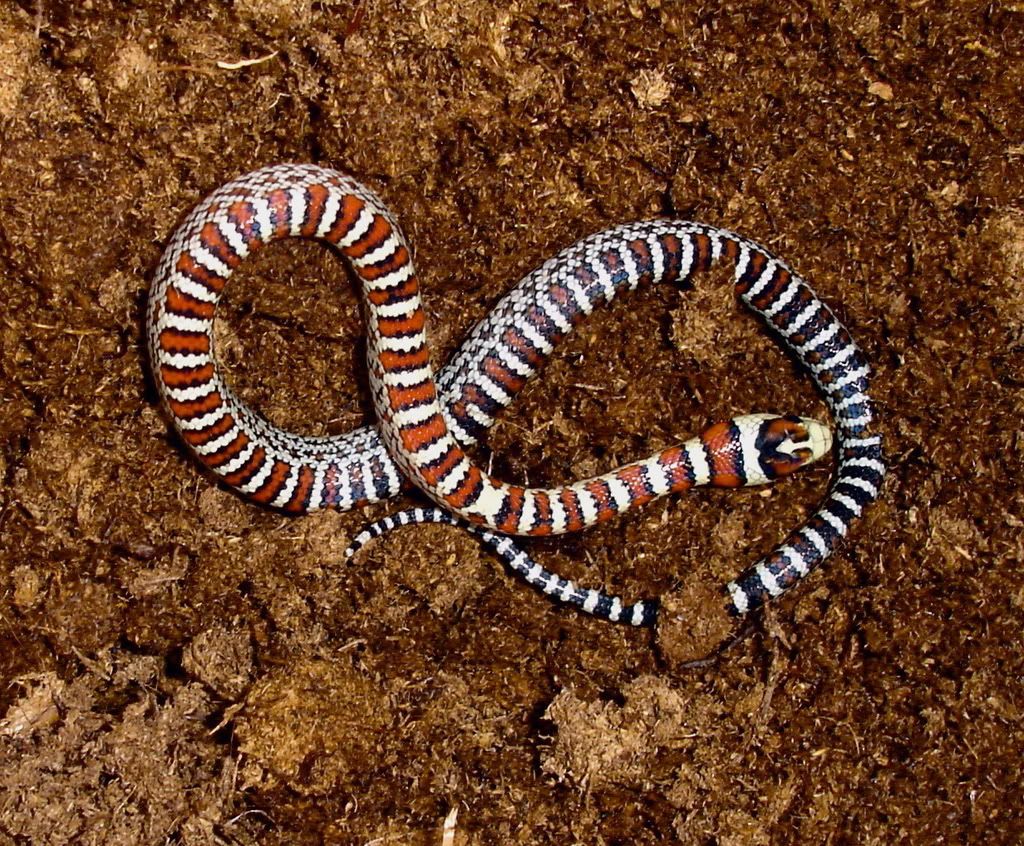
Here's one of my knoblochi hatchlings just hours after emerging from the egg.
I forgot to mention that the reason to why I moved my incubator was that during a heat spell back in the summer of 2006 I lost more than 80% of the eggs in my incubator. Temps outside stayed as high as 95F for almost a month and my incubator can only heat up and not cool down temps inside.
One more thing - english is not my first language, so I beg you to bare with me when I sometimes express myself in a strange way or spell wrong.
