Posted by:
tbrock
at Sat Feb 12 18:44:07 2011 [ Email Message ] [ Show All Posts by tbrock ]
>>I am looking for something active or at least hangs out once in awhile.If they just dont make good display animals thats fine I have a few other ideas.
>>I had a really nice leuc. texas ratsnake (which I lost) and she hid most the time and I maybe saw her once a week.Then not at all because she escaped out of the tiniest hole imaginable.
I'm not sure what exactly you are looking for in a display snake.
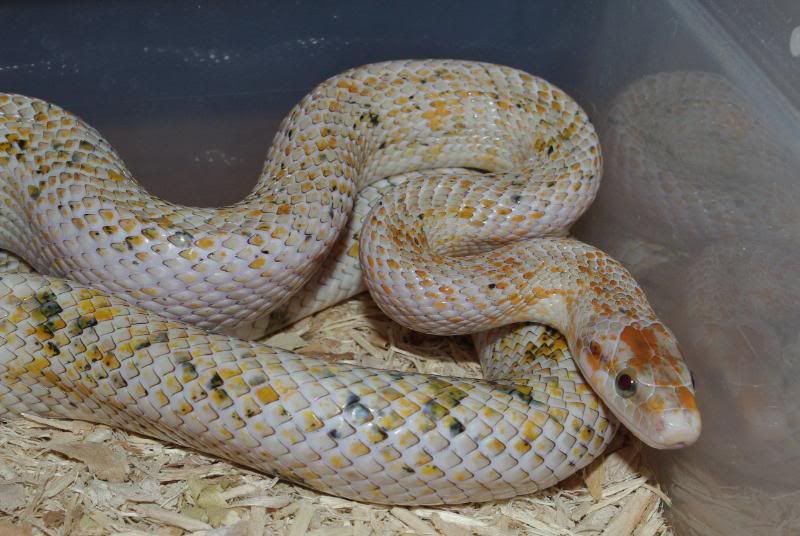
One morph which may appeal to you, since you like leucistics, is calico. There are at least two unrelated rat snake species which have calico morphs. One is black rats, whose calico mutation is called "calico cowsucker" by its originator, Will Bird. Another is calico Chinese beauty snakes (Orthriophis taeniurus taeniurus). Chinese beauties are not crazy about being handled and are mostly very flighty and shy - but if you provide a cage with branches, they will most likely do some climbing and perching. I like these guys a lot. Here is a pic of a subadult calico Chinese beauty.
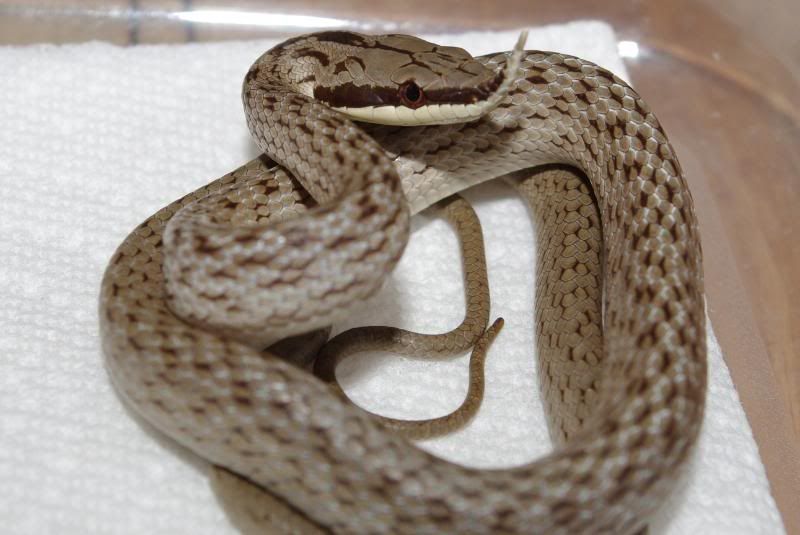
Another Asian which might be a good display animal is Elaphe dione - the Steppes rat snake. They are some of the most docile Asian rats, and stay fairly small - mostly under 40 inches. They are not very arboreal, but they are not shy and are diurnal, so they can be observed easily. Here is a photo of a very gravid female South Korean locality dione.

I have just gotten into another species from Asia, which seems like it would be an awesome display animal - Rhynchophis boulengeri, the Vietnamese rhino rat snake. Mine are babies and a little flighty, but they have a rep for being very docile as adults - and they are at least semi-arboreal. They go through an ontogenetic change and eventually become some shade of green - usually fairly bright.
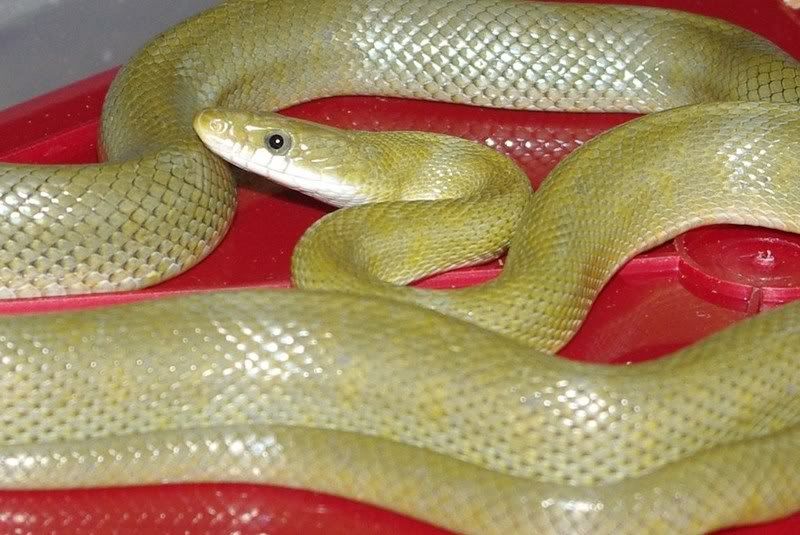
Another "green" rat snake is the Northern Green rat snake, Senticolis triapis intermedia. I have an adult pair and some of their 2010 offspring, and have found them to be mostly fairly docile, but a little shy in captivity. My adult female is very docile and diurnally active, but my adult male is somewhat flighty and less willing to be observed. The species has a rep for being difficult to keep in captivity, but I have not found them to be too difficult - aside from most of mine only wanting live mice for food. They need a well ventilated cage or tub and good dry and moist hides. Here is a (not very good) photo of my adult male, from a couple years ago.
-----
-Toby Brock
Southwestern Center for Herpetological Research
[ Hide Replies ]
- Which rat makes a good display? - biogeek2, Tue Feb 8 11:04:14 2011
- RE: Which rat makes a good display? - Bigtattoo, Tue Feb 8 12:31:59 2011
- RE: Which rat makes a good display? - pgcc0912, Tue Feb 8 12:57:53 2011
- RE: Which rat makes a good display? - FauxMako, Tue Feb 8 13:00:42 2011
- RE: Which rat makes a good display? - draybar, Tue Feb 8 16:01:39 2011

- RE: Which rat makes a good display? - tspuckler, Wed Feb 9 16:15:00 2011
- RE: Which rat makes a good display? - monklet, Thu Feb 10 10:15:45 2011
- RE: Which rat makes a good display? - donv, Fri Feb 11 15:16:48 2011
- RE: Which rat makes a good display? - cochran, Sat Feb 12 12:46:46 2011
 RE: Which rat makes a good display? - tbrock, Sat Feb 12 18:44:07 2011 RE: Which rat makes a good display? - tbrock, Sat Feb 12 18:44:07 2011- RE: Which rat makes a good display? - BillMcgElaphe, Sun Feb 13 18:51:07 2011
- RE: Which rat makes a good display? - myklx, Tue Feb 15 14:25:15 2011
|