return to main index

  mobile - desktop
follow us on facebook follow us on twitter follow us on YouTube link to us on LinkedIn
Southwestern Center for Herpetological Research  
Click here for Dragon Serpents
Locate a business by name: click to list your business
search the classifieds. buy an account
events by zip code list an event
Search the forums             Search in:
News & Events: How a python change the course of Attenbourgh's life . . . . . . . . . .  Make good choices . . . . . . . . . .  Burmese found on roadside in Wisconsin raises issues . . . . . . . . . .  Short interview with Bryan Suson of Sundown Reptiles . . . . . . . . . .  Happy Earth Day . . . . . . . . . .  Kingsnake Merch Store . . . . . . . . . .  Kingsnake returns to Tinley . . . . . . . . . .  kingsnake.com joins Monitor Brains! . . . . . . . . . .  Sneak Peek . . . . . . . . . .  Amphibian gut bacteria showing promise in cancer research . . . . . . . . . .  Herp Photo of the Day . . . . . . . . . .  Herp Photo of the Day . . . . . . . . . .  Meet The Baroness - The world's longest snake . . . . . . . . . .  Herp Photo of the Day . . . . . . . . . .  Updates? . . . . . . . . . .  Herp Photo of the Day . . . . . . . . . .  The mechanics behind the viper strike . . . . . . . . . .  Snakes on a Train? . . . . . . . . . .  Tracking the animals in the Florida Everglades - Meet the Croc Docs . . . . . . . . . .  Reintroduction attempts give San Francisco Garter a second chance . . . . . . . . . .  Promoting Reptiles is Our Jam Man . . . . . . . . . .  Origins of Chytrid discovered . . . . . . . . . .  Wisdom Wednesday - The Forums - The water is warm... Come on in! . . . . . . . . . .  Kingsnake.com Past, Present and Future . . . . . . . . . .  IHS Celebrates 50 years . . . . . . . . . .  End of January 2026 . . . . . . . . . .  Fun Fact Friday - Green Tree Monitor . . . . . . . . . .  The Evolution of the Osteoderm discovered . . . . . . . . . .  PACNWRS Expo Jan 2026 . . . . . . . . . .  Diamondback discovered in new Texas county for first time . . . . . . . . . .  Chicago Herpetological Society Meeting - May 17, 2026 . . . . . . . . . .  Bay Area Herpetological Society Meeting - May 22, 2026 . . . . . . . . . .  DFW Herp Society Meeting - May 23, 2026 . . . . . . . . . .  Tucson Herpetological Society Meeting - May 25, 2026 . . . . . . . . . .  Greater Cincinnati Herp Society Meeting - June 03, 2026 . . . . . . . . . .  CRE - Jun. 20-21, 2026 . . . . . . . . . .  Colorado Herp Society Meeting - June 20, 2026 . . . . . . . . . .  Chicago Herpetological Society Meeting - June 21, 2026 . . . . . . . . . .  Bay Area Herpetological Society Meeting - June 26, 2026 . . . . . . . . . .  DFW Herp Society Meeting - June 27, 2026 . . . . . . . . . . 

A short history and possible answer...

[ Login ] [ User Prefs ] [ Search Forums ] [ Back to Main Page ] [ Back to Kingsnake Forum ]

Posted by: zonatahunt at Thu May 13 15:59:55 2010   [ Email Message ] [ Show All Posts by zonatahunt ]  
   

First, this 'morph' is a little more common than most of you think. I've been working with this morph for almost a decade now, and know of multiple others working with them as well.


The original female from whom the first 'anery' morphs came from was a standard wild-type zonata. It had a lot of black, but its red was red. When it was bred to another snake from the same locality two 'anery' female snakes were produced. During the first few years of breeding, the same pair only produced female 'anerys' (this was simply due to low sample size; at first it was thought it was a sex-linked trait, but that has since been proven untrue as multiple male 'anerys' have been produced). While the trait is apparently a simple-recessive, it does manifest itself differently within the sexes - but only in the red rings. Females tend to be born with lavender-gray rings instead of red. By most females third shed they are almost completely pure black and white (with the white in both males and females having a purplish-blue hue). Males, on the other hand, are born with pinkish rings instead of red, and tend to retain some of the ringing as adults (the pink slowly turns to a gray).


These are NOT your typical anerythristic animals. I don't know what they are, but I do know they are unique. Some populations of alterna are born tri-color and ontogenetically change to a bi-color animal in a very similar fashion (but the white in alterna is normal, where it is not in these guys).


Everyone that has these is highly secretive about their animals. But they are a lot more prevalent in collections than they might appear.


Below are examples of a typical male and female of this morph:


Male
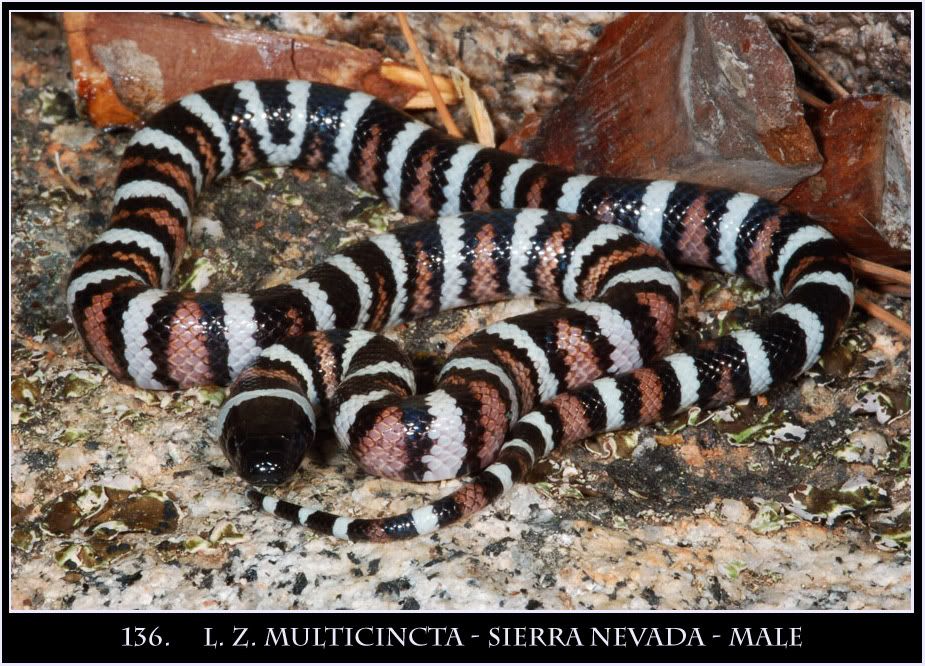


Female


Mitch


[ Show Entire Thread ]


>> Next Message:  RE: A short history and possible answer... - JKruse, Thu May 13 16:28:56 2010
>> Next Message:  also....... - JKruse, Thu May 13 16:34:40 2010
>> Next Message:  RE: A short history and possible answer... - Jlassiter, Thu May 13 18:53:07 2010

<< Previous Message:  "Anery" black/white Sierra zonata saga.. - JKruse, Thu May 13 00:44:44 2010 image in post

Click here for Dragon Serpents Click here to visit Classifieds Click for 65% off Shipping with Reptiles 2 You
KINGSNAKE.COM

Enjoy all our content free of charge with a user account that gives you full access to every feature. For added visibility, paid options are available - post in our Classifieds, showcase your business with Banner Ads or a Directory listing, promote reptile events, and more.

Quick Links
Community
Legal & Safety
Support

Register for free ✓ Sign up!

Kingsnake.com ® is a registered trademark © 1997-