I am looking to get a salamander for my fish tank, which has a 2-3" blue murron crayfish. I want to get a non-toxic/poisonous salamander for it, as the crayfish might eat it, and I don't want him to die. I can find NOTHING on the internet about which salamanders are non-toxic. If someone has a list of them, please tell me?
Reptile & Amphibian Forums
Welcome to kingsnake.com's message board system. Here you may share and discuss information with others about your favorite reptile and amphibian related topics such as care and feeding, caging requirements, permits and licenses, and more. Launched in 1997, the kingsnake.com message board system is one of the oldest and largest systems on the internet.


Non- toxic salamanders
blatzterbate
Apr 20, 2008 01:53 AM
Replies (11)
batrachos
Apr 20, 2008 09:17 PM
Your crayfish will almost certainly eat any salamander placed with him. Please do not put any salamander in the tank.
Most salamanders have skin secretions that could be considered toxic; they merely vary in which toxins and how much. Some of the toxins are generalized and would be poisonous to almost anything, while others may be directed at specific predators.
keechoo
Apr 21, 2008 03:55 PM
If you're pretty sure that your crayfish would eat the salamander then why get one?
Lucky for the salamanders they are poisonous to other creatures.
blatzterbate
Apr 22, 2008 12:55 AM
I'm not POSSITIVE. There's a chance. But I would like one in there. It's a 40 gallon tank, so there's a good chance it will be fine, but JUST IN CASE it gets eatten, I would prefer that they BOTH don't die.
keechoo
Apr 22, 2008 07:13 AM
The crayfish will kill it eventually as it did in my friend's 60 gallon tank and both will die. The salamander from the injury and the crayfish from the poisons.
blatzterbate
Apr 22, 2008 08:11 PM
So why didn't you tell them they were stupid? I've changed my mind. But I don't see why everyone on forums are always so pretentious and rude. Caudata was worse though. What a bunch of jerks.
keechoo
Apr 23, 2008 01:11 PM
I don't call people "stupid". I did tell him it wasn't a good idea but he wanted to try it out anyways. For some reason, he doesn't listen to women unless they have a male backing her up with facts and statistics.
I'm glad you decided against it.
Many people are pretentious on forums because they don't have to have a face to face conversation with that person. So how would the other person know if he was telling the truth or not? He can't unless he catches him in a lie.
CKing
Apr 22, 2008 11:50 PM
>>I'm not POSSITIVE. There's a chance. But I would like one in there. It's a 40 gallon tank, so there's a good chance it will be fine, but JUST IN CASE it gets eatten, I would prefer that they BOTH don't die.>>
Personally I think salamanders are more interesting than crayfish. I would get rid of the crayfish in favor of a salamander. 
Most salamanders are terrestrial, so they would drown if kept in water without a place to get out. Some salamanders are aquatic. Among these are the sirens, hellbender and amphiumas, none of them are very attractive even to salamander lovers.
The newts are more aquatic but some too will drown if it is not the breeding season. Some can live year round underwater though. Newts are the most toxic so they could be dangerous. The toxins of salamanders and newts are generally released only if they are attacked or if they are under stress. These toxins are generally distasteful. Predators like a coyote may bite on a salamander, usually the tail because that is what salamanders present to predators when they are approached. After biting the tail, the secretions from the salamander's tail will cause some predators to abandon the salamander. The salamander may lose a tail or part of it but it will probably survive, although I have seen a dead salamander in the wild with wounds at the base of the tail but nowhere else. I often see salamanders with regenerating tails in the wild, evidence of the effectiveness of such an anti-predatory strategy.
One salamander to try in your situation is the axolotl, the neotenic larvae of the Mexican salamander, Ambystoma mexicanum. It is readily available in pet stores, and are captive raised. If you lose one to a crayfish, at least it won't be detrimental to the declining amphibian populations around the world. It is toxic but not as much as the newts. Not sure whether it will be eaten or not, but this is a good one to try, if you must try.
batrachos
Apr 23, 2008 03:51 PM
To the OP- you proposed putting an animal that people around here care about in a situation that would almost certainly kill it, and implied that you were aware of the danger and didn't really care. What if you went on a bird forum and asked, "What kind of parrot can I keep with my python, that won't scratch the python when he eats it?" Would you expect a positive response?
I hope you stick around, but please do show a little more respect for the animals we all love.
More on topic, most crayfish need to be in single species tanks; they are very dangerous to fish and amphibians, even individuals that are as large as the crayfish.
Most of the big salamanders that CKing mentioned (though I disagree with his assessment of them; I love my lesser sirens, and would keep other big paedomorphic salamanders if I could) will prey on any small enough crayfish. Hellbenders eat little else.
Crayfish are wonderful tank inhabitants, just not with salamanders.
CKing
Apr 24, 2008 11:07 PM
>>More on topic, most crayfish need to be in single species tanks; they are very dangerous to fish and amphibians, even individuals that are as large as the crayfish.>>
Is that so? I have no idea that crayfish are dangerous to fish and amphibians. I do know that I can find them in the same streams as some species of western newts (genus Taricha), and they seem to coexist without problem. Perhaps it is because of the toxicity of the newts themselves.
http://en.wikipedia.org/wiki/California_Newt
The article above suggests that introduced crayfish can be a problem, but they nevertheless are unable to feed upon the adult newts, even though they are believed to cause a decline in newt populations because they feed on larvae and eggs.
>>Most of the big salamanders that CKing mentioned (though I disagree with his assessment of them; I love my lesser sirens, and would keep other big paedomorphic salamanders if I could) will prey on any small enough crayfish. Hellbenders eat little else.>>
Personally there is not a single salamander species that I find unattractive, and that includes the sirens, mudpuppies, amphiumas and hellbenders. I was merely speculating on what most people may think of the appearance of these salamanders. I think they are ugly by most standards, except to those who know them as well as many biologists and I do.
>>Crayfish are wonderful tank inhabitants, just not with salamanders.>>
As I said, I don't find crayfish attractive. I would much rather keep a salamander than a crayfish. I think most people in this forum would agree on that point.
batrachos
Apr 25, 2008 10:55 AM
I am quite fond of crayfish myself. Many of them are beautifully colored, and they are active and entertaining aquarium subjects.
Here's a wild pair mating; I don't know the ID.
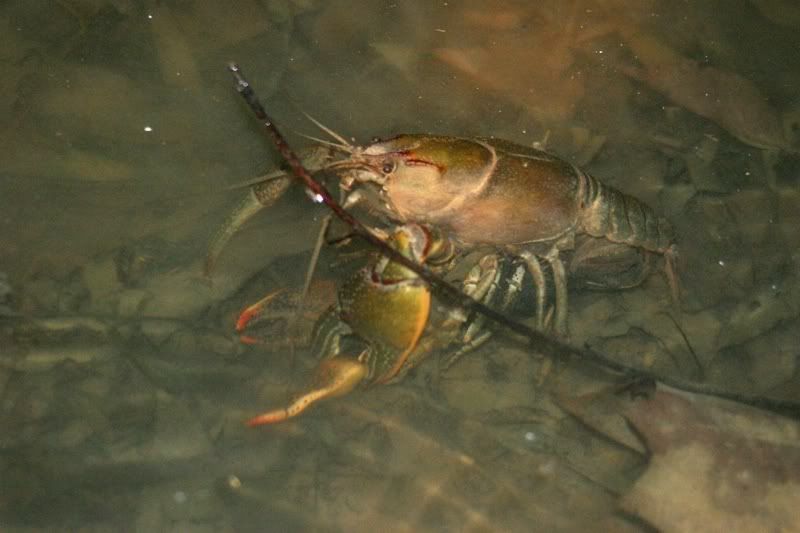
I should point out that just because two species inhabit the same space does not mean that they are compatible; after all, predators live where their prey live. In any case, crayfish are capable of great destruction, especially to soft-bodied animals like amphibians, even if they do not wish to eat the amphibians.
I would like to amend my previous blanket statement by saying that dwarf crayfish (Cambarellus species) are compatible with many other aquatic species. I have not kept them with newts, but I expect they would get along well. Of course, this doesn't help the OP who already owns a crayfish, but it might be helpful to others.
CKing
Apr 25, 2008 11:40 PM
>>I should point out that just because two species inhabit the same space does not mean that they are compatible; after all, predators live where their prey live. In any case, crayfish are capable of great destruction, especially to soft-bodied animals like amphibians, even if they do not wish to eat the amphibians.>>
That is quite true and I don't mean to imply that just because the newts I observe share the same stream as crayfish, they can then be kept together in an aquarium. In captivity, where the prey species cannot escape or hide, the predator may have an unfair advantage.
