Reptile & Amphibian Forums

Welcome to kingsnake.com's message board system. Here you may share and discuss information with others about your favorite reptile and amphibian related topics such as care and feeding, caging requirements, permits and licenses, and more. Launched in 1997, the kingsnake.com message board system is one of the oldest and largest systems on the internet.

Click here to visit Classifieds
https://www.crepnw.com/
Click here to visit Classifieds

I'm gonna have to quit keeping agalma

peter54 Jul 31, 2008 03:49 PM

About a year ago I posted here when my biggest female agalma got ill. I suspected that she had the much feared zonata disease. Prior to her sickness I had lost an 8 year old male, but he showed completely different symtoms and I did not think the two had any connections at all. The large fenmale died a few weeks ago. Now, out of my original nine agalmas only one seems normal. All the others have symtoms and all but two of them have stopped eating.

I feel devastated, all these beautiful animals and all the work, time and money spent on them - down the drain. I have spent about $3000 purchasing the 9 agalmas. I will never buy another zonata. This is just too hard to risk experiencing again.

Replies (12)

pyromaniac Jul 31, 2008 06:14 PM

Peter54,
I am truly sorry to hear of your devastating loss. You are such a meticulous and devoted breeder, and to have such an unforeseen thing happen is just the pits.
I have avoided getting agalma myself having heard of this odd disease, which seems to be some sort of virus. Is there anything you can do in the way of supportive measures in the hope that some of them can overcome this? It reminds me of feline leukemia, a disease I am unfortunately familiar with.

AllanBartlett Jul 31, 2008 06:58 PM

I'm really sorry to hear about what has happened to your agalma collection Peter. It happened to me about fifteen years ago. The disease wiped out my small colony. There was nothing I could do. I vowed that if I ever got back into breeding them that I would start with captive hatched babies from a clean line. I also made sure I didn't bring any new adult animals in from unknown sources after I got it back up and going. I can't emphasize enough that if anyone is keeping a colony of zonata, you have to have strict quarantine of any new animals that you decide to add to the colony if you did not produce them yourself. That should go for any new animals you add to your collection. Having said all this, I hope this traumatic event doesn't totally discourage you from trying to keep them again some time in the future. Take a few years off and let time heal the wounds. In my opinion, you'll want to eventually get back into zonatas. After all, hardly anyone is breeding them and they are a joy to work with.
Juarez Wonders

JKruse Jul 31, 2008 10:08 PM

about all this Pete. So very sorry. I wish there were something we could do. The frightening part is this is an under-researched disease and is quite pervasive. It's one of my worst fears actually. Good words of wisdon from Allan, as I concur.

But Pete, don't totally give up. Take a break, and I'm sure you'll find that spark again. It's still somewhere within you -- this has been just a real bad experience and having nothing to do with you per se. Again, I'm feeling for ya and I hope that you won't become a stranger in this or any other forums. Chin up bro.......

Jerry Kruse
-----
Jerry Kruse

"When the character of a man is not clear to you, look to his friends." -- Japanese Proverb

lamprophil Aug 01, 2008 11:54 AM

I too am sorry to hear about the loss of your animals. I can relate, as I recently had a mite scare in my collection, and the thought of having a room full of parasitized animals was truly frightening.

For zonata disease, I think a few tantalizing clues have emerged over the years. The biggest questions remains unanswered - is the disease contagious, or is it caused by an opportunistic virus that all zonata have, which doesn't rear its ugly head until the environment is appropriate for the virus to thrive? A friend and successful zonata breeder believes that humidity is the key, and he has rehabilitated zonata with the disease by keeping them in a moist environment for several weeks.

I'm one of the few zonata breeders who has never seen the disease in my collection, despite bringing in stock from a number of different sources over the years. My friend thinks he has an explanation: I live near the coast, where the marine layer tends to keep the humidity in my snake room high.

Now, whether these couple data points provide the answer or not isn't clear, but I do think it's a useful clue.

Patton Aug 01, 2008 01:05 PM

Hey Phil,
That would make sense. I think that if Zonata disease was
as destructive in the wild, as it is in captivity, that
wild populations would be completely dessimated. There
has to be more to this disease than science has discovered.
Wild populations don't seem to be disapearing due to
Zonata epidemics.
-Phil Patton
-----
Work is the curse
of the drinking class!

pyromaniac Aug 01, 2008 04:09 PM

Here is a link to a post about this disease. An excerpt:
(5) For L. zonata the disease is usually fatal. Some individuals do
eventually "shed out" of the skin disorder but the partial paralysis often
remains at some level. Providing moist conditions seems to help increase
the probability of survival possibly by just preventing death due to
dehydration and allowing the snake's own immune system to eventually
overcome the disease. Individuals that survive the disease do not appear to
be contagious.
It should be noted that L. zonata are highly stressed when conditions
become too hot and dry. We have noticed several individuals that acquired a
skin condition very similar to that described above minus the paralysis and
marred eye spectacles. The skin condition in these individuals cleared up
after moisture and cooler conditions were provided and the snakes completed
one or two shed cycles. We do not know if this alternative skin disorder is
also zonata disease but just in a less virulent form, but the temperature
and moisture conditions in the cage do seem to be related, possibly for
both cases.

I'm hoping Peter54 can save his babies. One gets attached to these little creatures so easily.

zonata disease?

lamprophil Aug 01, 2008 04:37 PM

Ah, thanks for the link! Another thing comes to mind: those who look for zonata in the wild know they disappear once it gets dry under the rocks. Perhaps they've learned (through selection) to avoid dry conditions.

peter54 Aug 01, 2008 07:52 PM

Thanks everybody for the comforting words. I do of course work hard to save what can be saved of my agalma collection. I currently have a number of 7 specimen, all but one born 2005. Three of them bred by German breeder Thomas Steffen, and the other three from the U.S. breeder(s) unknown. The seventh snake was imported to Sweden as a hatchling from the U.S. back in 1999 and that snake seems to be unaffected, at least so far.

The first two to show signs of having caught this illness, have been quarantined since early spring and they actually seem a bit better. I have kept them in a large plastic box, very humid and at rather moderate temps. They do not eat however and that of course is a problem.

The large female that died early this summer seemed to have a complete intestinal failure too, slimy stuff coming out of her and the anal section got all swollen and the hind part of her body quite deformed.

pyromaniac Aug 01, 2008 08:54 PM

For the two that are not eating, have you tried feeding them lizards?
I know everyone is set on having these kings eat rodents, but maybe going back to the drawing board, so to speak, and feeding them what they would eat in the wild might be successful. In Sweden I guess one would have to buy some sort of lizard. Here in the Sierras we are blessed with an abundance of fence lizards and skinks.
I am glad to hear that some of your babies are recovering with lower temperatures and increased humidity. I have been all over the Internet trying to find any data for the exact humidity levels they should have. I guess the best way to find this out would be to go out in the field and measure the humidity in rock crevices currently being inhabited by wild zonata king snakes.

peter54 Aug 02, 2008 08:55 AM

About them not eating, I'm not sure it has to do with the kind of food they are provided. I think it has more to do with their mobility being affected so severely that they just cannot manage to eat.

So far I have managed to feed one of these affected ones. That snake were not so badly immobilized and she managed to swallow a large fuzzie mouse.

The larger female that died stayed without food for 10 months and then I tried force feeding her with a 10 ml syringe connected to a thin plastic tubing. Food mix contained water, egg, grinded meat, calcium and B-vitamins. She died a few weeks later and I think that her methabolic system was not working.

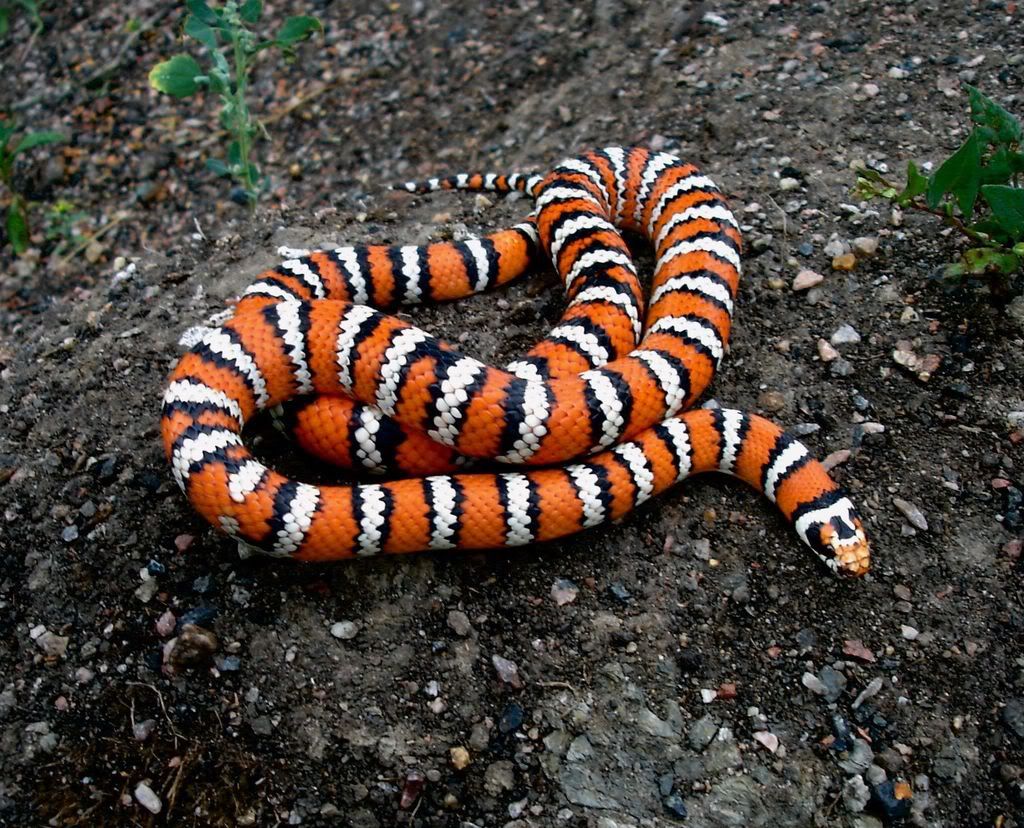
This pic shows my largest very orange 2005 female. She has the symtoms, not being able to control her body, strange curling up, body turned upsidedown, stiffness, shivering tail.

pyromaniac Aug 02, 2008 09:58 AM

It seems to be some sort of adenovirus. It is hard to find any information about what it is. All I could find was this:

Degenerative Encephalopathy in a Coastal Mountain Kingsnake

Paul Lynum Aug 10, 2008 11:20 AM

I know how you feel. Over the years of keeping zonata (20 plus) I've had problems occur with "the disease" here and there with them and it's very heart breaking. It always hit my best ones it seemed like. Last year I rid my collection of all zonata and don't think I'll work with them again. Awesome snakes but, too much trouble. It's much more pleasurable now for me to turn a rock and find them but, leave them. Also, on two occasions I've found the disease in the wild in two seperate mountain ranges. WTF?

PL

Site Tools