
Reptile & Amphibian Forums

Welcome to kingsnake.com's message board system. Here you may share and discuss information with others about your favorite reptile and amphibian related topics such as care and feeding, caging requirements, permits and licenses, and more. Launched in 1997, the kingsnake.com message board system is one of the oldest and largest systems on the internet.

Click here to visit Classifieds
Southwestern Center for Herpetological Research

For Gregg - Varanid Intelligence

Robert_Mendyk Jan 23, 2012 09:52 PM

Since the ongoing discussion is getting further and further down the page and is getting difficult to keep track of, I've decided to bump at least this part of the discussion up to the top of the page.

Gregg, in a recent post below you stated the following:

"My definition of intelligence (which happens to be THE definition of intelligence) is an animal that can solve problems, capable of abstract, complex thought, reasoning, advanced communication, self awareness, and most importantly, understanding. Out of all of those thing, what do varanids display?"

First, I'm not sure where you got this idea that there is a single, unifying definition of "intelligence", as in the field of psychology, there is no clear-cut single concept. There are probably dozens of books and hundreds of academic papers which deal with the problem of defining intelligence. It is one of many challenges psychologists face on a regular basis, especially when attempting to compare cognitive abilities between species and across broader taxonomic groups.

Second, you state that problem solving is one criterion for what you consider to be "intelligence". Yet, if you were familiar with the literature, you would be aware that there have been many published reports describing complex problem solving abilities in monitor lizards. Here are just a few reports that I suggest looking into:

Manrod, J.D., R. Hartdegen & G.M. Burghardt. 2008. Rapid solving of a problem apparatus by juvenile black-throated monitor lizards (Varanus albigularis albigularis). Animal Cognition 11(2): 267-273.

Firth, I., M. Turner, M. Robinson & R. Meek. 2003. Response of monitor lizards (Varanus spp.) to a repeated food source; evidence for association learning? Herpetological Bulletin 84: 1-4.

Gaalema, D.E. 2011. Visual discrimination and reversal learning in rough-necked monitor lizards (Varanus rudicollis). Journal of Comparative Psychology 125(2): 246-249.

Horn, H.-G. 1999. Evolutionary efficiency and success in monitors: a survey on behavior and behavioral strategies and some comments. In H.-G. Horn & W. Boehme (eds.), Advances in Monitor Research II. Mertensiella 11, pp. 167-180. Deutsche Gesellschaft fur Herpetologie und Terrarienkunde e.V., Rheinbach.

Krebs, U. 2007. On intelligence in man and monitor: observations, concepts, proposals. In H.-G. Horn, W. Boehme & U. Krebs (eds.), Advances in Monitor Research III. Mertensiella 16, pp. 44-58. Deutsche Gesellschaft fur Herpetologie und Terrarienkunde e.V., Rheinbach.

Mendyk, R.W. & H.-G. Horn. 2011. Skilled forelimb movements and extractive foraging in the arboreal monitor lizard Varanus beccarii (Doria, 1874). Herpetological Review 42(3): 343-349.

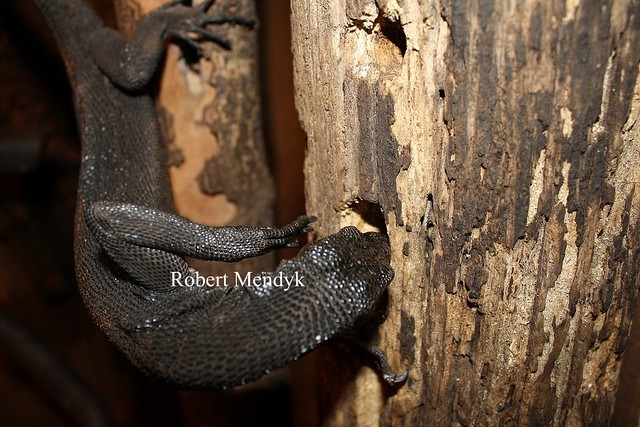
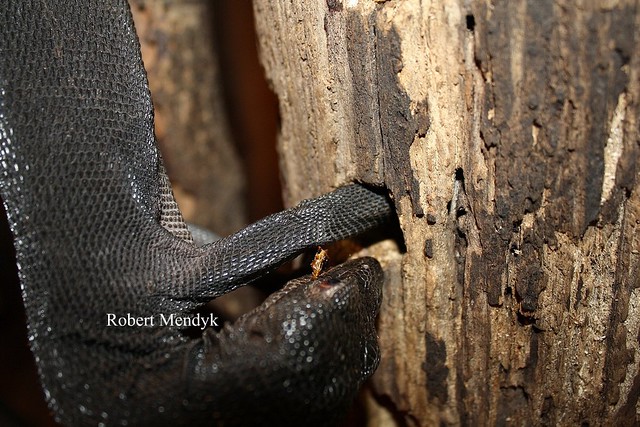
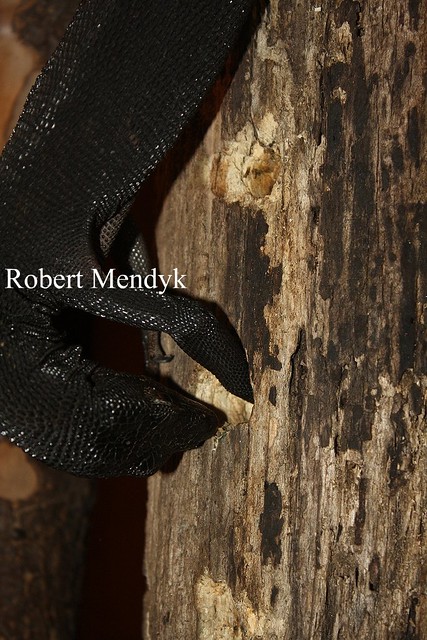
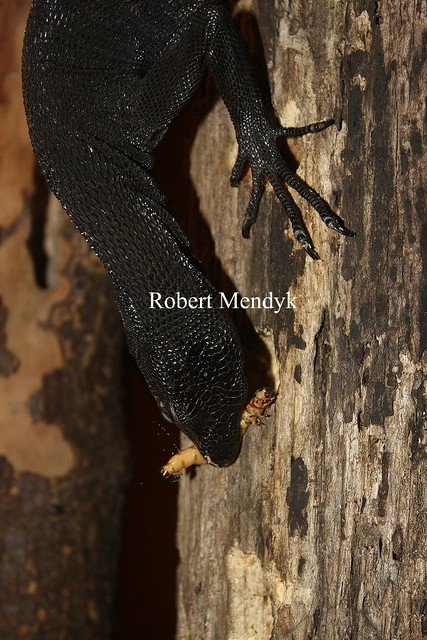
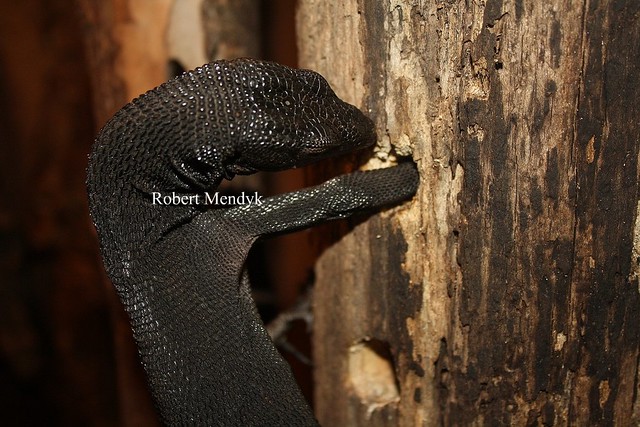
The last reference in this list documents an example of problem solving that I discovered in black tree monitors. Long story short (I can provide you with the full article if you'd like to read about this in greater detail), when V. beccarii were presented with prey items hidden inside of narrow openings too small for their heads to enter (holes drilled into tree limbs), the monitors switched from their conventional method of prey capture (seizure with the jaws) to utilizing a completely different set of motor skills to successfully extract prey from the holes through coordinated reaching forelimb movements. Here are a few photos depicting the behavior:

Here is some video footage depicting the behavior:

www.youtube.com/watch?v=KlPlYAEXLrw
www.youtube.com/watch?v=ilPhdnnS4gE&feature=related

While I consider the reaching forelimb movements themselves to have a genetic basis (instinctive), the thought process of switching from one foraging strategy to another and abandoning their primary method of prey capture (the jaws) represents a cognitive decision made by the monitor to solve a foraging dilemma (= "problem solving" ). Also interesting is the fact that depending on their body positioning, these animals will switch between use of their left and right forelimbs in order to reach deeper into tree holes to extract prey. This highlights yet another example of problem solving.

I don't know about you, but I consider this to be pretty spectacular and exciting, as I am unaware of any other reptile which demonstrates this particular ability (not to mention the coordination/dexterity when extracting prey from embedded matrices).

Replies (12)

wldktrptls Jan 23, 2012 10:46 PM

That's pretty cool. Soon they'll discover some obscure insular prasinid with a singular modified forefinger akin to that of the Aye-Aye from Madagascar, tapping up grubs to nibble on. But seriously, the varanids display all sorts of cognitive behaviors and capacities for learning. And they are certainly subject to operant conditioning.
Guy

MDFMONITOR Jan 24, 2012 05:04 PM

I think monitor intelligence is an survival food orientated intelligence, after all it took some intelligence & agility to get the rest of this chick, but if she was using her intelligence she'd of come & sat at my feet & got another chick off me!!

wldktrptls Jan 24, 2012 08:07 PM

You mean you feed chicks? Myself, I try to pick'em up after dinner...

Gregg_M_Madden Jan 24, 2012 09:26 AM

Bob,
Your paper is awesome man. While I was typing up my post about problem solving I was actually thinking about your paper. I honestly feel there is a fine line between instinctive and cognitive. I think it is more open to inerpretation than it is clearly cut.

I also agreed that varanids can learn basic things like where to find their food and how to get it. I dont consider that abstract thought. It is basic for their survival. Like I said Bob, and you know this, varanids are not mindless beings. However I do not feel they are super intelligent either. At least not as intelligent as some of their owners make them out to be. Every animal has some level of intelligence. They are only as intelligent as they need to be.

jburokas Jan 24, 2012 10:36 AM

This is a funny discussion. Perhaps the observer (us) isn't picking up on a simple fact....motivation. You have to "motivate" the animals to do these activities in order to "grade" them by our made up system of who is intelligent and who is not.

There was a study about primates (chimps/bonobos) vs domestic dogs. I'll look it up and link it here later. The dogs actually outperformed the allegedly more intelligent primates in learning where to find food. Apparently the primates just didn't pay all that much attention to the humans and the way to find the food item. The dogs intently watched the humans and picked up on the tricks quickly. Kinda funny considering the primates are supposed to be so smart compared to a dog, eh? Yet the dogs consistently achieved the task much faster than the primates. I think it's flawed logic to try to grade these animals based on things we want them to do and how much they remind us of ourselves or not. Monitors have relatively high metabolisms and catholic (adaptive) diets based on what's around to eat. They have to either be hard-wired or 'intelligent' to find these different food sources by design to some capacity. Personally, i think they're clever animals and they've got me hooked learning them. I'm not going to attempt to rank if I think they're smart or not and such though. What difference does it make what I think?

Did hell freeze over? Why are David and Bob here now.

Paradon Jan 24, 2012 10:52 AM

Maybe the dogs were much closer to the ground so they pick up the sense better... just a thought, though. Hehe!

murrindindi Jan 24, 2012 11:06 AM

Hi Paradon, you`ve certainly "thrown a spanner in the works" with that one!! (Wink)...

Gatorhunter Jan 24, 2012 11:12 AM

LOL Justin. I was very surprised to drag down through the topics to to see Dave and Bob.

I would like to add I think intelligence varies by species then by individuals. There are some people who are brain-dead to me and some of them may not pass the test we put animals through lol.

My crocs test boundries every day unlike any monitors I have ever owned (savs, bts, ackies, tristis). They are not 100% food driven either. I look at them and they look right back> My big varanus salvadorii was smart enough to train me-not the other way around

jburokas Jan 24, 2012 03:30 PM

Paradon - the funny thing (and my whole point really) was that the dogs were motivated to look at the humans training them and were actually interested in appeasing the people and getting the food. The primates developed 'attitudes' and were harder to pursuade to pay attention to the task. On the surface, you'd say "dog smart. monkey not smart" but it's not that simple. Doesn't mean a dog is necessarily "smarter" than a primate, but that MOTIVATION is something often overlooked when people get all anthropomorphic and want to make rash judgements about intelligence with these silly little Pavlovian tasks.

Gregg_M_Madden Jan 24, 2012 05:12 PM

Justin,
you bring up some good food for thought.

"the funny thing (and my whole point really) was that the dogs were motivated to look at the humans training them and were actually interested in appeasing the people and getting the food. The primates developed 'attitudes' and were harder to pursuade to pay attention to the task."

Now, dogs are by nature pack animals with a pretty complex social structure with an alpha/pack leader. Any individual under the alpha are submissive, subservient, and would do what they can to appease the alpha. Would the trainers in these studies not be looked at as the alpha?

We also know that primates have a similar but different social structure. One of the difference being is that primates might be a bit more "free thinking" and not as willing to submit as dogs are. Primates are more like us. If we are not interested in something, we pay little attention.

All of these animals evolved different skills, adaptations, and structures that benefit them and their survival as a species. Some of this involves learing from others in a pack, pride, group, or gang. Reptiles do not need to learn basic survival skills like social animals. They are hard wired to thrive right out of the mom or the eggs.

Justin, you have hatched how many varanids. Do the hatchlings need to learn how to hunt and kill their prey? Do they need to learn how or where to hide if they feel threatend? Do they get sad, upset, or do poorly if they are separated from other hatchlings? Ofcorse not. Their ability to learn is very limited and is pretty much only food orientated. Like where to find it and how to get it. Can we really measure intteligence by looking at things they are pretty much born to do?

I honestly do not think there is any real way to assess a reptiles intelligence. Mostly because wether we like to admit it or not they need to be tested against other animals. Anything being talked about here is just opinion based through observation. What I see and what others see can be totally different. Some people see their leopard gecko scratching the glass on the cage and think the gecko is looking for attention. When I see that, I know the gecko is just trying to get through a barrier. I just do not see varanids or any reptile as highly intelligent. The way they are is enough for me to appreciate them and to want to keep them and care for them. I do not need to make them out to be more than they really are for them to be special to me.

crocdoc2 Jan 24, 2012 07:02 PM

There seems to be some confusion between 'social' and 'intelligent'. An animal can be intelligent, but not social.

Here's an old video of my pair of lace monitors, which have learned how to 'ask' to be let out of the enclosure and then how to be lifted out. This was done a few years ago when they first started learning this routine. The reward is simply getting some 'wandering around' time outside the enclosure. What they have learned to do is:

1. Not scratch at the glass.
2. Only wait on the right hand side of the enclosure.
3. Sit quietly and tongue flick
4. Lift their left arm and place it into my hand, specifically between my thumb and forefinger, so I can get a grip around their upper arm to enable me to lift them out.

This all seems simple, but if you were to see them doing this you'd realise that there is a fair bit of intelligence and memory involved. If one of them starts scratching at the glass or waiting at the wrong end of the enclosure, all I have to do is turn my head away to ignore them and they will almost immediately head to the correct side of the enclosure and sit there quietly.

They were a bit round-bellied when I shot this, as it was done over the course of a weekend that I was also doing some feeding videos.
video of monitor routine

I'll post an updated video in a few months when I have more time to do some editing. In the older video the arm placement sometimes looks accidental - my hand seems to be exactly where they'd place their arm, anyway, if they were trying to climb out. What'll be different with the new video is that I have several clips of the male sitting there with one arm waving in the air, waiting for me, so you get a good feel for how intentional the movement is. I'm in the process of training him to raise his arm higher before I even open the enclosure.

jburokas Jan 24, 2012 11:31 PM

Gregg - I do think Monitors have an amazing capacity, for reptiles, to learn and memorize things. They fine-tune how to eat certain prey items efficiently from the first times to the polished technique - things like crawfish that must be eaten in "reverse" while mice are usually taken head-first. They also get very very good at moving to safe areas when spooked in a cage while some other reptiles just bang the glass or wall and almost knock themselves unconscious. It's little things they learn that impresses me. They most definitely recognize things they've seen or experienced previously and get better at dealing with it with more repetition. But do I "rank" them vs some other animals based on my human/anthropomorphic tasks not knowing how "motivated" they are to do the task?...no. I too can appreciate them for what they are and don't really think in terms of making them superior. I just happen to really dig Monitors and keep a whole crapload of them here. Why exactly they blow my skirt up?....I don't really know.

Site Tools
