Reptile & Amphibian Forums

Welcome to kingsnake.com's message board system. Here you may share and discuss information with others about your favorite reptile and amphibian related topics such as care and feeding, caging requirements, permits and licenses, and more. Launched in 1997, the kingsnake.com message board system is one of the oldest and largest systems on the internet.

Click for 65% off Shipping with Reptiles 2 You
Click for ZooMed
Click here for Dragon Serpents

Obsoleta range?

Ryan_Sikola Jul 24, 2012 12:32 AM

Does anyone have a range map of obsoleta rat snakes???

Do they dip into mexico and if so where and how far?
-----
Pituophis c. annectans
Senticolis t. intermedia
Rhinechis scalaris
Elaphe bairdi
Lampropeltis zonata
Lampropeltis t. campbelli
Lampropeltis m. thayeri

Replies (28)

DMong Jul 24, 2012 01:07 PM

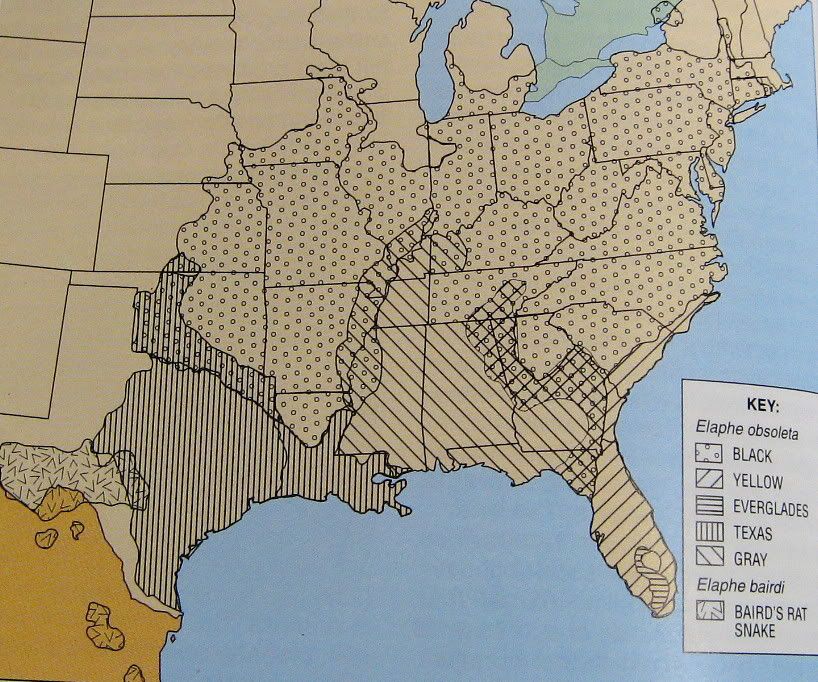
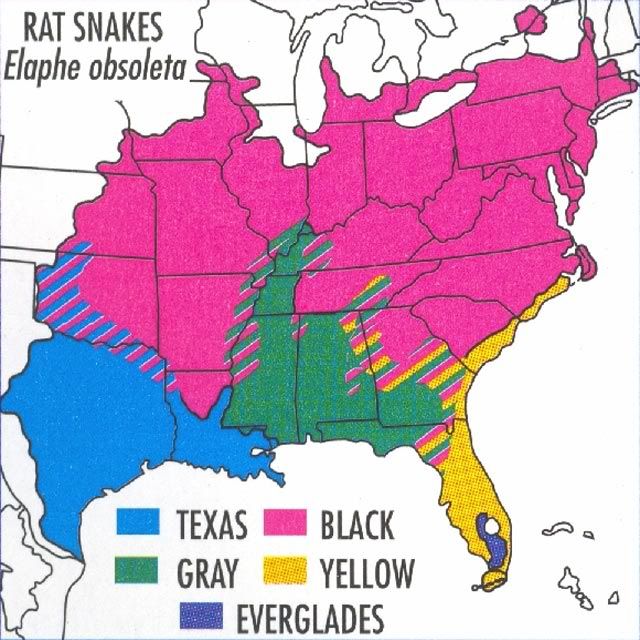
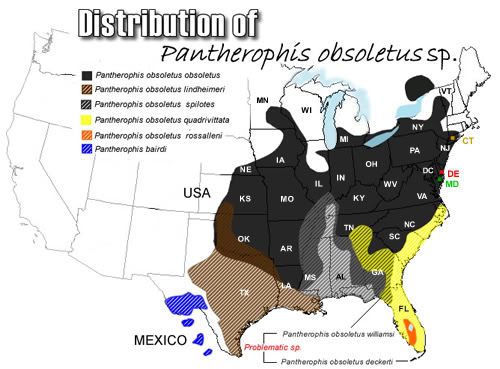
Here are three different obsoletus range maps. They vary some, but you can get a good general idea of their natural ranges and intergrade zones on either side of the colored/illustrated areas.

~Doug


-----
"a snake in the grass is a GOOD thing"

serpentinespecialties.webs.com

tbrock Jul 25, 2012 12:45 AM

Some good maps there, Doug - however, I am more in favor of the maps in Dixon's and Werler's "Texas Snakes" books (2000 and 2005) - which puts lindheimeri only ranging as far south as southern Nueces or maybe into the very northern tip of Kleberg Counties in Texas. This is well north of where all of the maps you posted have them ranging to. I have found lots of lindheimeri in Nueces County, but have never seen one south of southwestern Nueces...

Pantherophis bairdi is a different story and definitely ranges well into Mexico - and I still consider bairdi to be part of the Pantherophis obsoletus complex, myself - I don't agree with the split...
-----
-Toby Brock
Southwestern Center for Herpetological Research

tbrock Jul 25, 2012 12:14 PM

Here is our map at SWCHR, prepared by Tom Lott. This has lindheimeri ranging through Kleberg County - and also three disjunct locality dots in the lower Rio Grande Valley...

http://southwesternherp.com/snakes/lindheimeri.html

-----
-Toby Brock
Southwestern Center for Herpetological Research

DMong Jul 26, 2012 12:28 PM

That's interesting Toby. Yeah, some discrepancies and difference of interpretation will always have to be expected with range maps as you know.

Is there an obvious, or notable difference of habitat that you and/or others have noticed there that is not favorable to lindheimeri in the more southern counties you mentioned?. And are those three disjunct areas of populations more like the habitat in the northern range?

I am guessing the Nueces River basically acts as sort of a natural border for certain fauna, but certainly it isn't vast enough to prevent linheimeri from ever being able to populate the other side to some extent. Especially over countless millenia I would think.

Just thinking out loud a bit here, as I have never been in that area like you and many others have.

~Doug
-----
"a snake in the grass is a GOOD thing"

serpentinespecialties.webs.com

tbrock Jul 26, 2012 09:28 PM

Thanks Doug!

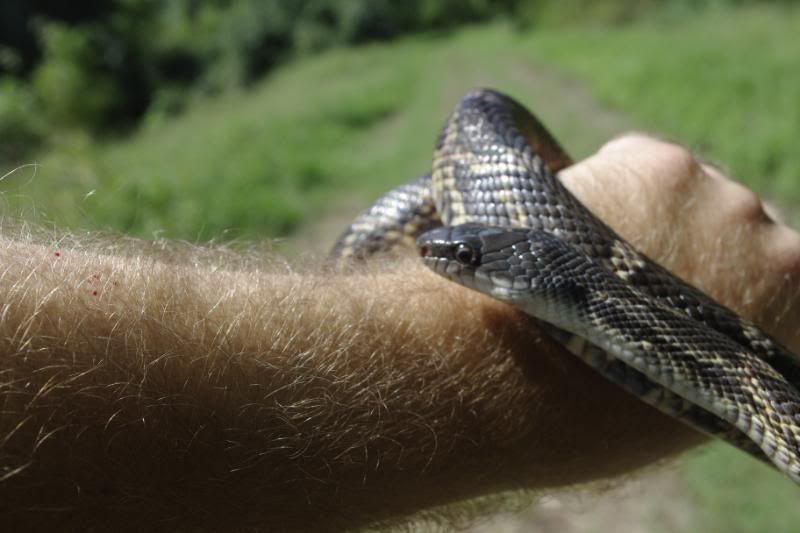
The Nueces River is no boundary whatsoever to lindheimeri - I see them swimming back and forth across it all the time. Here is a pic of one which swam right up behind me, while I was working on a public boat ramp.
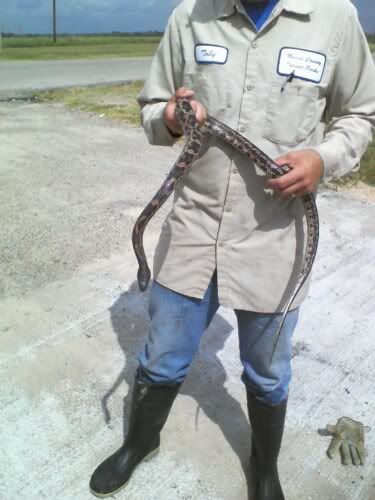
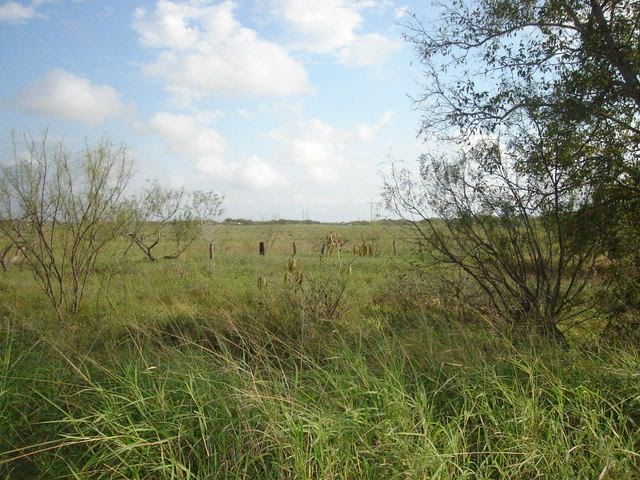
Lindheimeri is found throughout much of Nueces County, which is south of the Nueces River (the river is the border between San Patricio and Nueces Counties). There is a large floodplain throughout the county - land directly south of the river. This floodplain comprises some marsh, some riparian, and the meeting of those two habitat types with south Texas thornscrub. Riparian woodland seems to be this snake's preferred habitat, and it can be found along the courses of creeks, which only contain water some of the time - as long as there is woodland surrounding them.

Here are a few habitat shots - apologies because some are bad cell phone pics.

Here is a pic of semi-marsh Nueces River floodplain where it meets thornscrub. Both of our south Texas rat snakes (P. g. meahllmorum and P. o. lindheimeri) can be found in this area.
And a Texas Rat found near that spot.
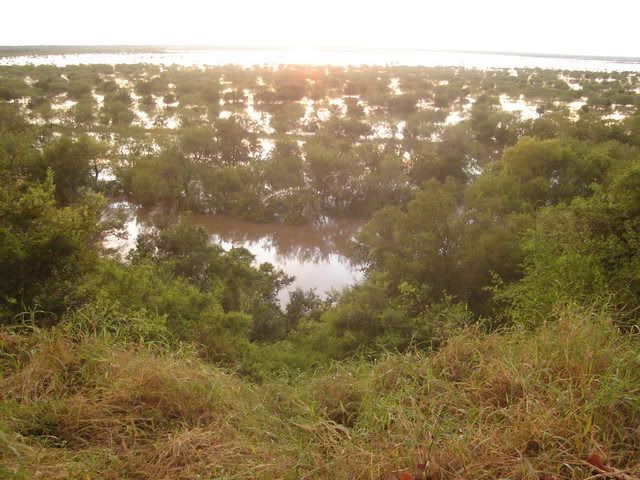
About a mile away during a flood.

Another shot of that flood from a bluff where I commonly see both rat snake species.
This is what a great majority of south Texas now looks like (that which is not being covered by malls, roads, or new neighborhoods) - plowed crop land. I took this pic becuse I found a DOR meahllmorum here. I have found a couple Texas Rats over the years in situations like this, but they are not common in these areas.

Here is a lindheimeri found a few miles southwest of the crop land in the above photo. This one is in a riparian area with a creek (usually dry) running through it.
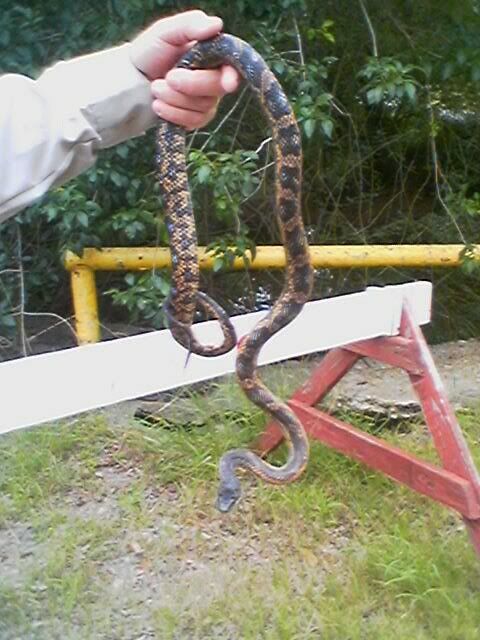
I know virtually nothing about the habitat in those three locality spots in the lower Rio Grande Valley - all of my herping experience in the lower RGV is east of those areas. I am going to explore some areas in southwest Nueces County south into Kleberg County soon - and now that I've rediscovered our map at SWCHR (and the fact that I don't know anything about those areas in the RGV), I am inspired to make a trip south as well. I don't know when I'll get down there, but it is definitely on the to do list now...
-----
-Toby Brock
Southwestern Center for Herpetological Research


DMong Jul 27, 2012 11:52 AM

LOL!!,....that's too funny that you have had them actually swim up on you and have seen them swimming across the Neuces River personally. From some of the pics I have seen of that river, it is extremely narrow and calm in places too, so that would only be like a casual swim across a little canal for them anyway...

Great photos of some of the lindheimeri,as well as the habitiat, Toby! Thanks for sharing those buddy.

~Doug
-----
"a snake in the grass is a GOOD thing"

serpentinespecialties.webs.com

tbrock Jul 27, 2012 07:28 PM

You are corect, Doug - the Nueces is just a leisurely swim for the most part. Yeah, that Texas Rat caused a commotion - first my co-workers were yelling that there was a water mocassin behind me. Then they really freaked out when I waded out and grabbed it. Of course, it always freaks them out when I pick up a snake. You've probably guessed by now - I get some incidental herping in at work sometimes. LOL

-----
-Toby Brock
Southwestern Center for Herpetological Research

Ryan_Sikola Jul 28, 2012 12:39 AM

Thank you guys for all the maps, info and pictures. I wonder if there are any secret islands of locality across the border and if so do they meet the mexican bairdi range at all?...
-----
Pituophis c. annectans
Senticolis t. intermedia
Rhinechis scalaris
Elaphe bairdi
Lampropeltis zonata
Lampropeltis t. campbelli
Lampropeltis m. thayeri

tbrock Jul 28, 2012 12:05 PM

Good question, Ryan. Their range definitely overlaps in Texas. Unfortunately, it is next to impossible to do any herping in Mexico these days - so it is likely that many things we wonder will be unknown for a long time.
-----
-Toby Brock
Southwestern Center for Herpetological Research
chrish Jul 29, 2012 10:20 PM

I have spent a lot of time in all parts of south Texas and into northern Mexico and haven't ever seen an obsoleta dead or alive. As common as obsoleta is in its normal Texas range and as conspicuous as they are as roadkills, I think if they occurred near the Texas border we would have a lot of specimens.

I would be skeptical of extralimital dots on maps as well because obsoleta is a snake that would be easily transported in firewood and other materials.

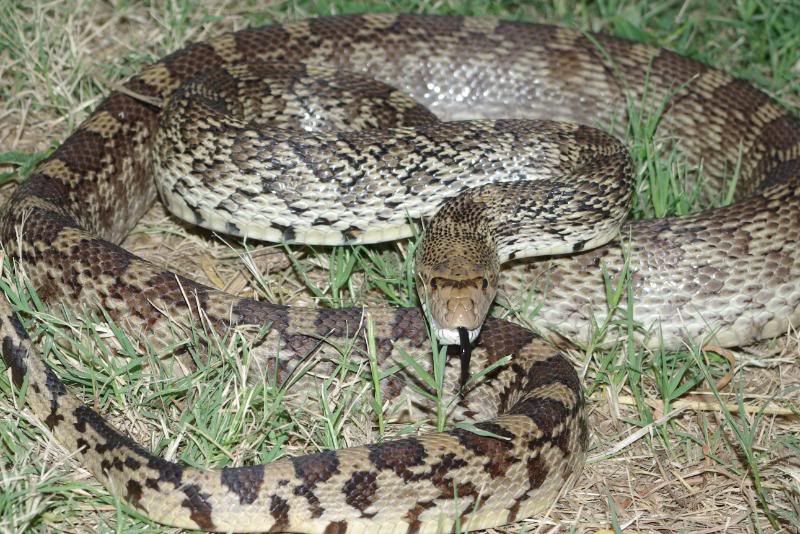
Those photos of the bullsnake planted a seed in my mind about bullsnakes vs obsoleta. Clearly obsoleta and guttata/emoryi can coexist and do over most of their range. But it seems that bullsnakes and obsoleta don't overlap in range/habitat very much. In parts of TX where obsoleta occur, P. catenifer don't (or are rare) and vice versa. Maybe it is competitive exclusion between those two species?
-----
Chris Harrison
San Antonio, Texas

DMong Jul 28, 2012 01:46 AM

LOL!,...yes, I can just picture the co-workers all gasping and yelling at you to not go near the "deadly moccasin" as you continued on and casually snatched it up..LMAO!!..

I had a neighbor that just recently warned me to be very careful walking my small dog because she just saw a snake in her garage and was immediately sprinkling moth balls in her flower beds to thwart the "deadly" snakes away. I already had a good idea of what kind it probably was, and when I asked her about it, she described the horribly venomous Black Racer viper! .

~Doug
-----
"a snake in the grass is a GOOD thing"

serpentinespecialties.webs.com

tbrock Jul 28, 2012 12:22 PM

Yeah, I always wonder at people and their insane fear of snakes. If they say it is six feet long, you can probably subtract 2 - 3 feet at least. I captured a 5.5 foot long bullsnake last summer, which had gotten into our shop at work - and was hanging out in the condensation pan of the air conditioner, in the attic. Talk about freaked out co-workers! LOL

-----
-Toby Brock
Southwestern Center for Herpetological Research
DMong Jul 28, 2012 02:32 PM

Nice Bull!, glad it didn't get hurt in there with the fans and electrical..LOL!

Yes, I totally agree. Most of the general public's perception of size goes right out the WINDOW when it comes to snake size/length.

That reminds me of this ridiculous nonsense about the 15-20 foot long Black Ratsnake news article a while back. Remember that nonsense???..complete with stupid news anchors, "experts" quotes and all!..LMAO!!
Image
-----
"a snake in the grass is a GOOD thing"

serpentinespecialties.webs.com

tbrock Jul 28, 2012 03:54 PM

Yep, I remember that silly stuff about the giant rat snake. Now that I am seeing that photo on a computer screen with a bit better resolution, I can see that it is definitely a black rat, and the "tree" it is climbing is most likely well in front of that building = the photo fore-shortening trick like the "giant rattler" people like to pull.
-----
-Toby Brock
Southwestern Center for Herpetological Research
DMong Jul 28, 2012 06:52 PM

Yeah, the tree is definitely many feet in front of the building. Yes, it was the same effect with that huge so-called "15 foot" Rattlesnake srory too...

I am always truly amazed at just how stupid people can actually be.

Here where just two "brilliant" comments made on a car forum after someone posted it there. I'm betting these two probably don't even know where to pump the gasoline into their car...

1) "The eaves (bottom of the shingles) on the garage are eight feet off the ground. That tree is going to measure approximately 8-10" across. Given the standard in construction in terms of eaves height that snake is an easy 13-15' long, and approximately 6-8" inches across"

2) "Looks like a big ol snake to me. Compare the length/size of the snake to the broom/rake handle leaned up against the shed right behind it. It would take some pretty careful trick photography to make a four foot snake look that big"

HAHAHA!!!!......please!!!.
Image
-----
"a snake in the grass is a GOOD thing"

serpentinespecialties.webs.com

chrish Jul 29, 2012 10:26 PM

and I still consider bairdi to be part of the Pantherophis obsoletus complex, myself - I don't agree with the split...

Toby,

I don't agree. I think bairdii and obsoleta show a very clear boundary where the two species come together and rarely hybridize. Think about the boundaries between the other taxa within the obsoleta group. They all intergrade over a wide area. Yet goo obsoleta and good bairdii can be found within a mile of each other in the hills of central Texas.
That was the basis on which they were separated and it still holds true today.

Chris
-----
Chris Harrison
San Antonio, Texas

tbrock Jul 30, 2012 06:35 AM

>>and I still consider bairdi to be part of the Pantherophis obsoletus complex, myself - I don't agree with the split...
>>
>>
>>Toby,
>>
>>I don't agree. I think bairdii and obsoleta show a very clear boundary where the two species come together and rarely hybridize. Think about the boundaries between the other taxa within the obsoleta group. They all intergrade over a wide area. Yet goo obsoleta and good bairdii can be found within a mile of each other in the hills of central Texas.
>>That was the basis on which they were separated and it still holds true today.
>>
>>Chris
>>-----
>>Chris Harrison
>>San Antonio, Texas

Chris,

And yet, hybrids do occur - not to the extent of intergradation of the other subs, but they do... Anyway, I am not a taxonomist, and bairdi is well accepted as its own separate taxon from the obsoletus group - so my opinion means nothing anyway. Also, I do / did understand the reasoning behind the split, and was just stating my opinion.
-----
-Toby Brock
Southwestern Center for Herpetological Research

tbrock Jul 30, 2012 12:19 PM

Even though I still consider bairdi to be a subspecies of the obsoletus complex, as a die-hard board member of the Southwestern Center for Herpetological Research (SWCHR), I officially recognize the split of bairdi from obsoletus, and I write the taxon as Pantherophis bairdi. SWCHR agrees with the split, so even if I do not agree, I feel that it is right to call bairdi a separate species. Much like being a law abiding citizen, I comply with laws, even when / if I do not agree with them...

-----
-Toby Brock
Southwestern Center for Herpetological Research

chrish Jul 30, 2012 01:21 PM

And yet, hybrids do occur - not to the extent of intergradation of the other subs, but they do...

Yes, they do although what constitutes a bairdii x obsoleta hybrid is up for debate. The criteria for recognizing one are a bit vague.

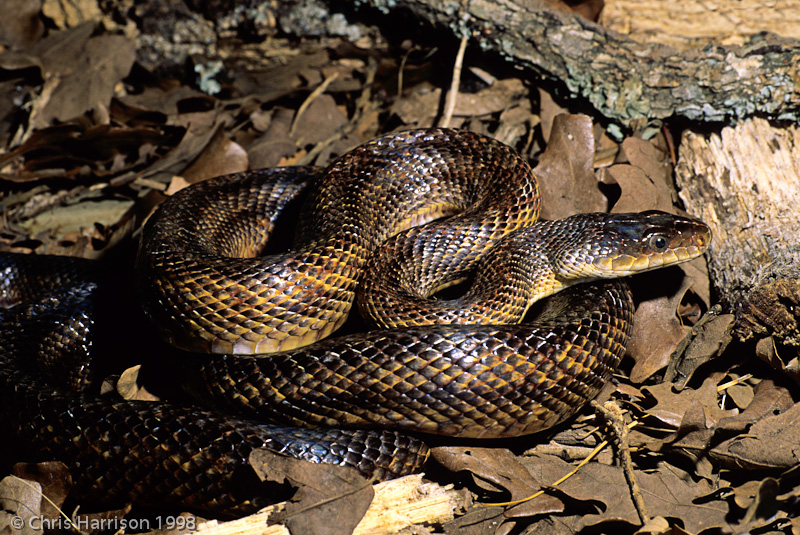
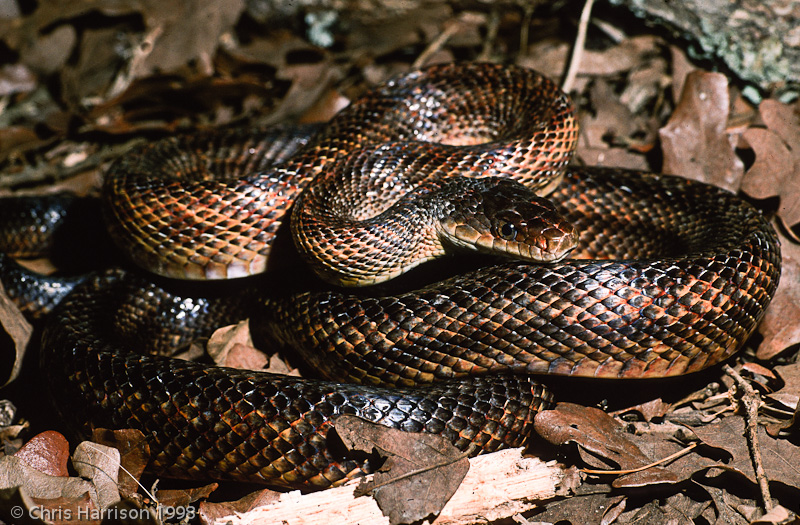
Here's a snake from Lost Maples State Park that was collected (legally) as a possible hybrid. However Dixon (2000) recorded it as the largest bairdii ever found...so who knows what it was. It certainly had the personality of an obsoleta!

BTW - not trying to change your mind...I just find the discussion interesting. When you look at a bairdii, they certainly do "seem" like obsoletus. I suspect they were a western population of obsoletus that was separated for a time and have come back together and now have weak reproductive isolation. Even though they come right up to each other's habitat/range, they rarely seem to interbreed (much like Milksnakes/Scarlet Kings in the southeast). If they were the same species, intergrades would be the norm in the contact zone.

On a second, unrelated note....I need to get off my a$$ and join your group. I'm not sure why I haven't in the past, except maybe that it requires a paper form rather than just registering and paying online.
.
Image
-----
Chris Harrison
San Antonio, Texas

DMong Jul 30, 2012 02:31 PM

Very cool specimen Chris. That one does sort of make you rub your chin and go..hmmm...

Here is a bairdi that was photographed in that very same Park as well that I found on the net.

~Doug
Baird's rat

-----
"a snake in the grass is a GOOD thing"

serpentinespecialties.webs.com

chrish Jul 30, 2012 03:13 PM

That snake in the link looks all bairdi to me, as have the other bairdi I've seen online from the county.

(http://www.naherp.com/search.php?r_owner=&r_group=6&r_genus=1815&r_species=1816&r_subspecies=&r_country=1&r_state=43&r_county=3053)

The thing that made the big snake look like a hybrid was the dark head. It was really a dark snake with a dark head, like a TX Rat. I've caught big bairdi on several occasions (albeit further west) but never seen one with a dark cap like that.
-----
Chris Harrison
San Antonio, Texas

DMong Jul 30, 2012 04:29 PM

Yeah, no doubt the link I posted looked all bairdi to mee too.

Yep, the darker head and body on the other specimen certainly does resemble linheimeri characteristics. On the other hand a very authentic hypermelanistic bairdi individual in it's purest of form could be deceiving too.

~Doug
-----
"a snake in the grass is a GOOD thing"

serpentinespecialties.webs.com

tbrock Jul 30, 2012 02:31 PM

Chris,

I've seen that photos somewhere before - very interesting specimen, and a good candidate for being a hybrid.

I also find the discussion interesting, and I doubt you (or anyone else) could change my mind - I'm pretty stubborn. LOL Actually, I've gone back and forth over my leanings on this subject, and I just feel like the similarities outweigh the differences between Baird's and Lindheimer's. I certainly agree with you on all points of habitat preference, and the separation of the two species - and also the fairly recent re-convergence.

On becoming a member over there, it is only the initial membership which requires the paper application - and you can now renew your membership online. I would personally be very happy to see you over there as a member, and I think we have a good thing going...
-----
-Toby Brock
Southwestern Center for Herpetological Research

chrish Jul 30, 2012 03:10 PM

It was neither a pretty, nor a very personable snake.
It took a friend and I a long time to get these shots due to repeated escapes, strikes, etc..

It would have been a lot easier now in the digital age, but this was slide film.
.
Image
-----
Chris Harrison
San Antonio, Texas

DMong Jul 30, 2012 04:34 PM

"It took a friend and I a long time to get these shots due to repeated escapes, strikes, etc.."

well that clinches it then.....a DEFINITE lindheimeri intergrade!!

Just kidding of course,...well, for the most part anyway..LOL!

~Doug
-----
"a snake in the grass is a GOOD thing"

serpentinespecialties.webs.com

draybar Aug 05, 2012 08:40 AM

>>It was neither a pretty, nor a very personable snake.
>>It took a friend and I a long time to get these shots due to repeated escapes, strikes, etc..
>>
>>It would have been a lot easier now in the digital age, but this was slide film.
>>.
>>
>>-----
>>Chris Harrison
>>San Antonio, Texas

I know this post is a week old but I have seen mention of this snake possibly being the largest bairdi ever found, if it's not a hybrid, and I have yet to see mention of it's actual size. Here or on the site linked to above....soooo...???

-----
Corn snakes and rat snakes...No one can have just one.
"Resistance is futile"
Jimmy Johnson
Draybars Snakes

chrish Aug 08, 2012 03:20 PM

The snake in the photo is the one discussed in Werler and Dixon's 2000 Texas Snakes book. It was 63.5 inches long, if I remember correctly (don't have the book here).

There have been a lot of anecdotal reports of bairdii in excess of 5 feet but I don't think any larger specimens have actually made it into collections. I have seen quite a few bairdii and never seen one as big as the one in that photo I posted.
-----
Chris Harrison
San Antonio, Texas

draybar Aug 08, 2012 05:20 PM

>>The snake in the photo is the one discussed in Werler and Dixon's 2000 Texas Snakes book. It was 63.5 inches long, if I remember correctly (don't have the book here).
>>
>>There have been a lot of anecdotal reports of bairdii in excess of 5 feet but I don't think any larger specimens have actually made it into collections. I have seen quite a few bairdii and never seen one as big as the one in that photo I posted.
>>-----
>>Chris Harrison
>>San Antonio, Texas

thanks Chris, I wasn't sure if you would see this way down here..
yeah it's like fish...they always look larger then they truly are...My bairdi are nice sized specimens but if I was to get a true measurement on the two largest I would be surprised if they were any longer then 50 to 52 inches. If someone saw them going across a road or under a bush, though, they would swear they were at least 6 ft
-----
Corn snakes and rat snakes...No one can have just one.
"Resistance is futile"
Jimmy Johnson
Draybars Snakes

Site Tools