Reptile & Amphibian Forums

Welcome to kingsnake.com's message board system. Here you may share and discuss information with others about your favorite reptile and amphibian related topics such as care and feeding, caging requirements, permits and licenses, and more. Launched in 1997, the kingsnake.com message board system is one of the oldest and largest systems on the internet.

Click for 65% off Shipping with Reptiles 2 You

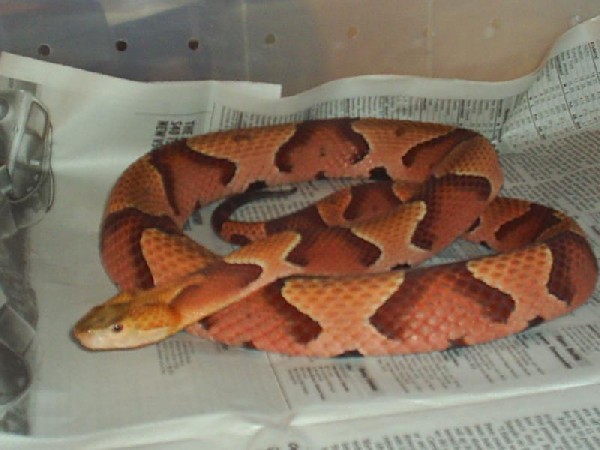
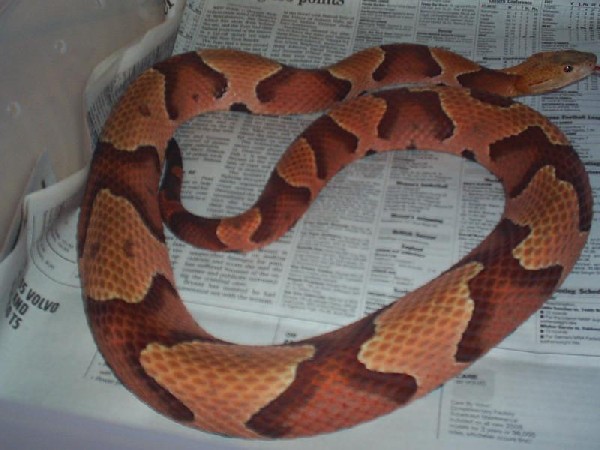
What kind of copperheads do i have?

masterfun40 Oct 26, 2010 07:52 PM

I bought 4 baby copperheads from somebody he SAID they were broadbanded but i immediately knew they were not but they did look ALOT nicer than southerns are they just nice southerns or what? i have a TERRIBLE camera its actually a camcorder that happens to take pictures also this was the absolute best pic i could get (if you can believe that LOL) but anyways id like to sell them and i need to know if there southerns for sure thanks.

http://i299.photobucket.com/albums/m...5/PICT0117.jpg

Replies (21)

RyanT Oct 26, 2010 10:08 PM

Would love to help ya figure it out though. I was all excited to be the first one to respond but can't see the pics, haha. They're probably intergrades of some type. Shouldn't be hard to tell when you can post the pics. Where are you located?

masterfun40 Oct 27, 2010 05:47 AM

Hey sorry idk how that happend? heres the real link

http://i299.photobucket.com/albums/mm320/joshmanblue5/PICT0117.jpg

RyanT Oct 27, 2010 09:50 AM

Yeah, I'd say Broad Band x Southern intergrades. Each individual will show varying traits from both species'. Don't suppose you have any locality info? Not really important, would just be more of a clue to what they are. Either way though, definitely not pure BBs.

masterfun40 Oct 27, 2010 03:15 PM

Hmmmm.....interesting I'm planning on selling them and needed to know what they were, but no i dont know the locality ha all i know is a buddy of mine bred his 2 coppers that were sold to him as BOTH broadbands and i wasnt buying that they were both broadbands. How much do these go for?

Kelly_Haller Oct 27, 2010 07:31 PM

I don't see any Broad-banded in that one. It's hard to tell from that photo, but it does appear to be a young Osage or A. c. phaeogaster. Could you post a more focused photo? Thanks,

Kelly

masterfun40 Oct 27, 2010 09:15 PM

Lol so i figured out my phone takes better pis than my stupid camcorder here

http://i299.photobucket.com/albums/mm320/joshmanblue5/1027002052.jpg

Kelly_Haller Oct 28, 2010 12:37 AM

-

RyanT Oct 28, 2010 12:40 AM

Of the 5 subspecies, I'm least familiar with Osages. But that doesn't look like any I've ever seen. Osages typically look like a Southern but with narrower, more symmetrical banding. That's how I picture them anyway. And also, Southern x BB is a common itergrade, especially in the Texas area if I'm not mistaken.

I'm still goin with Southern x Broad Band. Much better pic by the way. Feel free to post more, they're not bad looking little Coppers. I sorta love all of them though.

masterfun40 Oct 28, 2010 01:07 AM

Ha ok well i have 3 of the little guys then i have 1 baby northern you all saw the first baby so i'll show you the others (though i guess they all look the same except the northern lol)

Copperhead baby #2

http://i299.photobucket.com/albums/mm320/joshmanblue5/1028000143.jpg

http://i299.photobucket.com/albums/mm320/joshmanblue5/1028000142.jpg

Copperhead baby #3

http://i299.photobucket.com/albums/mm320/joshmanblue5/1028000155b.jpg

Northern Copperhead

http://i299.photobucket.com/albums/mm320/joshmanblue5/1028000200.jpg

RyanT Oct 28, 2010 01:14 AM

Thanks. Always nice to see babies. They're definitely Southern x Broad Bands. Do you have any idea what localities any of them are from? Including the Northern...which is also more than likely a Northern x Southern intergrade. Haha! It never stops.

masterfun40 Oct 28, 2010 01:20 AM

No sorry all i know is that the 3 babies that i'm unsure of were bred by a buddy of mine who bought a pair of copperheads as a broadband pair one turned out to be broadbanded (were pretty sure) the other we were unsure of.....thats ALL i know as for the northern i bought that from a very shady guy who just had it didnt tell me anything bout it said "give me $15" so i gave him the money and he said "my vans out back go get the snake out of the back you can keep the kritter keeper its in" (we were at a expo and his van was out back)

RyanT Oct 28, 2010 01:57 PM

Any pics of the parents of the babies? I'm just curious. I could study Coppers all day and never get bored.

masterfun40 Oct 28, 2010 02:34 PM

No i don't the guy who sold them to me him and I are not on good terms

RyanT Oct 28, 2010 04:12 PM

Oh. Hate it when that happens. But yeah, if you wanna get rid of them, just post ads somewhere or however you wanna do it. By the way, where are you located? Let people know they're intergrades, which is obvious anyway. If they're feeding and healthy, they're worth like $50 each or so, I would say.

masterfun40 Oct 28, 2010 07:59 PM

They actually not eating yet for me but I'm working on that 2 of them have ONCE then stopped for some reason. I'm located in Michigan

Kelly_Haller Oct 28, 2010 09:32 PM

The best way to key out an Osage is to look at the background color between the crossbands. Northerns and Southerns usually have some type of small markings or tick marks in the area between the crossbands. Osage will never have these markings and are always clear between the crossbands. I have captured, marked and released hundreds of them and can verify that.

The other identifying trait of the Osage is the prominent white border along the dark edges of the crossbands. Trans-Pecos will sometimes have these, but these white borders are never conspicuous on the Southerns or Northerns. Also, Southerns always have a pink or orange hue to their coloration that is never seen in the Osage, which have a much more gray-brown overall coloration except in large, older males. The dorsal section of the cross-bands on the Broad-banded would be much wider than on these young, even with intergrades. The young in question are showing all of the characteristic traits of the Osage. Below are a few photos of phaeogaster I have taken over the years in Northeast Kansas.

Kelly

RyanT Oct 29, 2010 11:07 AM

Hey Kelly, nice pics. Those definitely don't match my idea of Osages, but like I said, I'm least familiar with them. I honestly don't see any appeal to them at all. The other 4 subspecies are all distinct and amazing. Osages are just really dull to me. Kind of "generic". So you're saying those babies are pure Phaogaster? He had said the parents didn't look the same so that put me on the hybrid trail...Also, if he's from Michigan, what's the liklihood of him running across pure Osages? I'm enjoying this little mystery.

SnakesAndStuff Oct 30, 2010 10:43 AM

From the photos we can guess as to what the animals are phenotypically (with some degree of certainty), but with copperheads there is so much overlap in ranges and integredation that you can't tell for sure what it is and whether it is an integrade or not without information about where it was collected. I'm guessing since the original seller misrepresented the animal, actual collection data is not known.

The problem is, in areas of integrade the integrades can exhibit the traits of either subspecies or a mixture of the two. For example: I've seen people post photos before claiming to catch a northern copperhead and a southern copperhead under the same coverboard. This is false information. What they actually caught was a phenotypically northern copperhead and a phenotypically southern copperhead. However, since they're obviously in the zone of integradation they are most probably genotypically interade animals.

The general rule on copperheads is that their ventral pattern tells the tale. If you look at southern copperheads the dark ventral blotches are between the crossbands and the light ventral blotches are in line with the dorsal crossbands. On nothern copperheads the dark ventral blotches are in line with the dorsal crossbands and the light ventral blotches are between the dorsal crossbands. Osage copperheads often have a patternless belly. Also, on osage copperheads if you look at the last 1/3 of the body of the snake (snout to vent) the crossbands vary from southern copperheads. In southern copperheads the dark outline of the dorsal crossband extends to the very first dorsal scale row. In osage copperheads the dark outline of the crossband does not typically extend to the first dorsal scale row.

In broadbanded copperheads and and trans pecos copperheads their dorsal pattern is markedly different from that of northern and southern and osage copperheads by the lacking of prominence of compression of the crossband along the spine. Once again, one of the key characters between these two relies on the ventral pattern. Broadbanded copperheads tend to be more banded whereas trans pecos copperheads tend to have a more "pinched" ventral pattern. If you look at them from the side, slightly turned upwards you'll see on transpecos copperheads the presense of little "upside down U's" in the crossbands from the interaction of the dorsal and ventral patterns. On broadbanded coperheads this is not prominent.

These are generalities when keying out copperheads. In an animal with as many subspecies and as much integredation and captive manipulation and mutt-making it is very hard to tell what is going on with animals in captivity without orignal collection data. For that matter, it is often difficult to tell for sure what is going on from wild caught animals if you only hae a single specimen. Keying out subspecies often requires the observation of many specimens from a region to make sure that you're not seeing a freak animal or trait and to make sure you are looking at an appropriate representation of the animals in the area.

I hope this helps some. If you have any questions please respond.

Bobby Neal

texasreptiles Nov 02, 2010 07:45 PM

Great post Bobby!

Kelly_Haller Nov 02, 2010 09:05 PM

Of the hundreds of Osage I've captured over the years, virtually all had a relatively white belly with darker blotches along the edges and typically up onto the first scale row. I definitely agree on the difficulty with accurate subspecies determination in the intergrade zones. Good informative post.

Kelly

SnakesAndStuff Nov 09, 2010 05:22 PM

I was in a rush and stated something backwards...

In osage copprheads, the outlining of the crossbands extends to the first dorsal scale row, and in southerns it does not.

Site Tools