Crocdoc
Down a few threads you make mention of how wild Varius nest in their natural habitat.
Could you elaborate?
Also how can you "recreate" these conditions in captivity?
Mike
-----
Welcome to kingsnake.com's message board system. Here you may share and discuss information with others about your favorite reptile and amphibian related topics such as care and feeding, caging requirements, permits and licenses, and more. Launched in 1997, the kingsnake.com message board system is one of the oldest and largest systems on the internet.


Crocdoc
Down a few threads you make mention of how wild Varius nest in their natural habitat.
Could you elaborate?
Also how can you "recreate" these conditions in captivity?
Mike
-----
n/p
-----
I've just been told that I keep trying the same thing, expecting different results (see the exchange below).
Offering advice on lace monitor nesting and explaining the rationale behind it, knowing it will fall on deaf ears, would be doing exactly that.
Crocdoc
Other folk's would like to know the answers to these question from someone with long term first hand knowledge of wild Varius nesting and captive nesting, and how they both corrilate.
If your not up to it on this forum, hopefully the "others" will find these answers and cool photo's elsewhere.
Mike
Oh and by the way the exchage from below is the reason for these questions.
-----
Crocdoc,
I'd sure like to see them, I'm a novice varanid keeper, and try to soak up any info on them. I've always had the thought of how to recreate a termite mound in captivity.
-----
Jason
Hey, Jason,
Do you keep lace monitors? If so, send me a pm and we can exchange information via email.
No I don't, but knowledge never hurt anyone. I'm not on here to attack anyone or disprove any of your findings. Like I said, i'm a novice keeper. If anything the termite mound remark was my mind wondering.
-----
Jason
Perhaps you could mix a fine sawdust with a sand/mud sorta composite, but you'd still need some bugs for the maintainence crew.....
Huh, I like that idea. I'm sure you could repair it yourself, or move them into an incubator. I remember seeing something on "Dirty Jobs" where they built a house out of cob, that looks like it would work.
-----
Jason
Cob, eh? I ve seen houses made of haybales and stucco, but from a salad? Never heard of that. But seriously, do the lacies use inactive mounds, or only those still inhabited? I m sure the scent would play a role should it be the latter. Of course a spritz of formic acid might do the trick.....don't know what the lacies que on.
"But seriously, do the lacies use inactive mounds, or only those still inhabited? I m sure the scent would play a role should it be the latter. Of course a spritz of formic acid might do the trick.....don't know what the lacies que on."
They only use active mounds, because for this species the whole point behind using the mounds is the heat and humidity provided by the termites. Termite mounds are nature's nest boxes. The protection offered by the mound itself is secondary. Females will dig into a dead mound but stop short well before hitting the centre because the temperature and humidity levels are all wrong for nesting.
I suspect they use visual cues to find the mounds, as they stick out of the landscape like the proverbial dog huevos 
That does make good sense,, though I m sure that the security is a swell perk, especially with the termites repairing the entry hole, which, of course, also helps maintain the temps and humidity, quite consistently, I d imagine. Nice nestbox tie-in by the way! But I must say I m having trouble with the analogy of termite mounds(rather tall earthy structures) and dog eggs(which I must confess to having never seen) maybe its just me...but thanks for your insights in reguards to wild lacies. Always good to hear the observations of those on site as it were.
Guy
The mounds that lace monitors nest in are round and usually close to the ground (or on the trunk of a tree an arboreal), but still stick out like dog's balls (I presume that expression isn't just Australian).
Did not know of this configuration of termite mound. Ya learn something new every day, if you're lucky! As for the phrase, never heard it, but I live in the L.A. area so its pretty sheltered, linguisticly speaking...
Guy
I thought you were just mucking around about the expression, but my sincere apologies as it turns out it IS just an Australian expression, after all:
link to a page with the definition of the expression
Yes, these mounds aren't the tall, point sort one normally sees on wildlife programs about Australia or Africa. There are two main species in this area (and all of the way down up and down the coast until one hits the tropics) that make ground mounds, but the mounds of only one species are used (by both lace and heath monitors). The tree mounds they use occasionally are also made by the same genus, if not species, of termite.
Well,to be quite honest, I was mucking about to some degree, but I had never heard the phrase...
as for the mound configuration, when you refer to tree mounds, are those the more vertical types or are they actually up in trees?
"as for the mound configuration, when you refer to tree mounds, are those the more vertical types or are they actually up in trees?"
They're actually up in trees.
Arboreal termitarium in a tree. Normally they're half way up, but the top of this tree has fallen off at some stage.
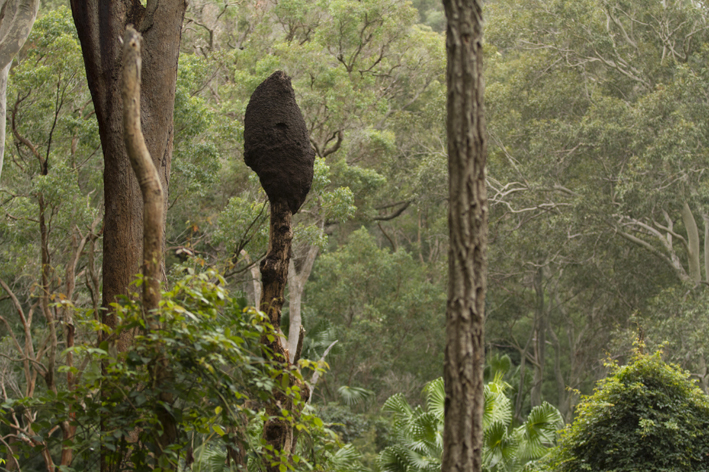
Cool! I ve never seen that before. Heck, I d put my eggs up in one of those if I didn't have a nestbox here at home already...... Thanks for the most illustrative photo!
Guy
"though I m sure that the security is a swell perk, especially with the termites repairing the entry hole"
Oh definitely. I didn't say it wasn't a factor, just that it was secondary to the heat/humidity. There are two species of monitor in Australia that are habitual termite mound nesters and it's no coincidence that those two species have the southernmost ranges of all Australian monitors. That and the fact that monitors ignore dead mounds suggest that temperature and humidity are key.
A number of years ago someone did a study on nesting by lace monitors in termite mounds and he found that in mounds in which the colonies died, the lace monitor eggs within also died, presumably mid-winter.
Cob is actually made of mud, straw, and I think cow crap too.
If I'm not mistaking, nile monitors have also been reported to use termite mounds. And I remember an account on a group of hatchling green tree monitors found inside an active termite mound. I'm sure other monitors use termite mounds, like Crocdoc said, there nature's incubator.
-----
Jason
Help, tips & resources quick links
Manage your user and advertising accounts
Advertising and services purchase quick links
